

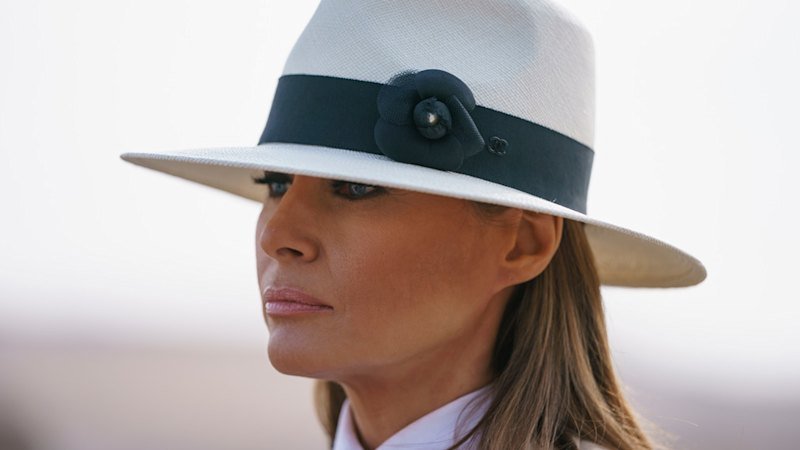
February 1, 2026 — Reviews of the documentary Melania, a $107 million Amazon production chronicling the life of America’s First Lady, have drawn widespread criticism since its global cinema release over the weekend. The film, which focuses on the 20 days leading up to Donald Trump’s return to the White House, has received just one star on Rotten Tomatoes and grossed over $8 million in its opening, surpassing initial expectations.
Harsh Critiques Highlight Film’s Shortcomings
Xan Brooks delivered one of the most pointed reviews, titling his assessment “Melania review – Trump film is a gilded trash remake of The Zone of Interest.” The comparison draws parallels to the film about Nazi commandant Rudolf Höss and his family’s life near Auschwitz, underscoring the perceived detachment in Melania. Brooks described the documentary as “dispiriting, deadly and unrevealing,” adding that while a compelling story exists about Melania Knauss’s journey from Slovenian model to the role akin to a modern Eva Braun, this version falls far short.
“She glides from the fashion fitting to the table setting, and from the ‘candlelit dinner’ to the ‘starlight ball’, with a face like a fist and a voice of sheet metal,” Brooks noted.
Accusations of Excessive Flattery
Frank Scheck called the film an extreme hagiography, stating, “To say that Melania is a hagiography would be an insult to hagiographies. This is a film that fawns so lavishly over its subject that you feel downright unpatriotic not gushing over it.” He pointed out the irony of director Brett Ratner at the helm, whose career faced setbacks in 2017 due to denied sexual assault allegations, yet appears to have rebounded in this project.
Joy Press labeled the documentary “interminable” and likened it to a mockumentary, saying, “If you were making a movie that parodied the current first lady of the United States, I’m not sure what you’d do differently.” She criticized it as propaganda lacking the visual flair of Leni Riefenstahl’s work, instead relying on repetitive depictions of opulent Trump settings—from Trump Tower to private jets and gala events—culminating at the White House.
Disconnect and Missed Opportunities
Brian Truitt highlighted a key flaw: the First Lady’s refusal to address the camera directly, creating a “brutal disconnect.” He observed that while Donald Trump discusses their son Barron, he avoids mentioning Melania herself. Truitt added that Barron emerges as the film’s most intriguing figure, with audiences eager to understand the teenager’s perspective amid the unfolding events.
Maureen Dowd characterized the production as a “gilded infomercial,” dismissing notions of hidden depth: “Many have fantasised that the first lady was Rapunzel in the tower, pining to be saved from the ogre. It turns out there is no mystery, no dark anguish.” Karl Quinn echoed this, noting that insights into the First Lady are “as thin on the ground as the hairs are on her husband’s head.”
Trump’s Positive Response and Behind-the-Scenes Details
President Donald Trump viewed the 104-minute film during a private White House screening over the weekend and praised it effusively. “It really brings back a glamour that you just don’t see any more,” Trump said. “Our country can use a little bit of that, right?”
Several reviewers noted the film’s eclectic soundtrack, starting with the Rolling Stones’ “Gimme Shelter”—lyrics evoking violence and turmoil—at Mar-a-Lago, where Melania first appears. Other tracks include Michael Jackson’s “Billie Jean” (referencing false allegations), Tears for Fears’ “Everybody Wants to Rule the World,” Ravel’s “Boléro,” and James Brown’s “It’s a Man’s Man’s Man’s World.” The selections, described as curiously ironic, were personally chosen by Melania, who is a longtime fan of Michael Jackson.
Marc Beckman, a senior adviser to the First Lady and one of the producers, confirmed her extensive involvement, overseeing production, editing, advertising, the trailer, and music choices.









