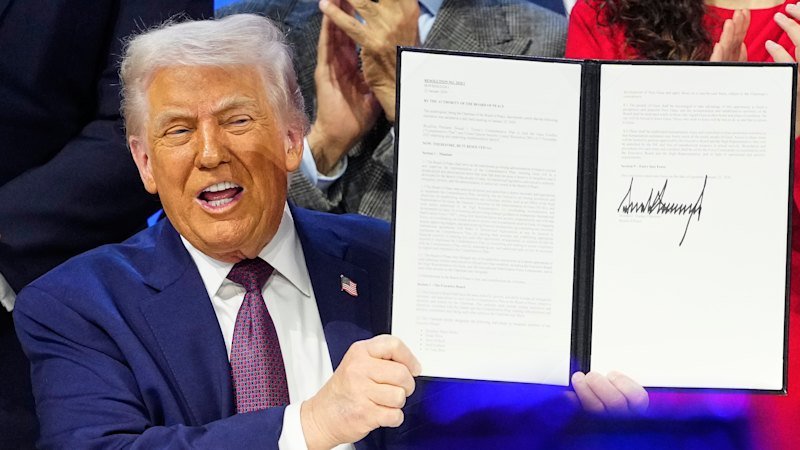
Australian Prime Minister Anthony Albanese faces increasing internal resistance to joining U.S. President Donald Trump’s proposed Board of Peace, as officials weigh a polite rejection to avoid straining relations with the unpredictable leader.
Growing Government Concerns
Government officials highlight worries over the board’s structure and its possible overlap with established international bodies like the United Nations. No formal decision has emerged yet, but the likelihood of Albanese turning down the invitation appears to be rising. Officials note there is no rush to respond, allowing time for careful deliberation.
These discussions occur against a backdrop of escalating tensions in the Middle East, including Israeli airstrikes over the weekend that claimed at least 30 lives in Gaza—one of the deadliest incidents since the October ceasefire. The Rafah crossing between Gaza and Egypt is also set to reopen soon, adding urgency to global diplomatic efforts.
Albanese has adopted a measured approach since Trump’s invitation two weeks ago. He has stressed his attention on pressing domestic priorities while reaffirming Australia’s firm commitment to the United Nations. When asked about the board on Friday, Albanese stated, “It must be said we have a very important security relationship with the United States through AUKUS, but also through organizations such as the Quad, the bilateral relationship that we have as well.” He added earlier, “It’s unclear what the objectives of this are, which is why we will give it further consideration.”
International Skepticism Builds
New Zealand Prime Minister Christopher Luxon formally rejected Trump’s offer on Friday, signaling caution among Western democracies. Several European nations, including France, Germany, Greece, Croatia, Sweden, and Slovenia, have also declined to participate. The United Kingdom has voiced significant doubts about the board’s makeup.
Invitations have extended to Russia and China as well, underscoring the board’s global scope. While enthusiasm remains low within the Australian government, leaders recognize the need for diplomatic finesse in any refusal to prevent alienating the sometimes volatile U.S. president.
Board’s Evolving Purpose
Initially envisioned as a mechanism to support Gaza’s reconstruction, the Board of Peace has broader goals. A leaked charter omits any reference to the Palestinian territory, raising fears it could sideline the UN’s role in international affairs.
Former Labor Foreign Minister Gareth Evans criticized the initiative, stating it is “manifestly designed to further undermine the UN, will further fragment the international system, does nothing to advance political resolution of the Israeli-Palestinian conflict, and Australia should have nothing to do with it.”
Likewise, former Liberal Foreign Minister Alexander Downer remarked, “The idea of President Trump being able to decide who is on and off it seems to make it too much of his plaything. I’d be happy for us to be involved in it in the context of Gaza, but beyond that, I think we should put it on hold.”
Albanese is scheduled to host Israeli President Isaac Herzog in Australia next week, providing another opportunity to address regional stability amid these developments.