

Bomb Cyclone Intensifies, Bringing Rare Snow to Florida and Chaos to the Carolinas
A powerful bomb cyclone is unleashing severe winter weather across the southeastern United States, stranding hundreds of vehicles, causing widespread crashes, and delivering subzero temperatures to areas unaccustomed to such extremes. The storm has led to record cold in Central Florida, where temperatures have plunged into the upper teens and low 20s—far below the typical 70s seasonal average. An extreme cold weather alert remains in effect until Monday.
Mass Stranding on Interstate 85 Near Charlotte
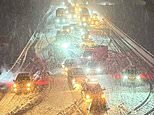
Heavy snowfall has paralyzed travel in North Carolina, with around 100 vehicles stranded on a northbound stretch of Interstate 85 north of Charlotte, near Kannapolis. More snow fell in a single day on Saturday than the city has seen in two decades. A crash involving a car and a tractor-trailer reduced the highway to one lane, triggering massive backups just as snow began accumulating rapidly.
Authorities reported 750 car crashes across North Carolina on Saturday. The quick accumulation trapped tractor-trailers and cars, blocking the interstate entirely. North Carolina State Highway Patrol 1st Sgt. Christopher Knox explained, ‘Once they’re blocking the interstate, everybody stops. We’re just limited in what we can do because of the interstate not being physically passable.’
Knox added, ‘It sounds like initially it is not necessarily a 100-car collision, but it’s just traffic that is stopped because we’re having to remove a vehicle that is blocking the roadway.’
Widespread Warnings and Snow Accumulations
Winter storm warnings cover all of North and South Carolina, parts of Georgia, eastern Tennessee, Kentucky, and southern Virginia. The heaviest snowfall, up to an inch per hour, targets areas near the North Carolina-South Carolina border until about 1 a.m. EST. Lighter snow continues across much of the region.
Road closures mount on Interstate 85 northeast of Charlotte and in Virginia. The Virginia Department of Transportation urges fewer vehicles on the roads, stating, ‘Fewer cars on the road during winter weather will help to keep everyone safe and allow crews to perform their jobs effectively.’
Snow totals include 14.5 inches in Faust, North Carolina; 12.5 inches in West Critz, Virginia; and over 9 inches in Harrisburg, Tennessee. In Cape Carteret, high winds blow snow sideways, making travel ‘treacherous and potentially life-threatening,’ according to the National Weather Service.
Dramatic Incidents and Infrastructure Impacts
In Gastonia, north of Charlotte, a semi-truck became stuck on icy tracks at Poplar Street and Airline Avenue, where a freight train struck and crushed it. The driver escaped unharmed before impact. The South Carolina Department of Public Safety reports numerous 911 calls for vehicles losing control and sliding into ditches.
The storm has canceled over 1,000 flights at Charlotte Douglas International Airport, a major American Airlines hub, with a 300-person snow team clearing runways. More than 600 flights are grounded at Atlanta’s Hartsfield-Jackson International Airport, the world’s busiest.
The National Weather Service warns, ‘An explosively deepening coastal cyclone will continue to bring moderate to heavy snow, high winds, and possibly blizzard conditions for the Carolinas.’ An arctic air surge will push below-freezing temperatures toward South Florida by Sunday morning.
Effects Reaching Florida and Power Outages
In Florida, snow flurries are possible around Tampa Bay late Saturday into Sunday, with a 10-20% chance. Orlando temperatures could drop to 25 degrees or below, while Miami sees mid-30s—levels not witnessed since 2010. Wind chills in northern and central areas may reach single digits.
The cold has closed Orlando theme parks, including Disney World and Universal Studios, with Disney’s Typhoon Lagoon shut until Monday. Wildlife faces risks, as meteorologist Brandon Buckingham notes, ‘Green iguanas are sensitive to the cold and can become stunned when temperatures fall into the 40s and 30s. When that happens, they may lose their grip and fall from the trees.’
Nearly 175,000 customers lack power Saturday night, primarily in the South, with Mississippi, Tennessee, and Louisiana most affected. Davis, West Virginia, recorded the lowest temperature in the lower 48 states at minus 28 degrees Fahrenheit.
Context from Recent Storms and Ongoing Recovery
This storm follows Winter Storm Fern, which killed over 100 people from Texas to New Jersey and left regions recovering from ice and snow. About 35 million Americans face extreme weather warnings for snow and ice as Winter Storm Gianna evolves into a bomb cyclone Sunday, intensifying unusually cold conditions in mild states like Florida.
In North Carolina’s Outer Banks, campgrounds and beaches close due to threats to oceanfront structures and highway sections. Mississippi Governor Tate Reeves reports the U.S. Army Corps of Engineers installing generators at critical sites, with 79 shelters and warming centers open statewide.
NASA delayed a key fueling test for its 322-foot rocket at Cape Canaveral, Florida, potentially postponing a manned Moon flyby mission next month. In Georgia, homeless resident Dolla Johnson, 65, sought refuge in a warming center, saying, ‘If I hadn’t have been here, I would be sleeping outside. There’s nowhere else to go. The bridges are not safe. Everything’s freezing over.’
Experts highlight hypothermia and frostbite risks, especially in the South where warm clothing may be scarce. Dr. David Nestler, an emergency medicine specialist, warns of these dangers. Tennessee Governor Bill Lee calls for clear timelines on power restoration and lineman deployments.
Mississippi officials describe this as the worst winter storm since 1994, with National Guard troops delivering supplies. Prolonged exposure to the cold can cause hypothermia and frostbite within minutes.









