

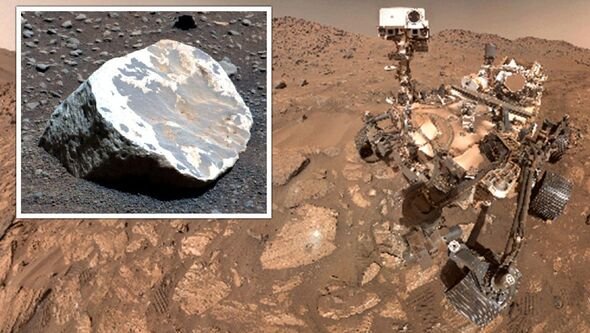
Small white rocks dotting the Martian surface in Jezero Crater provide strong evidence that the Red Planet once featured a much wetter environment, potentially suitable for life. NASA’s Perseverance rover has detected these stones as kaolinite clay, an aluminum-rich mineral that forms on Earth through prolonged exposure to rainfall in warm, humid conditions.
Discovery Details and Analysis
The rover’s SuperCam and Mastcam-Z instruments analyzed the rocks, which vary from pebbles to boulders. Chemical signatures match Earth samples from rainforests in South Africa and near San Diego, California, but lack indicators of hydrothermal origins, pointing instead to surface water erosion over millions of years.
Briony Horgan, a planetary science professor at Purdue University and Perseverance mission planner, states: “These rocks represent some of the most significant outcrops observed from orbit because they require extensive water to form. They suggest an ancient warmer, wetter climate with rain falling for millions of years.”
Implications for Mars’ Past Climate
Adrian Broz, a postdoctoral researcher at Purdue and lead study author, explains: “Kaolinite thrives in Earth’s rainforests, where heavy rains leach away other minerals over time. Its presence on arid Mars indicates far more water existed in the past.”
The rocks’ exact placement in Jezero Crater, an ancient lakebed roughly twice Lake Tahoe’s size, remains unclear. They may have arrived via rivers forming the delta or through meteor impacts. Larger kaolinite deposits appear in satellite images elsewhere on Mars, but Perseverance has yet to examine them directly.
Habitability and Future Exploration
Water’s role is crucial in the search for extraterrestrial life, as all known organisms rely on it. Broz adds: “Environments shaped by rainfall would have been highly habitable, potentially supporting microbial life if it ever existed on Mars.”
This finding aligns with ongoing evidence of Mars’ watery history, including ancient riverbeds and lake sediments. The Perseverance rover, which touched down in Jezero Crater in February 2021, continues its mission to map the surface and seek biosignatures.
Horgan concludes: “Each rock reveals a piece of Mars’ story. These suggest the planet was once far more Earth-like than previously thought.” Scientists anticipate further insights as the rover nears additional deposits.









