

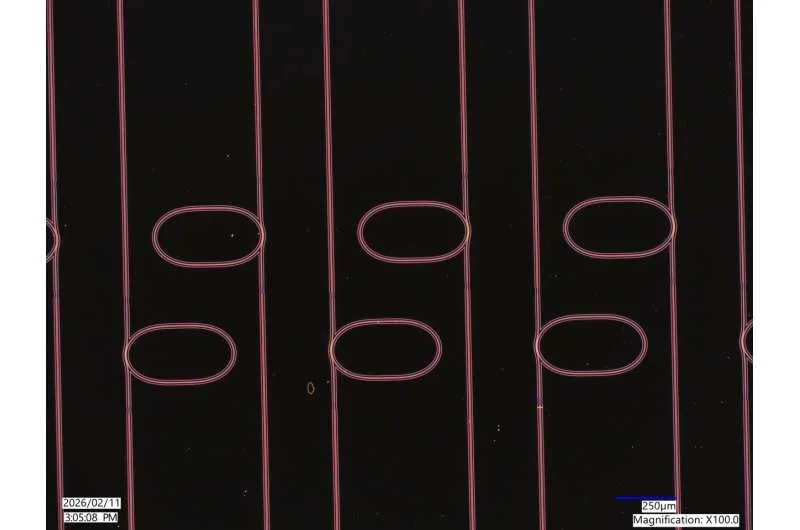
Researchers at the University of Colorado Boulder have developed high-performance optical microresonators that trap light longer within microscopic chips, paving the way for next-generation sensor technologies.
These tiny devices intensify light to enable advanced optical operations using minimal power. “Our work focuses on reducing optical power needs in these resonators for future applications,” said Bright Lu, a fourth-year doctoral student in electrical and computer engineering and lead author of the study. “These microresonators hold potential for diverse sensors, from navigation to chemical detection.”
Innovative Racetrack Resonator Design
The team utilized racetrack-shaped resonators, featuring elongated Euler curves similar to those in road and railway designs. These smooth curves prevent abrupt bends that cause light loss. “The racetrack curves minimize bending loss,” explained Won Park, Sheppard Professor of Electrical Engineering and co-advisor. “This design represents a key innovation.”
By guiding light smoothly, the resonators reduce losses significantly, allowing photons to circulate longer and interact more intensely.
Precision Fabrication in Clean Rooms
Constructed in the Colorado Shared Instrumentation in Nanofabrication and Characterization (COSINC) clean room, the microresonators leverage a new electron beam lithography system for sub-nanometer resolution. “Traditional lithography faces wavelength limits, but electron beam lithography overcomes this with electrons,” Lu noted.
The hands-on process transformed thin glass films into functional optical circuits. “Clean rooms offer massive, precise machines to create micron-wide structures—it’s incredibly satisfying,” Lu added.
Chalcogenide Materials Drive Performance
The devices incorporate chalcogenides, specialized semiconductor glasses with high transparency and nonlinearity. “Chalcogenides excel in photonics due to these properties,” Park stated. “This work delivers one of the top-performing chalcogenide devices.”
Professor Juliet Gopinath, who collaborated with Park for over a decade, highlighted the challenge: “Chalcogenides prove difficult yet rewarding for nonlinear photonic devices. Minimizing bend loss yields ultra-low-loss performance rivaling state-of-the-art materials.”
Rigorous Testing Reveals Sharp Resonances
James Erikson, a ics Ph.D. student, led testing by aligning lasers with waveguides to measure light transmission. Resonances appear as sharp dips in data, indicating trapped photons. “Ideal resonances are deep and narrow, like a needle through the signal,” Erikson described. “Seeing these sharp resonances confirmed we succeeded.”
Analysis quantified absorption, transmission, and thermal effects, crucial for high-power operation without damage.
Promising Future for Photonic Integration
These microresonators promise compact microlasers, chemical and biological sensors, and quantum tools. “They integrate lasers, modulators, and detectors into scalable systems,” Lu said. “The vision is mass production for manufacturers.”