

The United States recently hosted a critical minerals summit to diminish China’s leading position in producing components for smartphones, weapons, lithium-ion batteries, and electric vehicles. Participants included representatives from Argentina, Australia, Bolivia, Canada, Chile, the Democratic Republic of Congo, India, the European Union, Japan, South Korea, and the United Kingdom. This gathering reflects a broader shift in global trade dynamics, which Canadian Prime Minister Mark Carney described as a “rupture” in the rules-based international order.
China’s Overwhelming Market Share
China controls over 80% of global battery production, rising to 90% for grid-scale batteries used in wind and solar energy storage, according to International Energy Agency data. Global battery sales have surged sixfold since 2020, driven by declining prices and China’s efficient, low-cost manufacturing. Grid-scale battery system production has expanded 20-fold in the same timeframe. These trends make it improbable for the US to significantly reduce China’s influence in critical minerals production and processing.
Global Competition for Key Resources
Research into environmental politics, extractive industries, and renewable energy supply chains in Latin America highlights intensifying competition. South America holds over 50% of the world’s known lithium deposits, prompting heightened US engagement to limit Chinese involvement.
In 2025, the US government took a 5% stake in Canada-based Lithium Americas, which operates extensively in Argentina. That February, it announced a 10% investment in USA Rare Earth. The White House leveraged tariff threats and a $20 billion bailout to secure a new trade deal with Argentina. Additionally, the US-led Inter-American Development Bank committed over $140 million to boost critical mineral production and processing in Latin America.
China’s Strategic Investments
Despite US initiatives, China’s public-private partnerships secure its foothold while offshoring polluting processes. Ganfeng Lithium, active in Argentina for a decade, expanded in August 2025 through joint ventures with Lithium Americas at Pozuelos, Pastos Grandes, and Cauchari-Olaroz salt flats. Most output feeds battery and EV hubs in China and Southeast Asia.
In Chile, China’s stake remains a minority in SQM since 2018. President Gabriel Boric’s National Lithium Strategy limits new licenses to state firms Codelco and Enami. However, President-elect José Antonio Kast’s right-wing victory, backed by business interests, questions this nationalist approach.
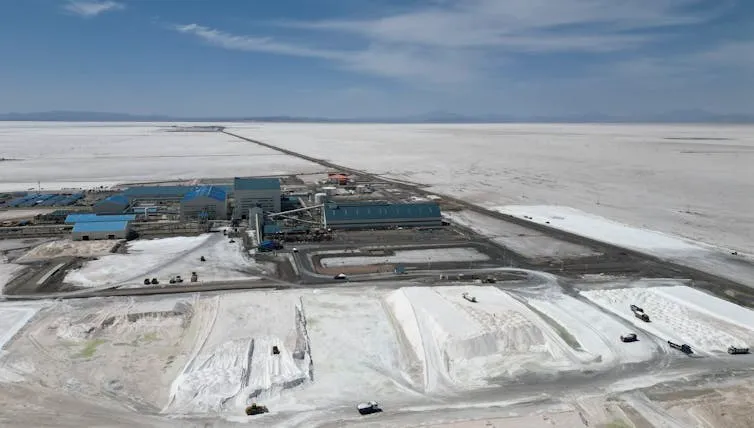
Bolivia faces similar shifts with its new right-wing government under Rodrigo Paz Pereira. Chinese and Russian firms hold strong positions; in 2024, state-owned YLB inked a $1 billion deal with the Chinese CBC consortium for the Uyuni salt flat. Yet, production stays minimal due to extraction challenges and profit-sharing disputes.
Future Prospects and Hurdles
Right-wing governments in Argentina, Bolivia, and Chile theoretically favor US interests. Argentina’s President Javier Milei has forged close ties with the White House and President Donald Trump. Chile, however, resists due to its copper market dominance, lithium nationalization debates, and Chinese influence.
Major uncertainties persist: Can US firms match China’s capacity in lithium-ion batteries while aligning with foreign policy? US-based Albemarle, a top lithium producer, is publicly traded with diverse investors. Globally, production involves American, Chinese, and Australian giants like Rio Tinto, often partnering with Tianqi and Ganfeng.
North America lacks the scale and cost competitiveness to supplant China in critical minerals for batteries, storage, and EVs. Building a superior supply chain to erode China’s dominance appears unlikely amid current economic and geopolitical conditions.









