Hood Hill captivates visitors with its symmetrical peak, stunning vistas, and ancient earthworks left by medieval builders and glaciers. This moorland gem near Whitestone Cliff, Lake Gormire, Roulston Scar, mysterious caves, the Devil’s Stride gap, and the Kilburn White Horse fosters endless tales.
Climbing Hood Hill’s Storied Summit
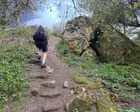
During a recent ascent with my son Lochy, the hill’s allure became evident. Its landscape draws stories from deep history. One account, documented by folklorist Thomas Gill in 1852, centers on the Altar Stone atop the summit ridge.
Local lore claims druids at Roulston used the stone for rituals. Early Christian missionaries arrived, prompting Satan’s furious appearance. His foot scorched the stone upon landing, and it flew to Hood Hill when he leaped away.
Links to Ancient Brigantes Territory
This tale predates the 19th-century discovery of a massive Iron Age fort at Roulston by over a century. It likely echoes folk memories from pre-Roman Britain, home to the Brigantes tribe and their druids.
The Altar Stone’s Dramatic Fate
Today, the site reveals only fragments in a deep crater. On September 21, 1954, an RAF Sabre F Mk4 jet plunged from a clear sky, destroying the plane, pilot, and stone in a direct impact.
Lochy, intrigued by the incident despite his disinterest in prehistory, offers insights: “The Sabres were among the first turbojet planes, so there was plenty wrong with them. Bird strikes usually meant game over.”
Hood Hill weaves together Brigantes, Romans, Vikings, Anglo-Saxons, Normans, the British Empire, and even Sabre jets into its geological narrative, its magnetic pull enduring through the ages.