

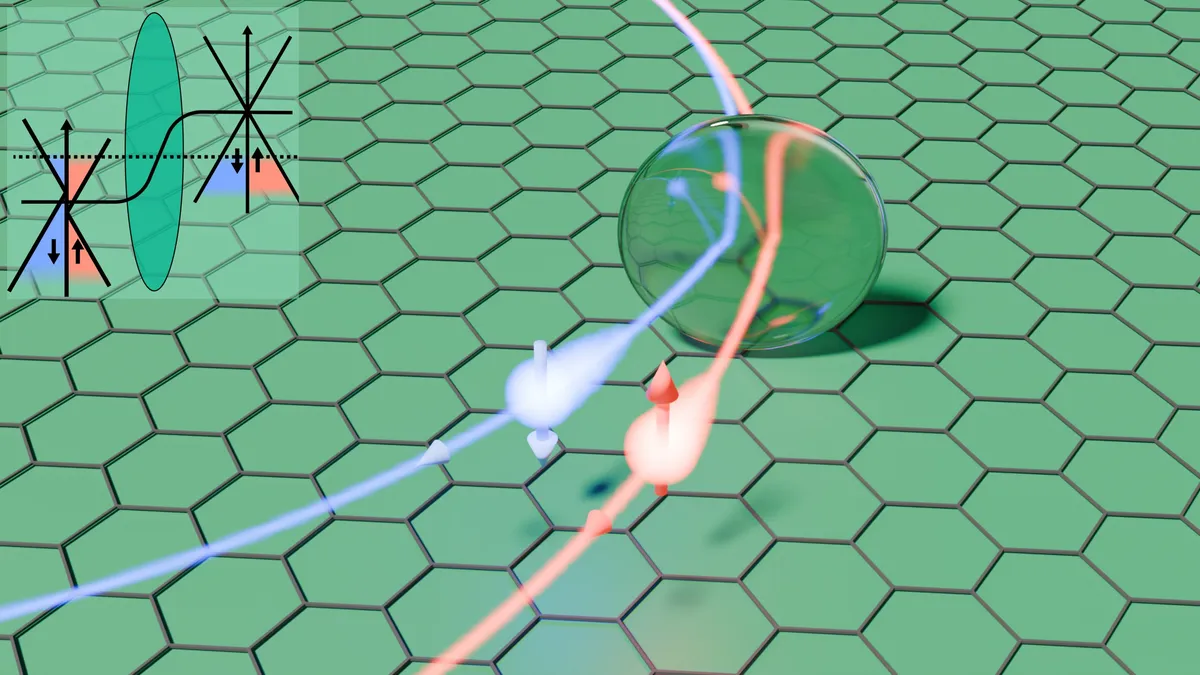
Researchers at the University of Manchester’s National Graphene Institute have demonstrated precise control over electrons in ultra-clean graphene, guiding them with their spin information preserved. This advancement paves the way for efficient low-power electronics and quantum technologies.
Ballistic Electron Transport with Spin Integrity
In a recent study, the team shows that electrons travel ballistically—without scattering or resistance—across micrometer distances in graphene at low temperatures. Remarkably, they maintain spin coherence even up to room temperature.
Using transverse magnetic focusing (TMF), scientists bend electron paths similar to light through a lens. These curved trajectories carry distinct spin signatures, confirming the method’s effectiveness.
Dr. Daniel Burrow, a co-author based in Manchester, stated, “What’s exciting here is that we can shape the path of electrons in graphene and, at the same time, tune how their spins behave. It’s a bit like using a set of lenses and mirrors, but for spin-polarized electrons. This opens a practical way to control spin without needing strong spin–orbit interaction in the material.”
Device Design and Spin Detection
The graphene device incorporates ferromagnetic cobalt contacts to inject and detect spin-polarized electrons along the edge of an encapsulated channel. A small out-of-plane magnetic field curves electron paths into cyclotron orbits.
When orbits match the precise size, electrons reach the detector, generating clear signal peaks at specific magnetic fields. The study resolves three such TMF peaks, with their height and sign varying based on magnetic contact alignment—direct evidence of spin transport via ballistic motion, not diffusion.
Tunable Spin Control via Gate Voltage
Adjusting the back gate voltage alters electron density in graphene, dramatically modulating the spin signal. Researchers enhanced signals beyond traditional nonlocal spin-valve methods and even reversed polarity in certain conditions.
This tunability stems from coupling between orbital motion and spin, induced by charge-transfer doping and proximity-exchange effects from ferromagnetic contacts. The adjacent graphene acts magnetically, enabling spin-dependent electron optics as electrons move into the non-magnetic channel—mimicking transistor behavior without spin–orbit coupling.
Toward Real-World Spintronic Devices
Clear ballistic transport occurs at 25 K, with quasi-ballistic effects persisting at room temperature. TMF peaks remain spin-sensitive at these levels, proving viability for practical applications.
This electron optics approach offers a new principle for spintronics, controlling electron spin rather than charge. It echoes the Datta–Das spin field-effect transistor but leverages optics over spin–orbit effects.
Co-author Dr. Ivan Vera Marun noted, “We have shown that electron optics in graphene can do more than guide electrons; it can actively shape their paths in a spin-dependent manner. Being able to control spin in this way, using low-power and scalable materials, moves us closer to practical spin-based technologies and future quantum systems.”









