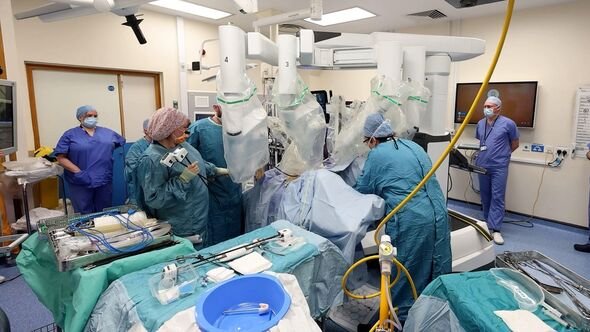
A groundbreaking wave of AI-enhanced surgical robots promises to reshape treatment for thousands of patients in the National Health Service, dramatically shortening recovery periods, minimizing risks, and alleviating strain on busy wards. This advanced digital tool, applied in intricate cancer and urgent procedures, rolls out nationwide, marking a pivotal leap in contemporary medical practice as noted by leading surgeons.
Core Features of the da Vinci 5 System
Central to this innovation is a sophisticated computer integrated with artificial intelligence, which analyzes extensive data streams in real time during surgeries while staying under the direct oversight of medical professionals. Dubbed da Vinci 5, the system expands access to minimally invasive techniques for numerous patients annually, involving smaller incisions, reduced discomfort, and accelerated healing.
These robots address critical challenges in the NHS, including persistent bed shortages and unprecedented wait times, by slashing extended hospital admissions. Procedures that once demanded a week or longer now enable discharge in less than a day, transforming patient experiences.
Enhanced Outcomes for Complex Conditions
Clinicians highlight potential improvements in results for individuals facing bowel, lung, pancreatic cancers, and advanced gynecological issues. The AI tools enable surgeons to swap major, intrusive cuts for pinpoint entry points, often under a few centimeters, versus traditional 8-10 centimeter openings. This boosts precision, limits tissue stress, and heightens overall safety.
Experts anticipate fewer severe complications, alongside better safeguarding of sensitive nerves, organs, and adjacent structures, which can influence post-operative well-being for years.
Implementation at Royal Stoke University Hospital
Among the initial UK facilities embracing this technology is Royal Stoke University Hospital, bolstered by a £12 million contribution from the Denise Coates Foundation to advance health initiatives and community support.
Consultant colorectal surgeon Mr. Philip Varghese describes the platform as a transformative upgrade in surgical capabilities. “This is cutting-edge technology,” he states. “It pushes the barrier of what we can do to the next level of precision and it is genuinely game-changing.”
He compares its evolution to smartphones: “It is like comparing an iPhone 1 to an iPhone 17 – the computer power is quicker, faster and more accurate, with additional navigational aspects built in.”
The enhanced visualization supports remote consultations among specialists across sites and generates insights that refine techniques, fostering gentler interventions with superior accuracy and lower risks of adverse events or fatalities.
Avoiding Traditional Trauma
The system facilitates trauma-free approaches in operations historically needing substantial external cuts. “We can remove the thyroid from inside the mouth using a small incision rather than cutting the neck,” Mr. Varghese explains. “And for cardiac surgery we can operate through a small cut rather than splitting the breastbone.”
Beyond immediate healing, it supports nerve-sparing methods in neurological and gynecological cases, preserving functions like sexual health that prior precision levels couldn’t achieve. “This is surgery we simply were not able to do before at this level of precision,” he adds.
Boosting Efficiency and Patient Throughput
Evidence from robotic applications demonstrates gains in operational efficiency, shorter stays that free resources, and safer handling of higher volumes. “People used to stay in hospital for five to ten days following an operation,” Mr. Varghese notes. “With this technology, they can be home within 23 hours.”
This shift optimizes schedules, permitting multiple procedures daily instead of one, enhancing overall capacity.
Importantly, the tools augment rather than supplant human expertise. “This is not dangerous,” Mr. Varghese assures. “It is operated by a surgeon, with the system constantly monitored and highlighting errors in real time, so the surgeon can adjust immediately.”
Royal Stoke plans to expand to six da Vinci units, positioning it as a top robotic hub, yet its broader impact could redefine NHS operations, enabling safer, faster care for more individuals nationwide.