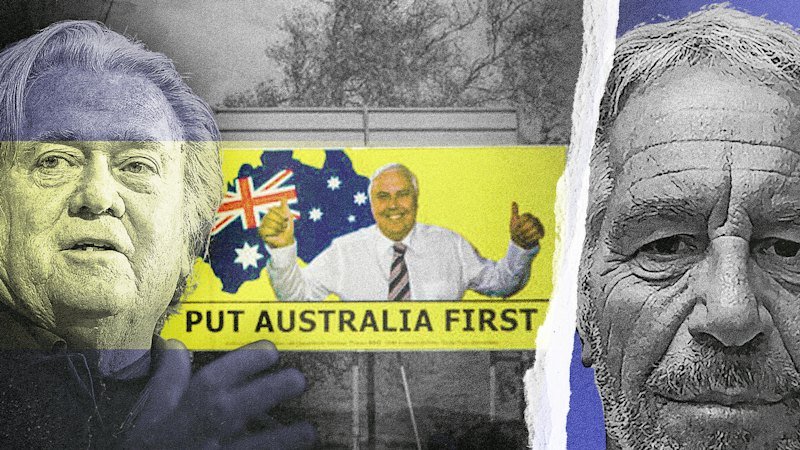
Former Trump strategist Steve Bannon claimed he convinced Australian billionaire Clive Palmer to fund a $60 million advertising blitz against China and climate change policies during the 2019 federal election. This revelation emerges from messages exchanged with Jeffrey Epstein, the convicted financier who died in custody in August 2019.
The Key Exchange
On May 20, 2019, just two days after Labor’s unexpected defeat, Bannon messaged an account linked to Epstein: “I had Clive Palmer do the $60m anti China and anti climate change ads.” The conversation highlights Bannon’s asserted role in one of Australia’s costliest political ad campaigns, aimed at upending traditional democratic processes globally.
Epstein responded by emphasizing the shift from conventional campaigning to online efforts, pointing to Australia’s election and Trump’s 2016 victory as proof that telephone polls no longer hold sway. “Telephone polls not accurate,” he wrote, advocating for borderless populist movements. “New, non geographically limited groupings… You can champion a true world bank of the people not the countries.”
Bannon agreed: “Yes that’s the objective. Next stop Kazikstan [sic].” This dialogue frames the 2019 Australian vote as part of a larger strategy among populist figures to challenge mainstream parties, environmental initiatives, and global bodies.
Details of Palmer’s Campaign
Bannon, known for leading Breitbart News and serving as a top advisor on Trump’s 2016 campaign, had voiced strong opinions on the Australian race earlier that May. He criticized it as lackluster and overly managed by consultants, which stripped away political passion.
Campaign records show Palmer invested $83.6 million to promote the United Australia Party. Ads flooded TV, radio, print, and online spaces, targeting Labor leader Bill Shorten, rejecting climate action, and raising alarms about Chinese influence. Some spots alleged “communist China” plotted a secret Australian takeover, including potential use of a remote Western Australia airport for invasion. Experts in defense and strategy labeled these assertions as fearmongering and unfounded conspiracy theories.
Despite securing no seats, Palmer took credit for the Coalition’s success, citing his party’s 3.5% primary vote and preference flows to the Liberals, especially in Queensland. Labor’s post-election analysis noted how Palmer’s spending overwhelmed their own ads across media, marking a disruptive entry by a wealthy outsider outpacing the party’s entire budget. “In the final stages of the campaign,” the review stated, “Palmer’s expenditure also directly backed in the Coalition’s anti-Labor messages, in an unprecedented act of collusion between supposed political rivals.”
The review called for changes to curb wealthy individuals’ ability to dominate elections, viewing unlimited spending as a risk to fair governance.
Bannon’s Australian Ties and Broader Network
Palmer, a longtime supporter of Queensland’s Liberal-National Party, previously won the Fairfax seat in 2013 and helped elect three senators. He lost in 2016 but maintained influence through bold, Trump-inspired ad strategies.
The Epstein files also shed light on Bannon’s close relationship with the financier. They often dined together, with Epstein offering access to homes in Paris and Palm Beach, plus his private jet. Messages reveal banter about French President Emmanuel Macron’s warnings on foreign meddling in European elections, including attacks from Macron’s team on Bannon and Russian-linked groups.
“U saw where Macron campaign manager coming after me personally,” Bannon texted. Epstein replied: “It is an attack on the sovereignty of the election… it makes you want to throw up,” before adding he “loved it.” These exchanges coincide with ongoing probes into Bannon’s European activities.
Bannon and Palmer have been approached for comment on these disclosures.