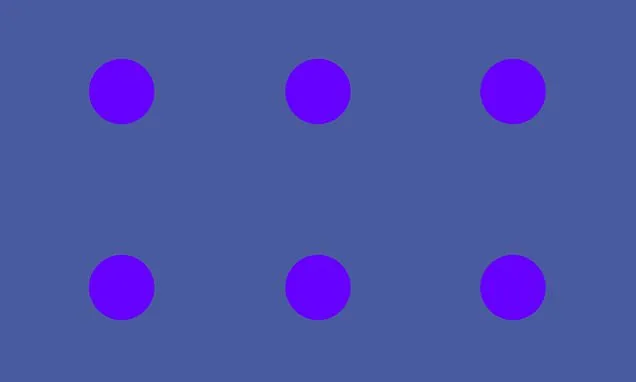
A captivating optical illusion challenges viewers to determine the color of dots in an image, demonstrating how easily the brain misinterprets hues. The dots appear to shift between blue and purple shades based on focus, highlighting the intricacies of human vision.
The Science Behind the Shifting Colors
Hinnerk Schulz-Hildebrandt, a biomedical optics engineer at Harvard Medical School, developed this illusion for a study published in the journal Perception. It reveals how the brain can misread identical purple dots: those at the fixation point look purple, while surrounding ones shift toward blue.
“In this paper a novel optical illusion is described in which purple structures (dots) are perceived as purple at the point of fixation, while the surrounding structures (dots) of the same purple colour are perceived toward a blue hue,” Schulz-Hildebrandt explains. “As the viewing distance increases, a greater number of purple structures (dots) revert to a purple appearance.”
Role of Cone Cells in Color Detection
The human eye relies on three types of cone cells to detect color: L-cones for long wavelengths (reds), M-cones for medium wavelengths (greens and yellows), and S-cones for short wavelengths (blues). These cones distribute unevenly across the retina. In the fovea—the area of sharpest vision—S-cones, responsible for blue detection, are nearly absent.
This scarcity makes direct blue perception weaker compared to other colors. “We don’t notice this usually,” states Jenny Bosten, a visual neuroscientist at the University of Sussex. “[That’s] because our brains have learned to ‘calibrate’ out the difference.”
How the Brain Enhances Contrast
In this nine-dot illusion, the brain adjusts perception to make dots stand out against the bluish background. Initially, dots blend with the background, prompting the brain to render them more purple at the center. Surrounding dots appear bluer, creating a dynamic shift visible while scanning the image.
The effect diminishes at greater distances, as more dots regain their purple hue. “The combination of these mechanisms…leads to a unique and impressive visual illustration,” Schulz-Hildebrandt notes. “A pattern of purple objects on a blueish background appears only purple where the viewer looks directly at it. In the periphery, the perception shifts towards blue. As the viewing distance increases, the number of objects perceived as purple also changes.”