

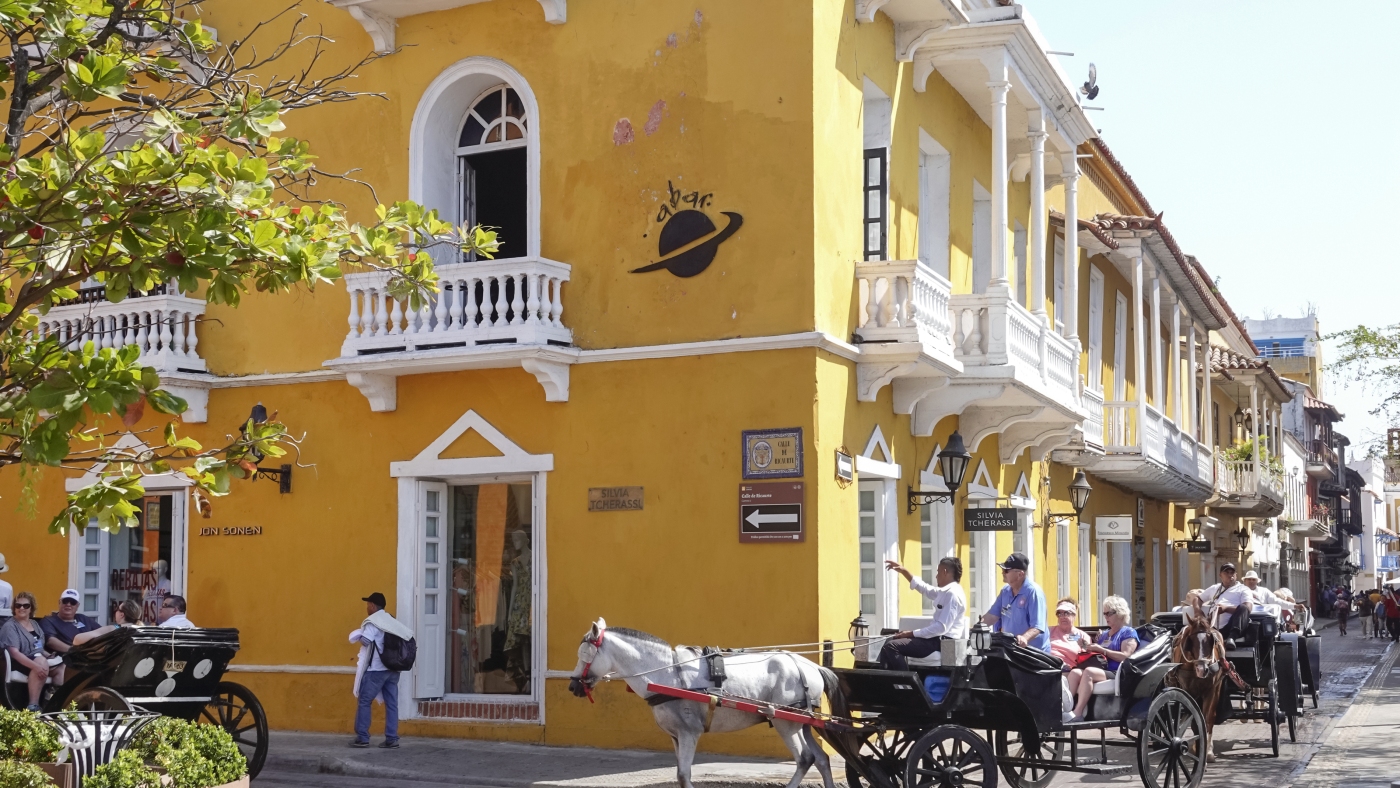
In Cartagena’s Outdated Metropolis, horse-drawn buggies nonetheless clip-clop over colonial streets — however not for for much longer.
Jeffrey Greenberg/Common Photos Group by way of Getty Photos
conceal caption
toggle caption
Jeffrey Greenberg/Common Photos Group by way of Getty Photos
CARTAGENA, Colombia — Cartagena sits on Colombia’s Caribbean coast and for many years it has been one of many nation’s most beloved locations.
Its historic middle is encircled by thick stone partitions, constructed by the Spaniards to fend off pirates. Inside, slim streets wind previous sun-drenched plazas and colonial mansions, a cityscape straight out of a film.
The town can be well-known for the horse-drawn buggies that carry vacationers via its streets; their large-spoked wheels clattering over the pavement, and their open tops good for snapshots of Cartagena’s appeal.
However quickly the romantic buggies will probably be outlawed by town authorities. Which desires to switch them with electrical automobiles as a result of issues over animal welfare.
The transfer has angered horse cart homeowners and traditionalists, pitting them in opposition to animal rights activists and native officers who say there must be no place for horse carts in a metropolis that wishes to painting itself as a worldwide vacation spot.
“It’s totally unhappy,” says Cristian Munoz, one among Cartagena’s conventional horse cart drivers. “We’re a part of this metropolis’s heritage, just like the partitions that encompass it.”

Cristian Munoz has been driving horse buggies for the previous 20 years. He says the electrical carts will cast off a part of town’s heritage.
Manuel Rueda/For NPR Information
conceal caption
toggle caption
Manuel Rueda/For NPR Information
Vacationers within the UNESCO World Heritage Website say that the horse carts are a enjoyable strategy to get round in Cartagena’s sweltering warmth. And plenty of respect the best way through which drivers inform the colonial metropolis’s historical past.
However animal rights activists have lengthy argued that these pleasure rides are horrible for the horses pulling the carriages, as a result of vehicles on town’s roads stress out the horses. And the pavement injures horses’ knees, and hurts their legs.
Fanny Pachon, an area animal rights activist, says that on a number of events, horses have collapsed from exhaustion.
“Horses are pack animals, and so they’re designed to hold issues,” she admits. “However they’re meant to be in rural areas, not in the midst of a metropolis with paved roads.”
Alejandro Riaño, a preferred comic from Bogota, has been lobbying Cartagena´s authorities to switch the horse carts for the previous 4 years.
In 2021, he raised greater than 25,000 {dollars} on a crowd funding website, to construct an electrical automobile that resembles a standard horse buggy, however runs with battery energy. The prototype was examined on town’s streets two years in the past.
“We’ve proven there may be the know-how now to do issues in another way” he mentioned.
After years of protests, town is lastly siding with Riaño and the animal rights activists.
On December 29, conventional horse-drawn buggies will probably be banned, and changed by a fleet of 62 electrical carriages imported from China, beneath a three way partnership between Cartagena’s metropolis authorities and Corpoturismo, an company that promotes tourism within the metropolis.

A employee fixes a wheel on one of many electrical carriages that Cartagena’s municipal authorities has imported from China.
Manuel Rueda/For NPR Information
conceal caption
toggle caption
Manuel Rueda/For NPR Information
The brand new automobiles have massive wheels and open tops, identical to the normal buggies. However they’re powered by massive batteries that may final for about 70km (43 miles) on a single cost.
As a substitute of reins, there is a steering wheel on the entrance for the motive force. The brand new carts additionally include audio system that may very well be used to play music, or to duplicate the sound of a horse’s gallop.
Liliana Rodriguez, Corpoturismo’s director, says that this new fleet of carts might encourage different cities the place horse carriages are nonetheless in use.
She mentioned that Cartagena’s carts may also be environmentally pleasant as a result of their batteries will probably be charged with solar energy.
“These are the sorts of modifications that new generations are demanding,” she mentioned.
The town is investing round 2 million {dollars} within the new fleet of electrical carts, and in a warehouse that’s fitted with a photo voltaic powered charging station.
However the homeowners of Cartagena’s horse carriages are anxious.
They are saying that the municipal authorities is pushing them out of a enterprise they’ve spent many years constructing.
“We aren’t in opposition to a transition,” mentioned Miguel Angel Cortez, the proprietor of two horse carts that make round $150 per day. “However we have to know the way we will probably be included.”
Cart homeowners mentioned they haven’t gotten any provides in writing from town authorities. However they’ve been to conferences the place there was some discuss of a $10,000 cost to compensate them for his or her carriages. Cart homeowners say that might hardly compensate for his or her losses.
Cartagena’s mayor Domek Turbay, accuses the cart homeowners of “sabotaging” negotiations. He says that the municipal authorities is keen to share the earnings of the brand new electrical automobiles with the horse cart homeowners. However up to now, there was no settlement between either side, and cart homeowners have threatened to sue town authorities for leaving them out of labor.
“I get the sensation that they’re attempting to reap the benefits of the scenario,” Mayor Turbay informed NPR information.
Turbay says that vacationers will have the ability to experience on town’s new electrical carts at no cost, for the following two months.
And a few of the carriage drivers — who at present work for cart homeowners — admit that they may apply for jobs driving the brand new electrical buggies.
However others are questioning if vacationers will wish to experience on electrical automobiles, even when they resemble nineteenth century carriages.
“Individuals come to Cartagena for custom,” says cart driver Cristian Munoz. “With out the horses, it isn’t the identical.”


