Catherine Opie’s exhibition To Be Seen marks her first major museum show in Britain at the National Portrait Gallery. The display features iconic works from the 1990s onward, capturing mythic American landscapes, families, and the often-overlooked lives of gay, lesbian, and queer Americans.
Iconic Works Challenging Norms
Opie’s bold photographs include portraits of friends and members of LA’s 1990s leather dyke community. Standouts feature Pig Pen, an androgynous figure gazing directly at the viewer, and the Being and Having series, where 13 butch lesbians don stick-on facial hair in a playful critique of gender roles. Another powerful image, Dyke, shows Steakhouse with the word “dyke” tattooed across her neck.
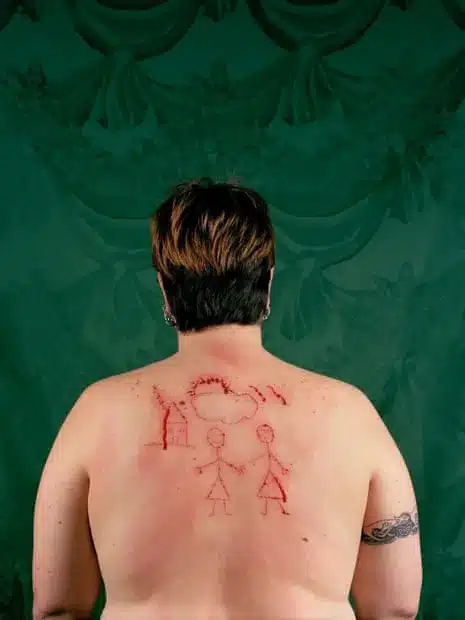
In 1993, Opie created Self-Portrait/Cutting, a striking self-portrait with a child’s drawing of a house and family carved into her back. The 64-year-old artist, speaking from her Los Angeles studio, emphasizes sincerity in her work. “Sincerity is really important to me,” she says. “Those basic qualities are actually very Christian, yet Christianity has excluded me because of my sexual preference.”
A Career Rooted in Vulnerability and Bravery
For 27 years, Opie taught photography at UCLA, urging students to display bravery in public spaces. Her images evoke deep emotional responses, as seen in Divinity Fudge, a drag performer in full attire, and Self-Portrait/Nursing, depicting Opie breastfeeding her son Oliver amid scars from earlier works.
These photos counter stereotypes of queer life with raw honesty. Opie recalls a childhood moment at age 11, struck by Lewis Hine’s 1908 image of a girl in a South Carolina cotton mill, sparking her empathy for marginalized lives. Raised near her father’s factory in Ohio before moving to California, she embraced creativity despite family resistance.
Family Influences and Personal Growth
A childhood self-portrait from 1970 shows young Opie in a strongman pose. Her mother, a short-haired PE teacher and athlete who swims a mile daily at 90, embodied similar traits. Opie laughs about friends mistaking her mom for a lesbian.
Parenting Oliver challenged Opie’s assumptions. Photos from In and Around Home capture him in a pink tutu, defying her hopes for a “boy-boy.” Now out as queer, he remains true to himself, Opie notes proudly.
Expanding Beyond Queer Portraits
In the late 2000s, Opie photographed high school football players across the US, viewing them as extensions of the American landscape. This followed visits to her then-wife’s family in Louisiana. She addresses critics who question her focus: “I’m dying for the day when every single heterosexual child has to come out to their parents as heterosexual.”
Her San Francisco art school days in the 1980s, amid theory from Foucault and October magazine, shaped early queer-focused work. Yet Opie balances fine art with commercial gigs, including Gucci’s 2025 campaign and past editorial shoots. “I loved making my toolbox as large as it could be,” she says. “I’m super into being capable.”
Addressing Controversy and Double Standards
Self-Portrait/Cutting symbolized queer domesticity amid homophobia. Opie clarifies its intent in the exhibition’s audio tour, guiding parents on discussing it with children: “Why don’t you ask them what the artist meant by the house with smoke from the chimney?” She critiques double standards: “As soon as the Vatican puts trigger warnings on its work, I’ll put trigger warnings on mine.”
Opie’s oeuvre bridges divides, from children’s drawings to blood lines, affirming existence across boundaries.
Catherine Opie: To Be Seen runs at the National Portrait Gallery in London from March 5 to May 31.