[ad_1]
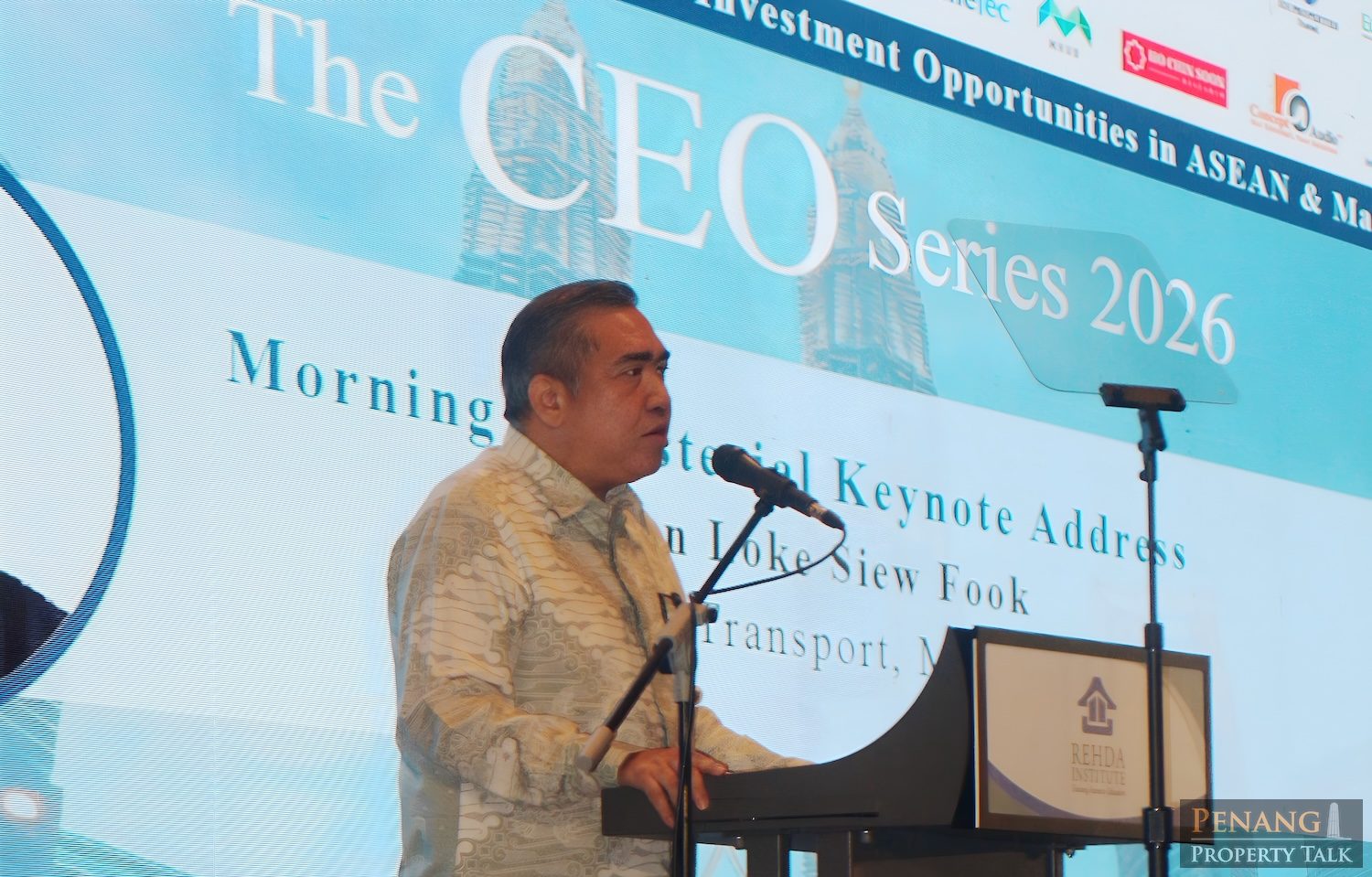
Transport infrastructure should be seen not merely as a supporting service, however as a strategic financial enabler that immediately shapes funding patterns, actual property demand and concrete growth outcomes, mentioned Minister of Transport YB Loke Siew Fook on the CEO Sequence 2026.
Delivering the morning keynote deal with, the minister mentioned 2026 will probably be a pivotal yr for Malaysia because it coincides with Go to Malaysia 12 months 2026, the place nationwide targets embody welcoming as much as 43 million worldwide guests. He famous that tourism, commerce and enterprise progress rely essentially on the standard, reliability and integration of transport techniques throughout the nation.
From the Ministry of Transport’s perspective, initiatives to reinforce air connectivity, modernise ports and enhance land transport networks should not merely about transferring individuals and items, however about unlocking financial potential, supporting industries and creating extra environment friendly city environments.
Classes from the Johor–Singapore Particular Financial Zone
The minister pointed to the Johor–Singapore Particular Financial Zone (JS-SEZ) as a transparent illustration of how transport infrastructure underpins actual property efficiency and investor confidence. Whereas the zone has attracted tens of billions of ringgit in accredited and dedicated investments, its long-term success hinges on transport techniques that may convert geographic proximity into financial productiveness.
He highlighted the stress on current cross-border highway infrastructure, with an estimated 300,000 commuters and 100,000 autos crossing each day, underscoring the necessity to diversify transport modes and relieve congestion.
Central to this transformation is the Johor Bahru–Singapore Speedy Transit System (RTS) Hyperlink, which he described as a structural financial enabler fairly than a standard rail venture. With a capability of as much as 10,000 passengers per hour per route, the RTS Hyperlink is predicted to cut back journey uncertainty and allow the JS-SEZ to perform as an built-in labour and enterprise ecosystem.
Implications for Penang’s progress corridors
Whereas the keynote centered closely on Johor, the rules outlined carry direct relevance for Penang, the place transport capability and concrete density are more and more shaping property demand and growth feasibility.
Penang’s industrial ecosystem — spanning Bayan Lepas, Batu Kawan and the Northern Hall — relies upon closely on dependable highway, port and airport connectivity. As Go to Malaysia 12 months 2026 approaches, air hyperlinks by means of Penang Worldwide Airport, improved last-mile connectivity and public transport integration will play a vital function in supporting tourism, providers and enterprise journey.
The minister’s emphasis on transport as a productiveness enabler fairly than a reactive response additionally resonates with Penang’s ongoing discussions round LRT, congestion administration and transit-oriented growth (TOD). As city land turns into extra constrained, the alignment between transport nodes, housing provide and employment centres will more and more decide venture viability and long-term worth.
Transport shaping actual property outcomes
In keeping with the minister, transport infrastructure doesn’t merely reply to growth, however actively shapes growth patterns. Main investments in rail, bus corridors and intercity connectivity create new nodes of accessibility, influencing residential demand, industrial exercise, industrial location and concrete density.
He highlighted TOD as a vital planning device that aligns transport capability with housing and employment, serving to to cut back congestion, enhance affordability and improve liveability. For policymakers and builders alike, transport planning due to this fact turns into a proactive instrument to information sustainable actual property progress fairly than a corrective measure after congestion and imbalance emerge.
Past capability, in direction of high quality and integration
Concluding his deal with, the minister confused that future competitiveness will probably be outlined not solely by transport capability, however by the standard, integration and resilience of infrastructure techniques. Digitally enabled border processes, environmentally sustainable transport and seamless multimodal integration are key to reworking connectivity into competitiveness.
For Penang, as with Johor, this indicators that future property and concrete progress will probably be carefully tied to how successfully transport investments are deliberate, coordinated and built-in into broader financial and spatial methods, significantly as Malaysia positions itself for a extra related and aggressive regional function in ASEAN
Be a part of our Telegram Channel now to obtain instantaneous replace on Penang newest initiatives and property information

[ad_2]