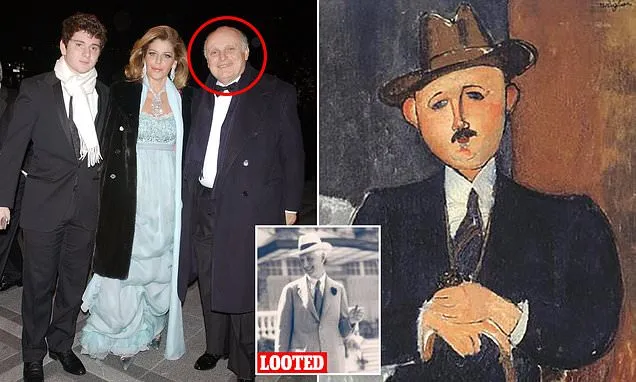
A New York Supreme Court judge has ruled that billionaire art dealer David Nahmad must return a valuable Amedeo Modigliani painting to the estate of a Jewish antiques dealer from whom it was seized during the Nazi occupation of France.
Details of the Painting and Original Ownership
The 1918 oil portrait, titled Seated Man With a Cane, depicts a chocolate merchant wearing a hat and tie. Once valued at approximately $25 million, the artwork originally belonged to Oscar Stettiner, who operated an antiques shop in Paris. Judge Joel M. Cohen determined that Stettiner owned the painting or at least held superior rights to it before its unlawful seizure.
“Oscar Stettiner owned or at a minimum had a superior right of possession of the painting prior to its unlawful seizure,” Cohen stated in his ruling.
Nazi Seizure and Auction Reappearance
Decades after the Nazis confiscated the painting and sold it to an unidentified buyer, it resurfaced at a 1996 auction. Nahmad’s company, International Art Center, acquired the work and has stored it in Switzerland since then. The Nahmad family has operated in the art trade for generations.
Post-War Legal Efforts and Current Lawsuit
Following World War II, Stettiner filed a claim in 1946. A French court ruled in his favor, ordering the painting’s return, but the buyer no longer possessed it. Stettiner passed away in 1948 without recovering the piece.
In 2015, Stettiner’s grandson, Philippe Maestracci, launched a lawsuit against Nahmad and his holding company, with assistance from Mondex, a firm specializing in recovering stolen art. The case centered on Nahmad’s link to International Art Center, which he eventually acknowledged controlling.
James Palmer, founder of Mondex, expressed elation over the verdict. “Our client, Mr. Maestracci, is overwhelmed with joy and the satisfaction that after so many years the quest of his grandfather has finally been fulfilled,” Palmer said. He added, “We now look forward to Mr. Nahmad abiding by his promise to return the painting upon receiving the order of the court, which today he has now received.”
Phillip Landrigan, a lawyer for the Stettiner estate, criticized Nahmad and his legal team for prolonging the litigation in hopes the heir would abandon the claim.
Nahmad’s Defense and Judge’s Findings
Nahmad pointed out that he had loaned the painting to several museums, including the Jewish Museum in Manhattan in 2004. “If you had any doubt about looted art, would you really lend it to a Jewish museum?” he remarked in a 2016 interview.
Judge Cohen noted that while the Stettiner family had been misinformed about the painting’s location for 50 years, the Nahmad family bore no responsibility for that. Nahmad purchased the work through Christie’s auction house. The judge highlighted compelling evidence, including records of Stettiner lending the painting to a 1930 exhibition in Venice.
“The evidence shows a straightforward and persuasive chain of ownership/right of possession flowing directly from Mr. Stettiner to Nazi seizure to a forced sale,” Cohen concluded.