


A whole bunch of yards of dinosaur tracks with toes and claws have been discovered within the Italian Alps in a area that can host the 2026 Winter Olympics, authorities mentioned Tuesday.
“This set of dinosaur footprints is among the largest collections in all of Europe, in the entire world,” Attilio Fontana, head of the Lombardy area in northern Italy, mentioned throughout a information convention.
The tracks, that are over 200 million years previous, have been found within the Stelvio Nationwide Park, in an space between the cities of Bormio and Livigno, which host a part of the Video games.
Nature photographer Elio Della Ferrera first noticed the imprints in September in an virtually vertical rocky slope.
Some measured as much as 16 inches in diameter.
The gathering “extends for lots of of meters and likewise represents a sequence of animal behaviors, as a result of along with seeing animals strolling collectively, there are additionally locations the place these animals meet,” Fontana mentioned.
Della Ferrera known as in paleontologist Cristiano Dal Sasso from Milan’s Pure Historical past Museum, who assembled a staff of Italian consultants to check the location.
The museum launched a number of photographs of the footprints uncovered within the so-called valley of dinosaurs on social media.
“It is an immense scientific heritage,” Dal Sasso mentioned within the area’s press launch.
Elio Della Ferrera, PaleoStelvio Archive
“The parallel walks are clear proof of herds transferring in synchrony, and there are additionally traces of extra advanced behaviors, similar to teams of animals gathered in a circle, maybe for protection.”
“Impressions of the toes and even the claws”
The tracks, at the moment lined by snow and off the overwhelmed observe, are preserved in Higher Triassic dolomitic rocks, courting again roughly 210 million years.
Many of the footprints are elongated and made by bipeds. One of the best-preserved ones bear traces of at the very least 4 toes.
That implies they belong to prosauropods, herbivorous dinosaurs with lengthy necks and small heads, that are thought-about the ancestors of the massive sauropods of the Jurassic interval just like the Brontosaurus, the consultants mentioned.
Prosauropods had sharp claws, and adults might attain as much as 33 toes in size.
There might also be tracks of predatory dinosaurs and archosaurs, the ancestors of crocodiles, the press launch mentioned.
Fabio Manucci, PaleoStelvio Archive 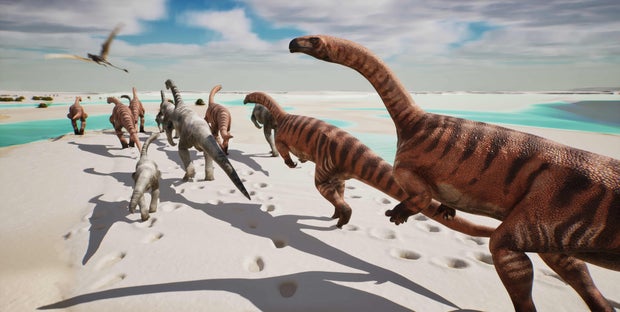
The prints are on an almost-vertical slope as a result of formation of the Alpine chain.
However when the dinosaurs walked by the world, it was shaped of tidal flats that stretched for lots of of miles, and the surroundings was tropical.
“The tracks have been made when the sediments have been nonetheless delicate and saturated with water, on the broad tidal flats surrounding the Tethys Ocean,” ichnologist Fabio Massimo Petti mentioned, referring to a prehistoric ocean.
“The plasticity of these very superb calcareous muds, now remodeled into rock, has in areas preserved actually outstanding anatomical particulars, similar to impressions of the toes and even the claws,” he mentioned.
The footprints have been then lined by sediments which protected them, however with the uplift of the Alps and the erosion of the mountainside, they’ve been introduced again into view.
“Because the layers containing the tracks are various and overlapping, now we have a novel alternative to check the evolution of animals and their surroundings over time,” geologist Fabrizio Berra mentioned. “Like studying the pages of a stone ebook.”
Different current dinosaur observe discoveries
Researchers have unearthed different dinosaur footprints not too long ago.
Earlier this month, paleontologists in Bolivia mentioned they discovered and meticulously documented 16,600 footprints left by theropods, the dinosaur group that features the Tyrannosaurus rex.
In March, scientists in England found a 650-foot path of dinosaur footprints made 160 million years in the past by huge sauropod dinosaurs.
In January, British researchers unearthed some 200 dinosaur footprints courting again 166 million years in a discover believed to be the largest in the UK.
That discovery was introduced just some months after a staff of paleontologists discovered matching dinosaur footprints on what are actually two completely different continents, separated by hundreds of miles of ocean.
In October 2023, engineers within the U.Okay. made a “dramatic discovery” of dinosaur footprints that consultants consider may very well be from a mantellisaurus, a kind of dinosaur that had simply three toes on every foot and traveled on its hind legs.


