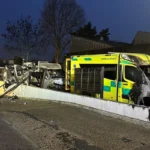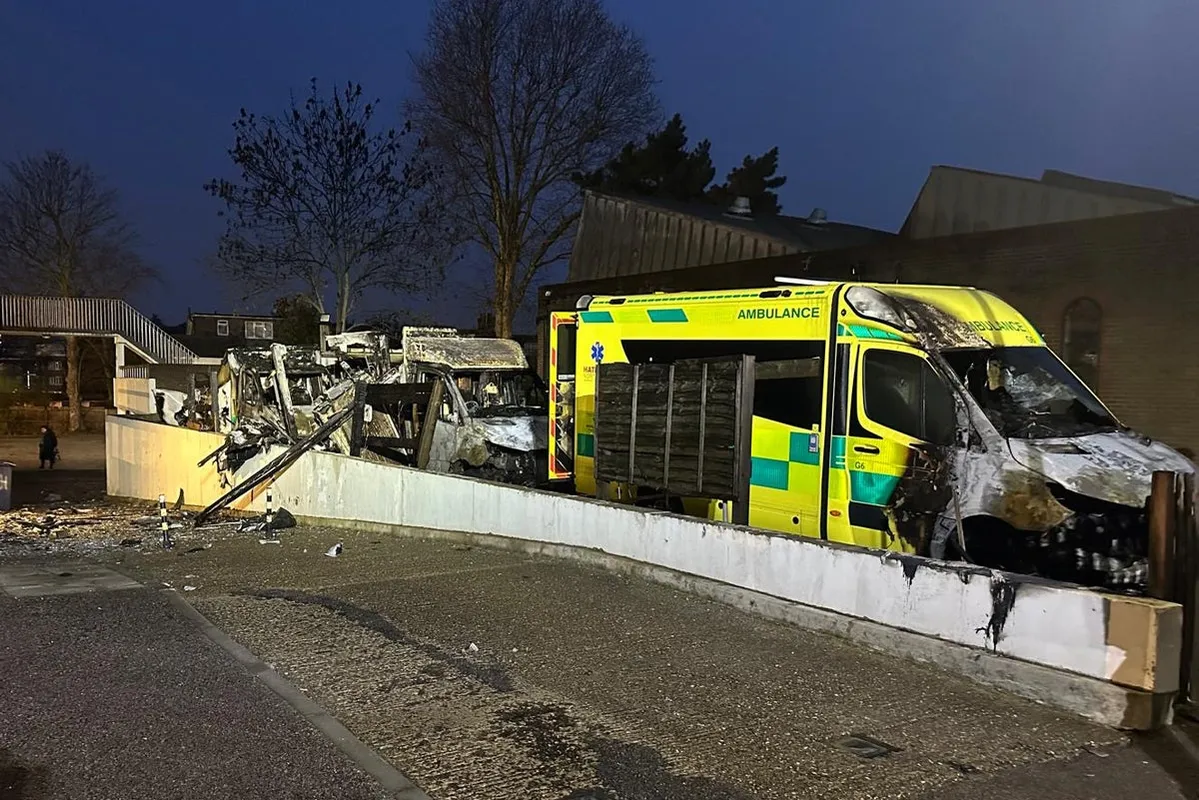
A Telegram channel linked to Harakat Ashab al-Yamin al-Islamiya (HAYI), translating to the Islamic Movement of the Companions of the Right, claimed responsibility for an arson attack on four Jewish ambulances in Golders Green, northwest London. The channel, with fewer than 200 subscribers, vanished by Tuesday after announcing “military operations” against U.S. and Israeli interests on March 9.
Details of the London Incident
CCTV footage captures three individuals igniting an ambulance in the early hours of Monday. The vehicles, operated by the Jewish charity Hatzola, sat in the parking lot of Machzike Hadath Synagogue. HAYI’s video claim featured text in Hebrew, English, and Arabic, targeting the synagogue as “one of the main bastions of support for Israel in Britain.” The group issued a “final warning” to EU citizens to avoid American and Zionist interests.
Metropolitan Police are verifying the claim but have not classified it as a terrorist incident. Security sources note HAYI’s tactics but question the group’s name and advise caution in attribution.
Broader Claims Across Europe
Before deletion, the channel shared videos of four other alleged arsons in Europe and details of a Czech Republic attack by the Earthquake Faction. One video depicted an incident near an American bank by Amsterdam’s World Trade Centre; another showed fires outside a Jewish school there. Amsterdam’s mayor described the school explosion as a “deliberate attack against the Jewish community” on March 14.
Additional footage claimed an explosion outside a Rotterdam synagogue, leading to arrests of five young men aged 17 to 19. Dutch authorities have not confirmed links between incidents. Videos of a Greek site attack on March 11 appear to be disinformation, per digital analysis from the International Centre for Counter-Terrorism researchers. These clips circulated earlier in Iraqi pro-Iranian militia channels.
The channel also highlighted Earthquake Faction’s fire at a Czech arms warehouse, now under terror investigation by local authorities. The group describes itself as an “internationalist underground network” targeting Zionist sites.
Expert Analysis on HAYI’s Origins
Experts question HAYI’s legitimacy, citing branding similarities to the Islamic Revolutionary Guard Corps (IRGC) network. Julian Lanchès, junior research fellow at the International Centre for Counter-Terrorism, found no prior references to HAYI before March 9. He noted suspicious dissemination via Iraqi pro-Iranian channels, linguistic errors in videos, and atypical logos like a sniper rifle over AK-style imagery.
“The suspicious dissemination patterns raise the question whether HAYI is a genuine terrorist group or merely serves as a façade for Iranian hybrid operations that enable plausible deniability,” Lanchès wrote. He suggests locally recruited actors over direct IRGC involvement.
Roger Macmillan, former security director at Iran International, observed: “This is an organisation which really seems to have come to life after the joint US-Israeli attacks in Iran. It looks as though they’ve claimed responsibility for attacks across Europe, including Liege, Rotterdam and Amsterdam.” He suspects Iranian backing to instill fear.
Dr. Hans-Jacob Schindler, senior director at the Counter Extremism Project, doubts a new group’s rapid network: “Whether the perpetrators are connected, or whether it’s a framework the IRGC is giving them, is up for discussion. It’s much more powerful to say that a new terrorist group exists… These actors will post everything they can to insinuate that Europe has become very very unsafe.”
Jason Brodsky, policy director at United Against Nuclear Iran, pointed to IRGC-adopted logos: “The IRGC has different options… it can activate sleeper cells in the United Kingdom or it can employ transnational criminal syndicates to target Israeli interests, Jewish organisations, and the Iranian diaspora.”
Labour peer Kevan Jones, chair of the UK’s Intelligence and Security Committee, highlighted proxy use: “What you are dealing with here is not necessarily just organised crime groups, but also people who are just paid.” He compared it to Russian tactics, like last year’s east London warehouse attack by paid individuals.
Recent precedents include two Swedish teens jailed for grenade attacks on Israel’s embassy in Denmark, linked to a criminal network acting as a Middle Eastern terror group’s “armed wing.”