[ad_1]
Chinese language firm Moonshot AI upgraded its open-sourced Kimi K2 mannequin, reworking it right into a coding and imaginative and prescient mannequin with an structure that helps an agent swarm orchestration.
The brand new mannequin, Moonshot Kimi K2.5, is an effective possibility for enterprises that need brokers that may robotically cross off actions as a substitute of getting a framework be a central resolution maker.
The corporate characterised Kimi K2.5 as an “all-in-one mannequin” that helps each visible and textual content inputs, letting customers leverage the mannequin for extra visible coding tasks.
Moonshot didn’t publicly disclose K2.5’s parameter depend, however the Kimi K2 mannequin that it's based mostly on, had 1 trillion complete parameters and 32 billion activated parameters due to its mixture-of-experts structure.
That is the newest open-source mannequin to supply an alternative choice to the extra closed choices from Google, OpenAI, and Anthropic, and it outperforms them on key metrics together with agentic workflows, coding, and imaginative and prescient.
On the Humanity’s Final Examination (HLE) benchmark, Kimi K2.5 scored 50.2% (with instruments), surpassing OpenAI’s GPT-5.2 (xhigh) and Claude Opus 4.5. It additionally achieved 76.8% on SWE-bench Verified, cementing its standing as a top-tier coding mannequin, although GPT-5.2 and Opus 4.5 overtake it right here at 80 and 80.9, respectively.
Moonshot mentioned in a press launch that it's seen a 170% enhance in customers between September and November for Kimi K2 and Kimi K2 Considering, which was launched in early November.
Agent swarm and built-in orchestration
Moonshot goals to leverage self-directed brokers and the agent swarm paradigm constructed into Kimi K2.5. Agent swarm has been touted as the following frontier in enterprise AI improvement and agent-based programs. It has attracted vital consideration previously few months.
For enterprises, which means in the event that they construct agent ecosystems with Kimi K2.5, they will anticipate to scale extra effectively. However as a substitute of scaling “up” or rising mannequin sizes to create bigger brokers, it’s betting on making extra brokers that may basically orchestrate themselves.
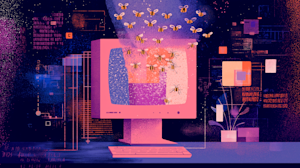
Kimi K2.5 “creates and coordinates a swarm of specialised brokers working in parallel.” The corporate in contrast it to a beehive the place every agent performs a process whereas contributing to a standard objective. The mannequin learns to self-direct as much as 100 sub-agents and may execute parallel workflows of as much as 1,500 device calls.
“Benchmarks solely inform half the story. Moonshot AI believes AGI ought to in the end be evaluated by its potential to finish real-world duties effectively beneath real-world time constraints. The actual metric they care about is: how a lot of your day did AI truly give again to you? Operating in parallel considerably reduces the time wanted for a posh process — duties that required days of labor now may be completed in minutes,” the corporate mentioned.
Enterprises contemplating their orchestration methods have begun taking a look at agentic platforms the place brokers talk and cross off duties, reasonably than following a inflexible orchestration framework that dictates when an motion is accomplished.
Whereas Kimi K2.5 could supply a compelling possibility for organizations that wish to use this type of orchestration, some could really feel extra comfy avoiding agent-based orchestration baked into the mannequin and as a substitute utilizing a unique platform to distinguish the mannequin coaching from the agentic process.
It is because enterprises usually need extra flexibility by which fashions make up their brokers, to allow them to construct an ecosystem of brokers that faucet LLMs that work greatest for particular actions.
Some agent platforms, similar to Salesforce, AWS Bedrock, and IBM, supply separate observability, administration, and monitoring instruments that assist customers orchestrate AI brokers constructed with completely different fashions and allow them to work collectively.
Multimodal coding and visible debugging
Kimi K2.5 additionally excels in coding and claims to be “the strongest open-source mannequin to this point for coding with imaginative and prescient.”
The mannequin lets customers code visible layouts, together with consumer interfaces and interactions. It causes over photos and movies to know duties encoded in visible inputs. For instance, K2.5 can reconstruct a web site’s code just by analyzing a video recording of the location in motion, translating visible cues into interactive layouts and animations.
“Interfaces, layouts, and interactions which are tough to explain exactly in language may be communicated by means of screenshots or display recordings, which the mannequin can interpret and switch into totally practical web sites. This allows a brand new class of vibe coding experiences,” Moonshot mentioned.
This functionality is built-in into Kimi Code, a brand new terminal-based device that works with IDEs like VSCode and Cursor.
It helps "autonomous visible debugging," the place the mannequin visually inspects its personal output—similar to a rendered webpage—references documentation, and iterates on the code to repair format shifts or aesthetic errors with out human intervention.
Not like different multimodal fashions that may create and perceive photos, Kimi K2.5 can construct frontend interactions for web sites with visuals, not simply the code behind them.
API pricing
Moonshot AI has aggressively priced the K2.5 API to compete with main US labs, providing vital reductions in comparison with its earlier K2 Turbo mannequin.
-
Enter: $0.60 per million tokens (a 47.8% lower).
-
Cached Enter: $0.10 per million tokens (a 33.3% lower).
-
Output: $3.00 per million tokens (a 62.5% lower).
The low price of cached inputs ($0.10/M tokens) is especially related for the "Agent Swarm" options, which regularly require sustaining giant context home windows throughout a number of sub-agents and in depth device utilization.
Modified MIT license
Whereas Kimi K2.5 is open-sourced, it’s launched beneath a Modified MIT License that features a particular clause concentrating on "hyperscale" industrial customers.
The license grants customary permissions to make use of, copy, modify, and promote the software program.
Nevertheless, it stipulates that if the software program or any by-product work is used for a industrial services or products that has greater than 100 million month-to-month lively customers (MAU) or greater than $20 million USD in month-to-month income, the entity should prominently show "Kimi K2.5" on the consumer interface.
This clause ensures that whereas the mannequin stays free and open for the overwhelming majority of the developer neighborhood and startups, main tech giants can’t white-label Moonshot’s expertise with out offering seen attribution.
It's not full "open supply" however it’s higher than Meta's related Llama Licensing phrases for its "open supply" household of fashions, which required these firms with 700 million or extra month-to-month customers to acquire a particular enterprise license from the corporate.
What it means for contemporary enterprise AI builders
For the practitioners defining the fashionable AI stack— from LLM decision-makers optimizing deployment cycles to AI orchestration leaders establishing brokers and AI-powered automated enterprise processes — Kimi K2.5 represents a basic shift in leverage.
By embedding swarm orchestration immediately into the mannequin, Moonshot AI successfully arms these resource-constrained builders an artificial workforce, permitting a single engineer to direct 100 autonomous sub-agents as simply as a single immediate.
This "scale-out" structure immediately addresses information decisionmakers' dilemma of balancing complicated pipelines with restricted headcount, whereas the slashed pricing construction transforms high-context information processing from a budget-breaking luxurious right into a routine commodity.
Finally, K2.5 suggests a future the place the first constraint on an engineering group is now not the variety of arms on keyboards, however the potential of its leaders to choreograph a swarm.
[ad_2]