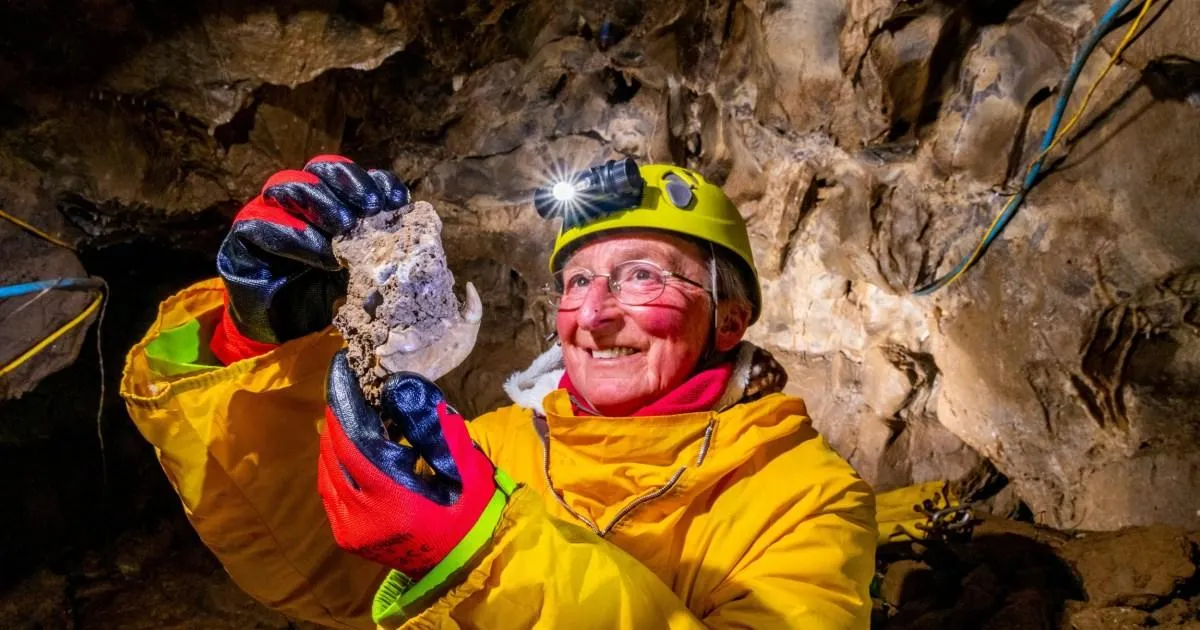
A caver from the Craven Potholing Club has uncovered a prehistoric wolverine jawbone, estimated to be 80,000 to 90,000 years old, deep within a cave in the Yorkshire Dales National Park.
Known as the Arctic’s fiercest survivor, the wolverine (Gulo gulo) belongs to the mustelid family and stands out as the largest land-based member. These powerful predators, resembling compact bears, measure 65 to 104 cm in length with bushy tails up to 26 cm long. They thrive in cold northern regions of North America and Eurasia, renowned for their strength, cunning, and ability to challenge animals twice their size.
Details of the Discovery
The find occurred at Stump Cross Cavern, a 300-million-year-old system where teams work to access a new section called C Chamber for public tours. Club members have manually excavated the site for over a year.
Rowan Worsman, a club member, sifted through buckets of rubble and noticed a white fragment. It turned out to be a wolverine jaw complete with teeth from the Ice Age era.
“It is quite exciting,” Rowan stated. “It’s hard work, you get cold, wet and dirty down there and when you find something like that you think maybe it’s worth it.”
Theories Behind the Remains
Experts ponder how the wolverine ended up in the cave. One leading theory suggests it followed the scent of animals that had fallen into natural pit traps, feasted on the carcasses, but failed to escape.
Tom Thompson, who coordinates the dig, described the animal: “It’s the kind of predator that leaps on something and tears it to pieces, and is about the size of a sheep.”
He added that scientific evidence points to cannibalism among trapped wolverines, followed by a massive flood that swept the remains into the cave’s depths. There, they became encased in stalactites, preserving them for millennia.
The excavation, approved by Natural England, has already removed 75 tonnes of rubble from prior operations, with 200 tonnes remaining. The goal is to unveil C Chamber by 2028, marking the first new section in 25 years and creating a 75-meter extension with stunning decorations and a circular route.
Future Prospects
Director Oliver Bowerman commended the volunteers, who travel from areas like Hull and Lancashire. “The cavers are explorers, they’ve been digging voluntarily for a long time,” he said.
The site has previously yielded Ice Age remains such as reindeer and bison. Bowerman predicts more discoveries: “I’d put my life savings on there being a lot more down there. A wolverine in Yorkshire is not something many people know about and it will be a brilliant display piece for us.”
Palaeontologists will now analyze the jawbone to gain insights into Ice Age wildlife in the Yorkshire Dales.