Iran’s President Masoud Pezeshkian issued an apology for attacks on neighboring nations even as Iranian missiles and drones targeted Gulf Arab states. This development highlights potential fractures in Tehran’s command over its military forces. Pezeshkian also dismissed U.S. President Donald Trump’s calls for unconditional surrender.
Leadership Challenges Emerge One Week into Conflict
Exactly one week after a February 28 airstrike ignited the war—killing Supreme Leader Ayatollah Ali Khamenei—Pezeshkian, part of Iran’s tripartite leadership council, delivered a defiant message. The hastily recorded video, lacking professional production, underscores the theocracy’s limited influence over the paramilitary Revolutionary Guard, which operates ballistic missiles independently and selects its own targets.
Pezeshkian stated that the leadership council has communicated with the armed forces regarding the strikes. “I should apologize to the neighboring countries that were attacked by Iran, on my own behalf,” he said. “From now on, they should not attack neighboring countries or fire missiles at them, unless we are attacked by those countries. I think we should solve this through diplomacy.”
Adding to the confusion, Gen. Abolfazl Shekarchi, Iran’s armed forces spokesman, clarified that Tehran targets only nations providing bases for U.S. invasions.
U.S. Response and Escalation Warnings
Trump responded on Truth Social, noting Pezeshkian’s apology and warning of intensified strikes. “Today Iran will be hit very hard!” he posted. “Under serious consideration for complete destruction and certain death, because of Iran’s bad behavior, are areas and groups of people that were not considered for targeting up until this moment in time.”
The U.S. approved a $151 million arms sale to Israel amid vows of no negotiations without Iran’s surrender. Officials anticipate the most intense bombing campaign yet. Iran’s U.N. ambassador affirmed the nation will take all necessary measures for self-defense.
Gulf States Face Missile and Drone Barrages
Hours before the apology, Iranian projectiles disrupted Dubai International Airport, forcing passengers into train tunnels. Emirates Airlines briefly suspended all flights before resuming operations. Saudi Arabia intercepted drones near its Shaybah oil field and downed a ballistic missile aimed at Prince Sultan Air Base, home to U.S. forces. Sirens blared in Bahrain as attacks targeted the island nation.
Explosions rocked western Tehran from Israeli strikes, with smoke rising over the city. Incoming Iranian missiles triggered bomb shelters across Israel, including Jerusalem, though no casualties were reported.
Casualties and Broader Impacts
The conflict has claimed at least 1,230 lives in Iran, over 200 in Lebanon, 11 in Israel, and six U.S. troops. U.S. and Israeli strikes focus on Iran’s military, leadership, and nuclear sites, with objectives evolving from regime change to internal leadership shifts.
A prominent Iranian cleric, Ayatollah Nasser Makarem Shirazi, called on the Assembly of Experts to swiftly appoint a new supreme leader, despite airstrikes damaging related facilities. “The timely realization of this important matter will lead to national authority and the best possible organization of affairs,” Shirazi stated.
Naval Incidents and Economic Warnings
An Iranian naval vessel, IRIS Lavan, docked in India’s Kochi port after reporting issues. Foreign Minister Subrahmanyam Jaishankar described the permission as a humane gesture. A U.S. submarine sank another Iranian ship, IRIS Dena, off Sri Lanka, while IRIS Bushehr sought aid there.
Qatar’s energy minister, Saad al-Kaabi, warned the war risks global economic collapse, potentially driving oil prices to $150 per barrel. Benchmark U.S. crude exceeded $90 Friday, the highest in over two years.
Fighting Intensifies in Lebanon
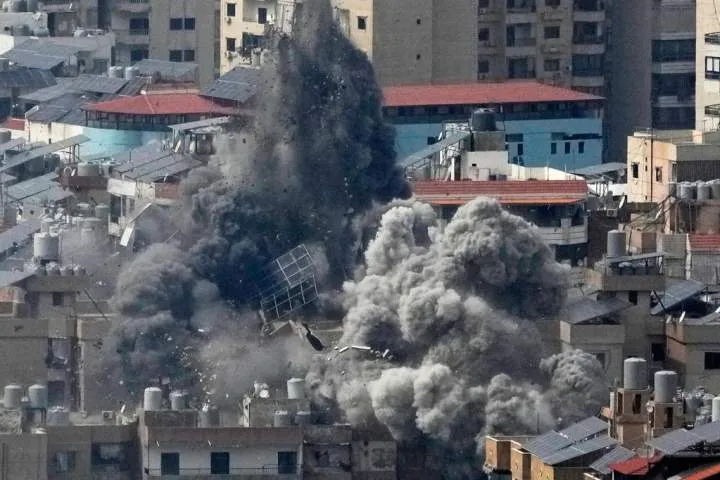
Iran-backed Hezbollah reported clashes with Israeli forces in eastern Lebanon’s mountains. Lebanon’s Health Ministry confirmed 41 deaths and 40 injuries from Israeli airstrikes near Nabi Chit, including three soldiers. Over 200 have died and 800 wounded in Beirut suburbs since Monday.
Hezbollah urged evacuations in northern Israeli towns like Kiryat Shmona and Nahariya. Israel’s military rejected evacuations, pledging to defend residents and bolster southern Lebanon operations.