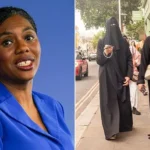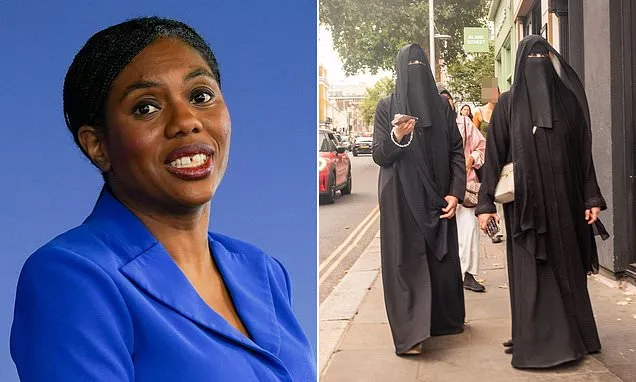
Tory leader Kemi Badenoch evaluates a potential burka ban as a measure against Islamic extremism. Shadow Home Secretary Chris Philp and Shadow Justice Secretary Nick Timothy closely examine the policy’s merits within a broader review of Islamist concerns.
Shift from Previous Stance
This consideration marks a departure from Badenoch’s earlier position. Nine months ago, she stated on BBC Radio 4 that she would not support an outright ban due to enforcement challenges.
“I don’t think women should be forced to wear things that their husbands or their communities want,” she said. “If you have segregated societies, those things happen. But what I’m not doing is announcing that I’m going to ban the burka. Are we going to send police officers into people’s homes to check if they’re wearing the burka at a time when we can’t even keep prisoners in prison? Do we have space in prison to put people wearing the burka in there? This is what I mean by people just saying things, announcing policies without plans.”
Concerns Over the Garment
Philp expresses worries that the burka, which covers a woman’s body except for the eyes, fosters division, promotes extremism, and hinders integration.
Policy Alignments and Divisions
Such a ban aligns with Reform UK’s stance, where home affairs spokesman Zia Yusuf advocates prohibiting all face coverings, including burkas and balaclavas, in public spaces.
It contrasts sharply with Labour’s position ahead of May local elections. Home Secretary Shabana Mahmood, the first Muslim woman in the role, maintains that the government should not dictate citizens’ clothing choices.
International Examples
Numerous Western nations enforce partial or full burka bans, including France, the Netherlands, Switzerland, Belgium, Austria, and Bulgaria. France’s ban gained approval from the European Court of Human Rights, which upheld arguments that face coverings undermine women’s dignity, clash with secular values, and threaten social cohesion. The court ruled the measure protects others’ rights without violating the European Convention on Human Rights.
Countries with large Muslim populations, such as Kazakhstan, Turkmenistan, and Uzbekistan, have implemented bans primarily for security reasons.