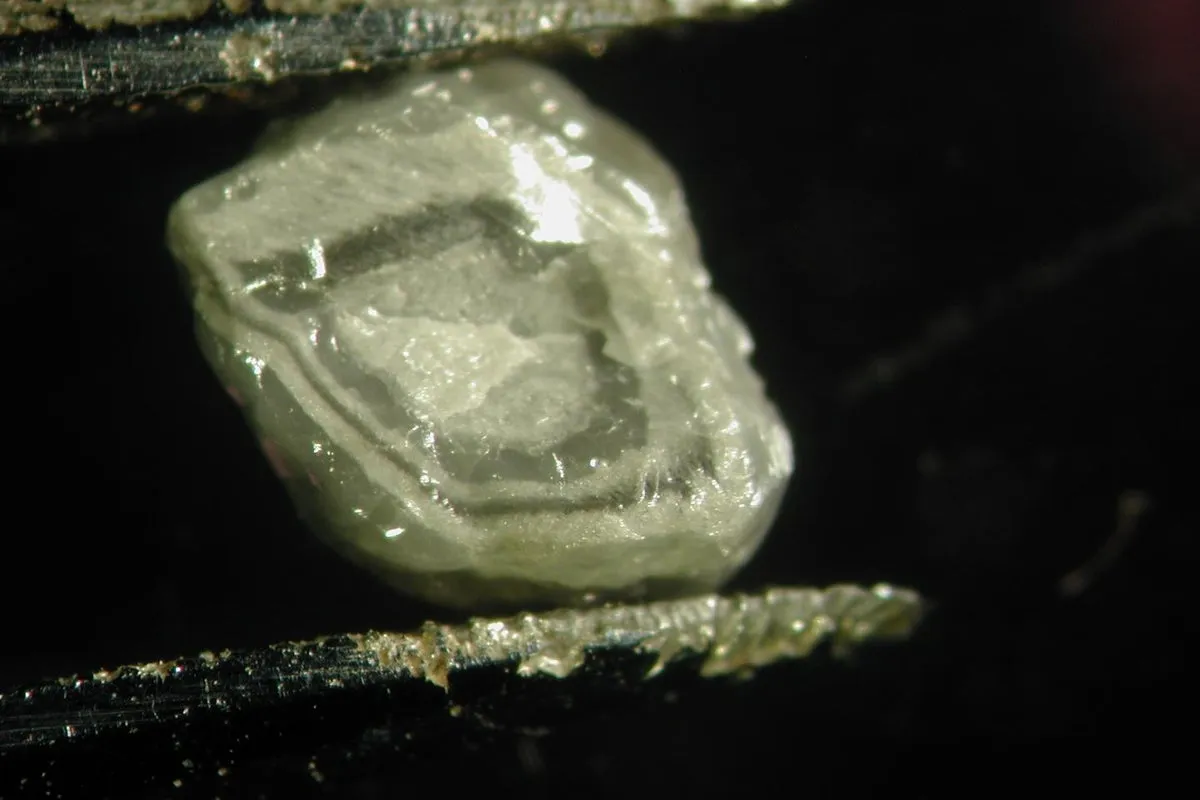
Researchers have successfully synthesized a millimeter-sized piece of pure hexagonal diamond, a form of carbon long theorized to exceed the hardness of conventional cubic diamonds. This breakthrough material, previously observed only at meteorite impact sites, demonstrates superior mechanical properties.
Synthesis Process
Scientists from China’s Henan Key Laboratory of Diamond Materials and Devices transformed highly oriented pyrolytic graphite (HOPG) into hexagonal diamond using extreme conditions. They sandwiched the graphite between tungsten carbide anvils and applied 20 gigapascals of pressure—equivalent to 200,000 times atmospheric pressure—at temperatures ranging from 1,300°C to 1,900°C.
The pressure on the stacked carbon layers triggered the phase transition, yielding a bulk sample of phase-pure hexagonal diamond. “Here we report the synthesis of millimetre-sized, phase-pure hexagonal diamond from highly oriented pyrolytic graphite (HOPG),” the researchers state in their study published in Nature.
Structural Confirmation
To verify the material’s structure, the team employed X-ray diffraction, which maps atomic positions by bouncing X-rays off the sample. Advanced microscopy further revealed the distinctive hexagonal stacking of carbon atoms, confirming its purity and eliminating doubts about its existence as a separate carbon phase.
Superior Hardness and Stability
Mechanical tests involved pressing a diamond tip into the sample to measure resistance to scratching and denting. The hexagonal diamond registered a hardness of approximately 114 gigapascals, surpassing the typical 110 gigapascals of natural cubic diamonds.
“Bulk hexagonal diamond exhibits a slightly higher hardness than cubic diamond and high thermal stability,” the scientists note. These properties resolve ongoing debates and open doors for applications in advanced tools, semiconductors, and cutting technologies.