Researchers have introduced a groundbreaking quadratic gravity theory that redefines the quantum origins of the universe, offering fresh insights into the Big Bang and its earliest phases. This approach indicates that the universe’s swift initial expansion emerged naturally from a robust quantum gravity framework.
A Fresh Approach to Cosmic Beginnings
Dr. Niayesh Afshordi, professor of ics and astronomy at the University of Waterloo and the Perimeter Institute, spearheaded the team investigating a unified method to merge gravity with quantum mechanics—the principles governing subatomic particles. While Einstein’s general relativity excels in many scenarios, it falters under the intense conditions of the universe’s birth. The researchers applied Quadratic Quantum Gravity, a model that maintains mathematical stability at extraordinarily high energies akin to those during the Big Bang.
Unlike conventional Big Bang models that incorporate Einstein’s gravity alongside manually added elements, this theory delivers a seamless connection between the universe’s infancy and today’s observed cosmology.
Quantum Gravity Drives Inflation
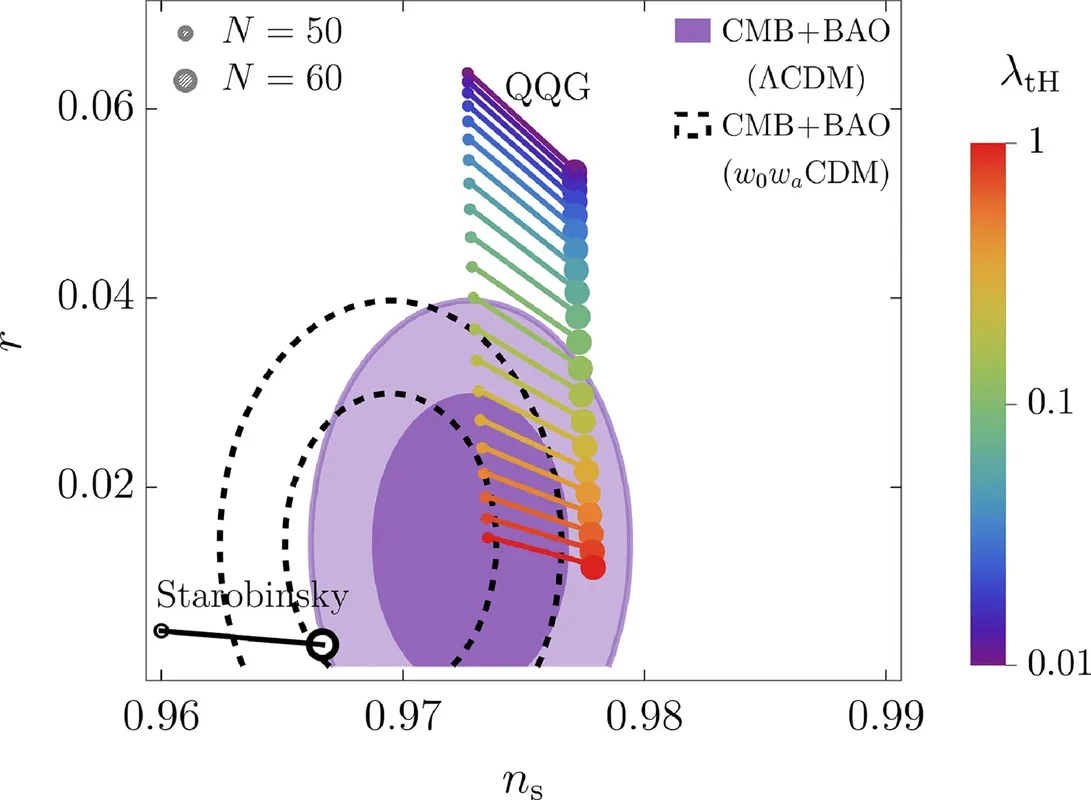
The model demonstrates that the rapid early expansion, known as inflation—a cornerstone of contemporary cosmology explaining the universe’s current structure—arises organically from this quantum gravity theory, without supplementary components. It also forecasts a baseline level of primordial gravitational waves, subtle spacetime distortions from the universe’s first instants. Future experiments could detect these waves, providing a pathway to validate quantum origins of the cosmos.
“This work shows that the universe’s explosive early growth can come directly from a deeper theory of gravity itself,” Afshordi stated. “Instead of adding new pieces to Einstein’s theory, we found that the rapid expansion emerges naturally once gravity is treated in a way that remains consistent at extremely high energies.”
Testable Forecasts in Precision Cosmology
The theory’s predictions surprised the team with their observability. “Even though this model deals with incredibly high energies, it leads to clear predictions that today’s experiments can actually look for,” Afshordi noted. “That direct link between quantum gravity and real data is rare and exciting.”
Cosmology now enters an era of high-precision measurements, with advanced galaxy surveys, cosmic microwave background studies, and gravitational wave observatories poised to probe once-theoretical concepts. As basic inflation models face challenges, this quantum gravity-based alternative gains relevance.
Ruolin Liu, a Ph.D. student at the University of Waterloo and the Perimeter Institute, along with Dr. Jerome Quintin, a lecturer at l’École de technologie supérieure and former postdoctoral researcher at the University of Waterloo and the Perimeter Institute, co-authored the study. The team aims to sharpen predictions for forthcoming experiments, linking quantum gravity to particle ics and early universe enigmas.