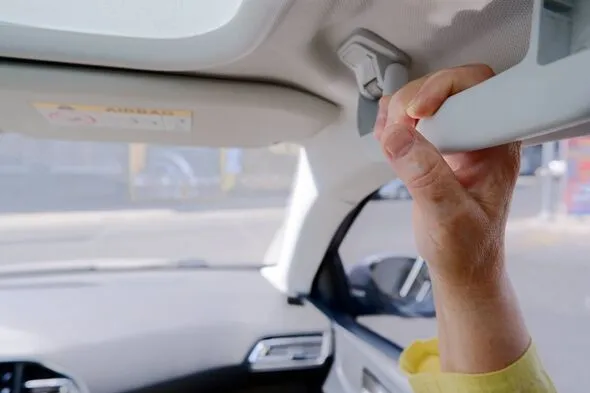
Many motorists across Britain are only now learning the true purpose of the grab handles positioned above passenger doors in petrol and diesel vehicles. These features provide essential support for individuals with disabilities during entry and exit.
The Primary Function of Grab Handles
Grab handles offer crucial assistance to passengers needing extra help to climb in or step out safely. Although some drivers grip them during motion, their main role focuses on accessibility rather than in-transit stability.
Experts describe the handle as the ‘oh no’ handle, ideal for passengers during sudden maneuvers, but emphasize its value for those requiring support. Driver-side doors typically lack these handles since the steering wheel serves a similar purpose, and grabbing one while driving poses safety risks.
Common Misuses Revealed by Drivers
Motorists frequently admit to alternative uses over the years. Many hang suits or laundry on them for convenience during travel.
One driver noted: “Your ‘oh no’ handle is just called the fear handle. The way I usually use it is by hanging suits that are supposed to look sharp when I arrive.”
Another shared: “They come in handy for hanging your laundry from the cleaners.”
A third recalled: “When I was younger, I used to swing on the two car handles!”
Benefits Across Vehicle Types and Users
Automotive specialists highlight broader applications. In larger vehicles, grab handles deliver leverage for hoisting up or lowering down, avoiding risky jumps. In compact cars, they support a smooth descent to the pavement.
This aid proves vital for people with disabilities, older adults, and pregnant individuals.
Rising Demand Reflected in Blue Badge Figures
New data shows one in 20 people in England holds a Blue Badge. As of March 31 last year, 3.07 million individuals across the country were authorized for these disabled parking permits, marking an 8% increase from the prior year. This represents 5.2% of the population.
Local authorities face calls to combat fraudulent use, as these permits serve as a lifeline for genuine needs. Renewed every three years, they allow closer parking to shops and services for social events or medical appointments.
Department for Transport figures reveal regional variations, with the North East at 6.1% of the population holding badges and London at 3.5%.
Eligibility expanded in 2019 to include non-visible conditions like Parkinson’s, dementia, and epilepsy.