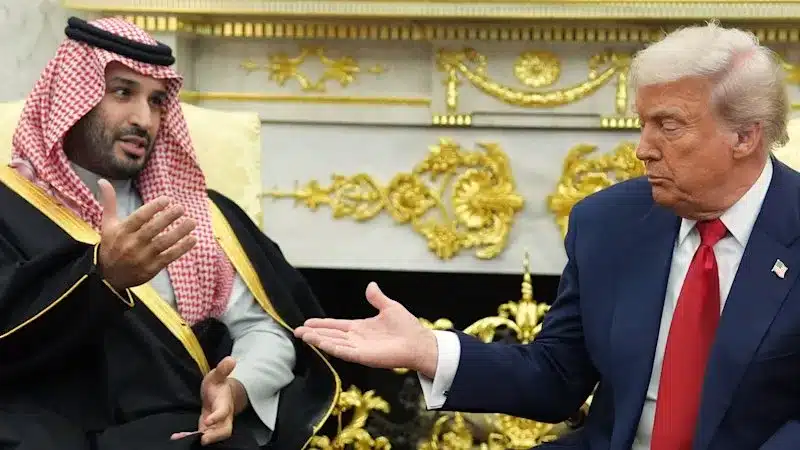
Saudi Arabia aligns with Israel in pressing the United States to conduct strikes on Iran. Crown Prince Mohammed bin Salman advocated for military action during multiple recent phone calls with President Donald Trump. Israeli Prime Minister Benjamin Netanyahu persists in his efforts to encourage U.S. involvement in attacks against Iran.
Background on Recent Escalations
The United States and Israel executed joint strikes on Saturday morning Iran time, resulting in the death of Iran’s Supreme Leader Ayatollah Ali Khamenei. Iran responded with attacks on six neighboring countries, inadvertently fostering unity across the Middle East against the Islamic Republic.
Leaders from Saudi Arabia and the United Arab Emirates, once divided, held discussions following missile impacts on their territories. The Saudi crown prince affirmed his nation’s readiness to deploy all its capabilities in support of its neighbor, just before confirming strikes on Saudi soil.
These joint operations proceeded despite U.S. intelligence assessments indicating Iran’s military poses no imminent threat to the American mainland for at least the next decade. Iran’s reprisals targeted civilian structures, igniting a luxury hotel in Dubai, damaging a high-rise in Bahrain, and striking a Kuwaiti airport, drawing widespread condemnation.
Gulf Unity Against Regional Threat
While most Gulf states lack formal ties with Israel—except Bahrain and the UAE—they view Iran as a major destabilizing force. In conversations with U.S. officials, the Saudi crown prince warned that Iran would strengthen further without immediate U.S. strikes.
Saudi public statements denied permission for using its airspace in any Iran operation, highlighting the crown prince’s caution regarding potential retaliation against vital oil facilities.
Perspectives from Regional Experts
Emirati political commentator Abdulkhaleq Abdulla describes Iran as the common threat uniting Gulf Cooperation Council nations, regardless of internal differences. “When things get tough, they come together,” he stated.
Saudi geopolitical researcher Salman Al-Ansari emphasizes Riyadh’s unwavering security stance amid tensions with the UAE. “Riyadh’s security doctrine remains consistent even amid bilateral tensions with the UAE,” he noted. “We must distinguish between principled commitments and bilateral disagreements. Saudi Arabia’s approach to regional security is not transactional but foundational. The kingdom has never spared, and will never spare, any effort to safeguard regional stability. As the leading pillar of the GCC, Saudi Arabia engaged directly with the leadership of every state targeted by Iran, placing its full political and strategic weight behind their security.”
Saudi foreign policy expert Aziz Alghashian views the strikes as an opportunity to ease UAE-Saudi frictions, fostering cooperation despite disagreements over conflicts in Sudan and Yemen. Both nations consistently align on countering Iran.
Dr. Yoel Guzansky, senior fellow at Israel’s National Institute for Security Studies, observes that Gulf states previously urged restraint from Trump on Iran strikes. Iran’s broad attacks now propel them toward greater U.S. collaboration. “It’s not just that Iran has united them but [it] may push them towards more co-operation with the US, now they have the legitimacy after being attacked,” Guzansky explained. Saudi Arabia pledged its military resources to affected Gulf states, signaling solidarity—similar to responses after prior incidents involving Qatar.
Danny Citrinowicz, former head of Israeli military intelligence and Iran specialist at the Institute for National Security Studies, highlights how Saudi Arabia and the UAE now share a unified goal to conclude the conflict, driven by concerns over assaults on tourism hubs and essential infrastructure. All Gulf nations face attacks except Oman, the mediator in Iran-U.S. negotiations.