Washington recently issued a stern warning to the European Union over its rearmament plans, particularly the ‘buy European’ clauses in a revised security directive. The U.S. State Department and Department of Defense highlighted concerns about protectionist policies that exclude American companies while European firms enjoy broad access to the U.S. market.
US Response to EU Policies
The U.S. submission, filed on February 13, states: “Protectionist and exclusionary policies that strong-arm American companies out of the market when Europe’s largest defense firms continue to greatly benefit from market access in the United States are the wrong course of action.” This follows U.S. President Donald Trump’s executive order signed on February 6, which prioritizes arms sales to allies with higher defense spending and accelerates delivery of weapons and equipment.
Officials view Europe’s defense buildup as an economic threat. The submission ties EU procurement restrictions to risks for NATO capabilities and violations of a U.S.-EU trade framework, where the EU committed to purchasing more American weapons. “U.S. companies are deeply integrated into the European economy and supply chain, employ thousands of European citizens in highly skilled jobs, and help Europe deliver credible capabilities,” it notes. Excluding U.S. producers could hinder European nations from acquiring essential defense capabilities and strain transatlantic NATO ties.
The EU counters with its Anti-Coercion Instrument to shield member states from economic pressure. In response, the U.S. signals potential retaliation if EU policies disadvantage American defense firms.
Canada’s ‘Build, Partner, Buy’ Defense Approach
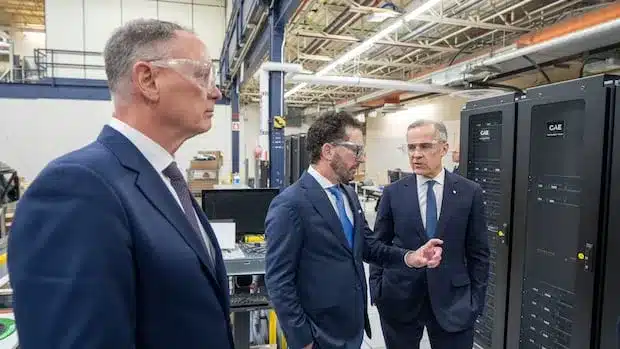
Canada’s freshly unveiled defense industrial strategy adopts a ‘build, partner, buy’ philosophy. It prioritizes domestic manufacturers, then partnerships with allies to attract investment and technology, resorting to foreign purchases only as a last option. Prime Minister Mark Carney emphasized: “Only after exhausting these options will we buy from abroad.” The plan targets 70 percent of federal defense contracts to Canadian firms within a decade.
Carney addressed potential tensions from Trump’s order, stating Canada can develop alongside the U.S. rather than compete. “We are very confident in our ability to grow our defence capabilities,” he said. “I’m going to use the term complementary as opposed to competition, but complementary to American supply.” The U.S. embassy in Ottawa offered no comment on differences in approach toward Canada versus the EU.
Canada’s defense sector features 12 Original Equipment Manufacturers (OEMs), including General Dynamics Land Systems-Canada, CAE Inc., General Dynamics Mission Systems-Canada, General Dynamics Ordnance and Tactical Systems-Canada, MDA Space, Bell Textron Canada, Bombardier, Irving Shipbuilding, Seaspan Shipyards, L3Harris Wescam, Lockheed Martin Canada, IMP Aerospace & Defence, and Roshel. Many are subsidiaries of U.S. firms or produce components for American products, raising questions about shifting from a ‘branch plant’ model to a robust economic driver.
Allied Models for Defense Growth
South Korea exemplifies using defense procurement as an industrial engine through its Defense Acquisition Program Administration (DAPA), which handles requirements, development, exports, and growth. Secretary of State for Defence Procurement Stephen Fuhr noted its sophistication surpasses Canada’s current efforts.
Major contractors like Hanwha, Korea Aerospace Industries, and Hyundai’s defense units operate commercially under state guidance. Defence Procurement Minister Seok Jong Gun explained: “When the military decides to acquire it, we do it. The decision-making process is very fast.” This approach turns domestic needs into export successes, including advanced submarines competing globally.
Sweden employs a hybrid model with publicly traded Saab leading the sector. The Swedish Defence Materiel Administration (FMV) collaborates on long-term planning, while strict export controls via the Inspectorate of Strategic Products ensure governance without direct state ownership.