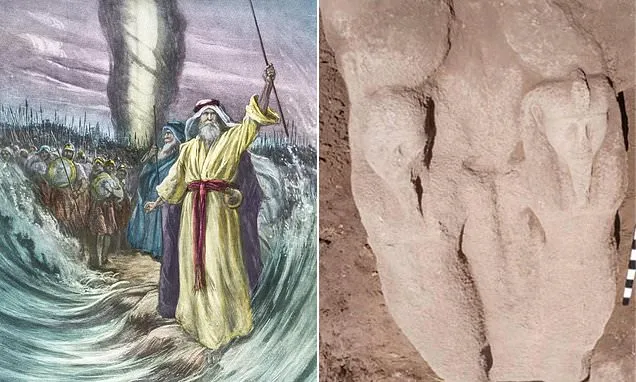
Archaeologists excavate a massive fragment of an ancient pharaoh’s statue from Egypt’s Nile Delta, identifying it as Ramesses II, the ruler many scholars connect to the biblical Pharaoh in the Book of Exodus.
Details of the Discovery
Excavation teams uncover the statue’s legs and base at Tel Faraoun in the eastern Nile Delta. Officials with the Supreme Council of Antiquities report the piece measures about seven feet tall and weighs five to six tons. Despite erosion, surviving details match royal sculptures from Egypt’s New Kingdom era, spanning 1550 to 1070 BC.
Researchers determine the statue likely originated elsewhere, possibly transported from Pi-Ramesses, Ramesses II’s grand capital in the Delta. Experts suggest it later moved to Tel Faraoun, ancient Emet, for reuse in a temple complex.
Ramesses II and Biblical Ties
Ramesses II reigns from 1279 to 1213 BC, commanding a 100,000-strong army with renowned military prowess. Scholars frequently link him to Exodus due to biblical references in Exodus 1:11 to Hebrew slaves building ‘Raamses,’ aligning with Pi-Ramesses constructed in the 13th century BC.
While the Bible omits the Pharaoh’s name, this geographic match, his extended rule, and 19th Dynasty timing position him as a prime candidate. Officials note the fragment may belong to a larger group portraying the king with deities, akin to ceremonial triads in temple art.
Ongoing Analysis and Debate
Further examination of stone composition, carving styles, and inscriptions aims to confirm origins and relocation history. Historians debate the Exodus Pharaoh’s identity, with no definitive archaeological proof. Geographic overlaps bolster Ramesses II’s association, though interpretations vary.
Recent Related Finds
In 2024, another team discovers a 3,000-year-old bronze sword bearing Ramesses II’s markings at a military fort in Housh Eissa, south of Alexandria. The site, Tell Al-Abqain, includes barracks and storage for supplies.
Elizabeth Frood, an Oxford University Egyptologist, states: ‘An object to bear the cartouches of Rameses II would suggest to me that it belonged to someone of relatively high rank. To be able to display such an object, even though it would have been presumably in a scabbard, was a marker of status and prestige.’
Experts clarify the sword likely equipped a high-ranking soldier, not the king himself.