AI Transforms Understanding of US Winter Weather Patterns
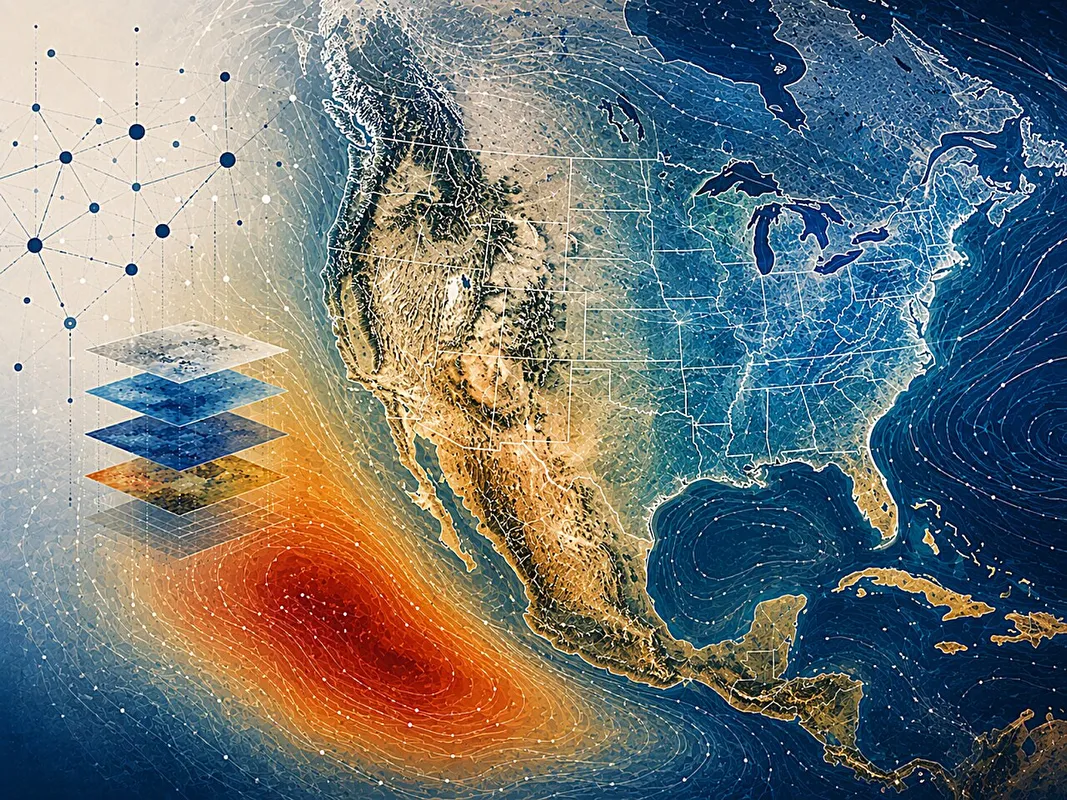
Advanced artificial intelligence systems now illuminate the ical forces behind winter precipitation across the United States. Researchers led by Antonios Mamalakis from the University of Virginia School of Data Science and Department of Environmental Sciences employ deep learning and explainable AI (XAI) to pinpoint climate patterns that drive seasonal forecasts. These insights promise better preparation for droughts, floods, wildfires, and water shortages, especially in southern regions where predictability stands out.
Explainable AI Builds Trust in Climate Predictions
Prediction accuracy alone falls short; trust in the underlying reasons matters most. “We want to know whether or not the AI model we have trained predicts correctly for the right reasons,” Mamalakis stated. Explainable AI opens the black box of these systems, ensuring decisions stem from meaningful climate signals rather than statistical shortcuts.
In high-stakes scenarios like hurricane forecasting, models must avoid flaws that fail under new conditions. “If a new event falls outside the distribution of events the model was trained on, those shortcuts will not apply anymore, and the model can derive significantly wrong predictions,” Mamalakis explained. Evaluations now demand ical relevance alongside accuracy.
Southern US Shows Stronger Winter Precipitation Predictability
Southern states, particularly the Southeast and Gulf Coast including Florida, Georgia, the Carolinas, and Virginia, exhibit superior forecasting skills for winter rains. This aligns with established links to El Niño and La Niña events in the tropical Pacific.
“The signal of El Niño and La Niña events is much stronger over the southern U.S.,” Mamalakis noted. “For example, during El Niño years, the jet stream tends to intensify and shift to the south, bringing more winter storms and wetter conditions.” AI models consistently highlight the tropical Pacific as the primary driver, with additional influences from the tropical Atlantic Ocean.
Meta Consensus Validates AI’s Scientific Insights
Diverse AI systems converge on shared conclusions, a phenomenon termed “meta consensus.” “If the models agree about what they agree on and where they disagree, that’s a good indicator they have learned something ical,” Mamalakis said. Strongest alignment occurs during pronounced El Niño and La Niña periods, signaling robust ical learning.
This approach elevates AI from a mere forecasting tool to a driver of scientific discovery.
Balancing AI’s Promise with Sustainability Challenges
AI accelerates climate knowledge but raises environmental concerns. “On the one hand, AI can help accelerate science and help us gain new knowledge,” Mamalakis observed. “On the other hand, at large scales, especially in massive data centers, it can require ridiculous amounts of energy.”
This “sustainability paradox” pits benefits against the energy demands of expansive data centers. Smaller, local models mitigate issues for now, yet scaling demands careful management. Reliable long-range forecasts could optimize water use, mitigate floods and droughts, and enhance responses to extremes.