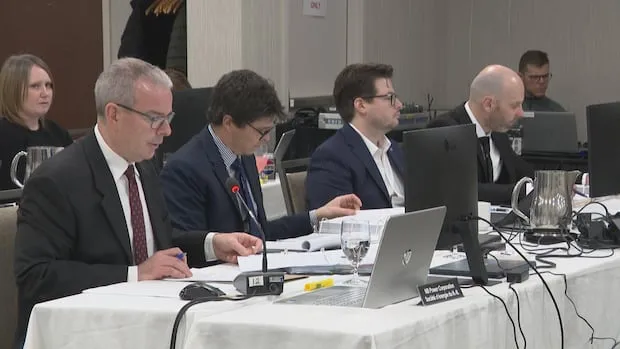
Regulatory hearings for New Brunswick Power’s proposed Tantramar gas and diesel plant advanced significantly when an expert witness opposed the project before the Energy and Utilities Board. Toby Couture, a battery and renewable energy specialist hired by the Conservation Council of New Brunswick, presented evidence favoring renewables supported by battery storage over the utility’s gas-and-diesel proposal to meet power capacity demands.
Challenge to Expert’s Credibility Fails
Before Couture testified, New Brunswick Power lawyer John Furey argued for about an hour to disqualify both the expert and his evidence. Furey questioned Couture’s objectivity, citing a 2007 paper he co-authored with New Brunswick Green Party Leader David Coon. The paper linked global climate goals to energy transitions and urged reduced reliance on fossil fuels.
Couture did not fully endorse those dated statements but recalled a quote from former Saudi Arabian oil minister Sheikh Zaki Yamani: “The Stone Age didn’t end because we ran out of stones.”
“It ended because we developed better ways of doing things,” Couture stated during the hearing from his home in Germany. “Technological change is really what drives the market forward, and in this case, we are in the midst of a technological revolution.”
Furey alleged Couture selectively used data to support his stance, pointing to inconsistencies in the 35-page evidence submission. Conservation Council lawyer Kostantina Northrup countered that no deliberate evidence manipulation occurred and noted similar unintentional errors in prior testimony. She argued such issues influence evidence weight, not admissibility.
The board sided with Northrup, accepting Couture’s evidence for review.
Debate Centers on Battery Capacity Factors
During cross-examination, Couture challenged New Brunswick Power’s claim that a 1,000-megawatt battery would be needed for 400 megawatts of reliable capacity. He contended this miscalculated batteries’ “effective load carrying capacity,” or dependable output.
Battery systems do not contribute their full rated capacity to these calculations. New Brunswick Power applies a 40% capacity factor, requiring a 1,000-megawatt battery for 400 megawatts of effective capacity. Couture advocated starting at 80%, which decreases as more storage is added. With minimal existing utility-scale batteries, he estimated the first 500 megawatts would deliver 400 megawatts of effective capacity.
Energy and Utilities Board Chair Christopher Stewart and member Kenneth McCullough sought further clarification on this key point.
Cross-examination of remaining expert witnesses, including those from the public intervener, continues into Friday. Final arguments await a future date.