

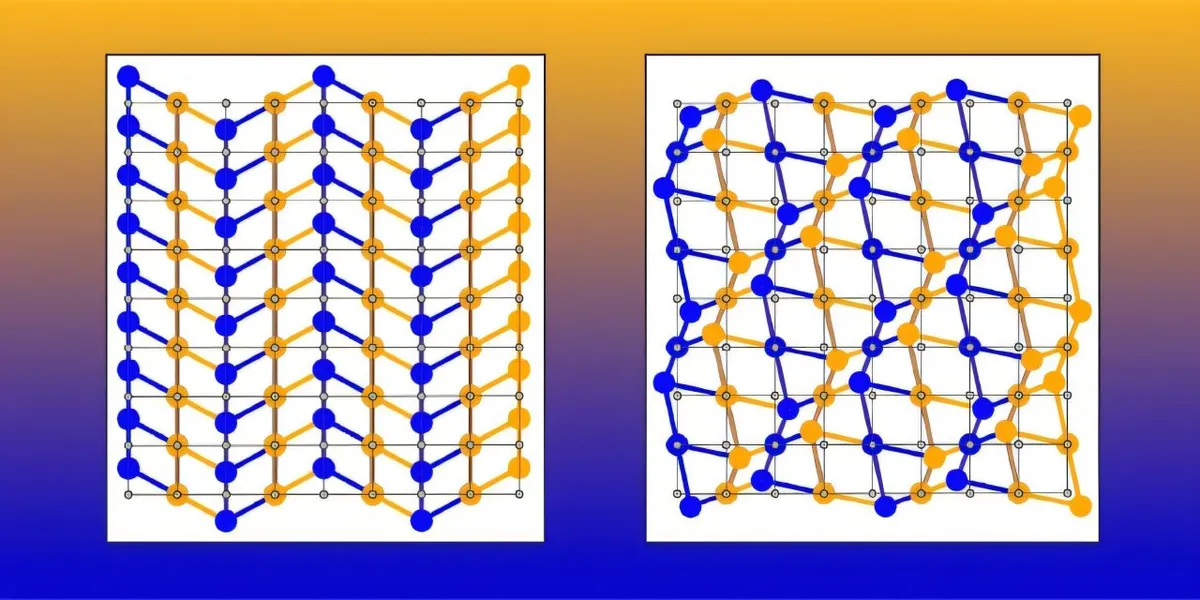
Electronic nematicity emerges in certain crystalline solids when electrons’ collective properties, like charge or spin densities, form ordered patterns that break the crystal’s rotational symmetry. This phase spans diverse materials and drives key phenomena such as unconventional superconductivity and magnetism.
The Nematicity Paradox
Experiments reveal a striking contradiction: nematic materials display clear order at large scales but appear disordered at microscopic levels. Patches of order coexist with vast disordered regions, raising the question of how macroscopic nematicity arises from microscopic chaos.
Linking Nematicity and Elasticity
Joe Meese, a postdoctoral research associate at the University of Illinois Urbana-Champaign, and Professor Rafael Fernandes developed a novel model that integrates overlooked elasticity effects. Their approach, termed nematoelasticity, shows how a crystal’s elastic response selectively couples to specific nematic modes.
Meese explains, “When electrons develop long-wavelength nematicity, it mimics elastic strain, compressing one axis while stretching another.” This coupling influences nematic fluctuations directionally.
Symmetry Breaking in Action
In square atomic lattices, electrons break fourfold rotational symmetry to twofold, resembling a rectangle. Observable effects include anisotropic electrical resistance along different directions.
First proposed in a 1998 paper co-authored by Illinois ics Professor Eduardo Fradkin, nematicity appears in two-dimensional electron gases, topological insulators, twisted bilayer graphene, and high-temperature superconductors.
Macroscopic Order, Microscopic Inhomogeneity
Meese notes, “At largest scales, nematic order emerges as temperature drops. Yet microscopically, nematicity proves inhomogeneous.” Defects like misaligned atoms or vacancies introduce strains that disrupt order.
The Helical Basis Revolution
Traditional order parameters use a d-orbital-like basis, complicating elasticity integration via compatibility relations (CRs)—equations ensuring strain consistency without cracking.
The researchers introduced a helical basis, momentum-adaptive with five parameters akin to longitudinal and transverse phonons. Fernandes states, “This basis satisfies CRs automatically, simplifying analysis.”
CRs divide modes into compatible (low-energy, defect-resistant) and incompatible (high-energy, disorder-linked). Elasticity boosts compatible modes for long-range order while suppressing incompatible ones, shielding macro scales from defects.
Resolving the Puzzle
This selective coupling explains the paradox: defects induce microscopic disorder but elasticity protects compatible modes, enabling macroscopic nematicity. Direction-selective criticality persists even in isotropic crystals.
Broader Implications
The framework applies universally across crystals. Fernandes summarizes, “Nematoelasticity unifies these theories, revealing how lattice deformations alter electronic states.”
Future work explores nematoplasticity—plastic deformations from excessive strain—and nematic waves driving defect motion. Meese anticipates, “Disorder may become dynamic degrees of freedom tied to electronic correlations.”
Fernandes adds, “This tool reexamines nematicity’s role in superconductivity and quantum phase transitions, plus defect interactions.”









