


[ad_1]
A remarkably well-preserved Roman sarcophagus has been unearthed in Hungary’s capital, providing a uncommon window into the lifetime of the younger lady inside and the world she inhabited round 1,700 years in the past.
The sarcophagus was untouched by looters and sealed for hundreds of years. It was discovered with its stone lid mounted in place, secured by steel clamps and molten lead. When researchers rigorously lifted the lid, they uncovered a whole skeleton surrounded by dozens of artifacts.
“The peculiarity of the discovering is that it was a hermetically sealed sarcophagus. It was not disturbed beforehand, so it was intact,” stated Gabriella Fényes, the excavation’s lead archaeologist.
Archaeologists with the Budapest Historical past Museum found the limestone coffin throughout a large-scale excavation in Óbuda, a northern district of the town that when fashioned a part of Aquincum, a bustling Roman settlement on the Danube frontier.
The coffin lay among the many ruins of deserted homes in 1 / 4 of Aquincum vacated within the third century and later repurposed as a burial floor. Close by, researchers uncovered a Roman aqueduct and eight less complicated graves, however none approaching the richness or pristine situation of the sealed tomb.
Gabor Lakos, Budapest Historical past Museum by way of AP 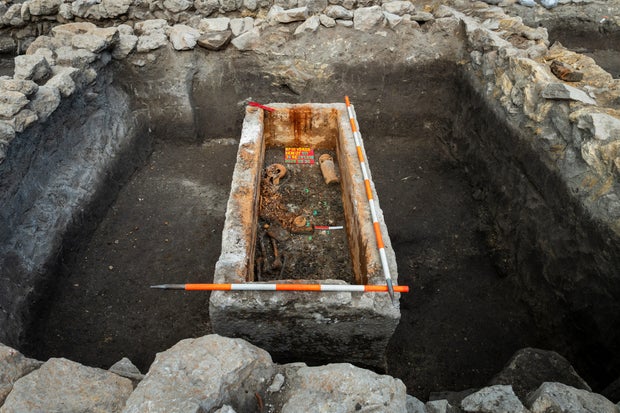
Preserving with Roman funerary customs, the sarcophagus held an array of objects: two utterly intact glass vessels, bronze figures and 140 cash. A bone hair pin, a chunk of amber jewellery and traces of gold-threaded material, together with the dimensions of the skeleton, level to the grave belonging to a younger lady.
The objects, Fényes stated, had been “gadgets given to the deceased by her relations for her everlasting journey.”
“The deceased was buried very rigorously by her relations. They should have actually cherished who they buried right here,” she stated.
Anthropologists at the moment are analyzing the younger lady’s stays, which is anticipated to disclose extra about her age, well being and origins. However even now, the grave’s placement and abundance of artifacts provide sturdy clues.
The sarcophagus and its contents “positively make it stand out,” stated Gergely Kostyál, a Roman-period specialist and coleader of the mission. “This most likely signifies that the deceased was well-to-do or of a better social standing.”
Gabor Lakos, Budapest Historical past Museum by way of AP 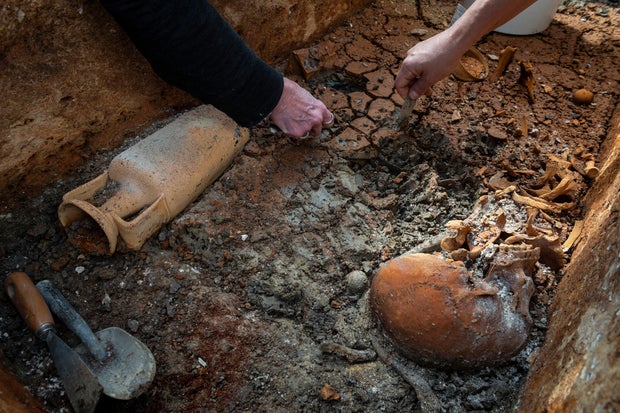
“It’s really uncommon to discover a sarcophagus like this, untouched and by no means used earlier than, as a result of within the fourth century it was widespread to reuse earlier sarcophagi,” he added. “It’s fairly clear that this sarcophagus was made particularly for the deceased.”
Excavators additionally eliminated a layer of mud roughly 4 centimeters, or 1.5 inches, thick from contained in the coffin that Fényes hoped may include extra treasures.
Photos confirmed golden jewellery discovered on the web site, in addition to a glass flask, a glass jar and different intact gadgets after they had been collected. Photographs additionally confirmed archaeologists analyzing the cranium of the girl, alongside different stays. Different footage confirmed staff lifting the lid of the sarcophagus utilizing heavy equipment, after securing it.
Gabor Lakos, Budapest Historical past Museum by way of AP 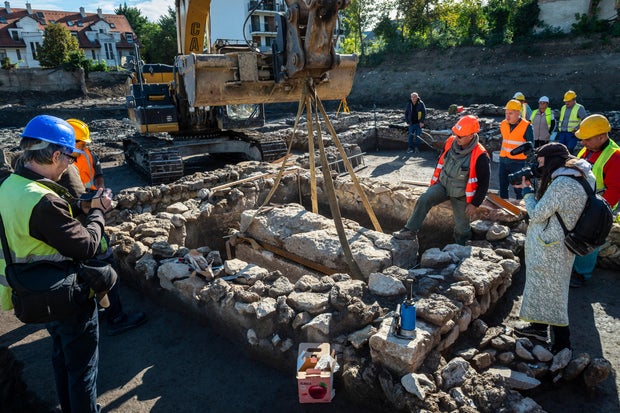
For Fényes, the invention of the Roman sarcophagus is just not solely of scientific significance, however an emotionally resonant perception into the devotion displayed by individuals in an historical time.
“I used to be very touched by the care and expression of affection that we had been capable of get a glimpse of,” she stated. “Even now, I shudder to assume how painful it should have been for the individuals at the moment to bury this younger girl.”
Bela Szandelszky/AP 
[ad_2]









