

[ad_1]

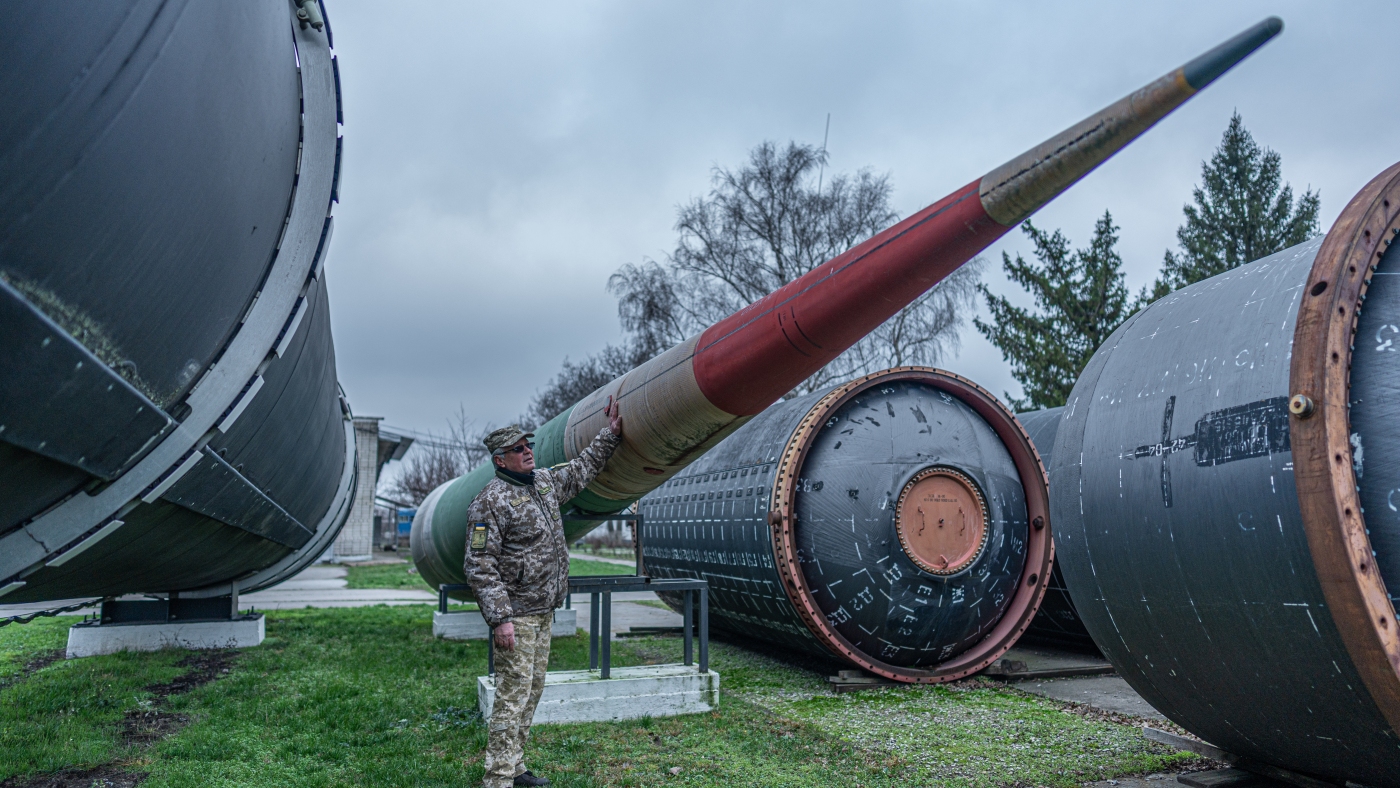
Hennadiy Vladimirovitch Fil, 65, former deputy commander of the Soviet Union’s 309th Missile Regiment, stands close to an outdated Soviet air protection missile on the Museum of the Strategic Missile Forces, the place he’s now a information, on Dec. 5.
Anton Shtuka for NPR
cover caption
toggle caption
Anton Shtuka for NPR
POBUZKE, Ukraine — In the course of huge farm fields in southern Ukraine, you will discover what was as soon as a secret Soviet intercontinental ballistic missile launch web site. As we speak it is the Museum of Strategic Missile Forces.
Apart from chronicling the Chilly Conflict arms race between the Soviet Union and United States, the museum tells the story of how Ukraine dismantled its nuclear weapons arsenal — with assurances from the U.S., Britain and Russia that its sovereignty can be revered — shortly after changing into an unbiased nation in 1991.
As we speak most Ukrainians consider that call to surrender nukes was a fateful mistake. For them, this museum is a bitter reminder of what they are saying was their “naivety” and “betrayal.”
On this chilly, blustery December day, there aren’t many guests, however Ihor Volodin and Inna Kravchuk have come from the neighboring Cherkasy area.
“I believe it is part of our historical past and it is essential to learn about it,” says Kravchuk. However she says it additionally makes her indignant: “If we had stored these weapons, most likely Russia wouldn’t have attacked. The nuclear weapons have been our insurance coverage.”

Ihor Volodin, 31, a latest customer on the museum, is a Nationwide Guard service member who additionally designs 3D-printable radio-controlled tanks.
Anton Shtuka for NPR
cover caption
toggle caption
Anton Shtuka for NPR
Hennadiy Vladimirovitch Fil, a 65-year-old information, as soon as served as a lieutenant colonel within the elite rocket forces right here. He attributes his youthful complexion to on a regular basis he spent in an underground silo on the web site.
Fil says hardly anybody of a sure age leaves the museum with out cursing.
However earlier than that betrayal, there have been 4 many years of the Chilly Conflict arms race, and this museum plunges guests deep into that period on the Soviet aspect. Black-and-white portraits of Soviet commanders sporting stern seems to be and chests filled with medals stare down from the partitions, whereas outdated rotary telephones and antiquated Sixties management panels assist re-create the gloomy ambiance of the epoch. The place is without delay creepy, fascinating and at occasions overwhelming with element.
Fil makes use of an extended pointer to spotlight wall maps and charts that chronicle the arms race and deliberate mutual destruction between the U.S. and USSR. He says the ten intercontinental ballistic missiles as soon as primarily based right here may have reached the U.S. East Coast inside 25 minutes of launch. Every may carry 10 nuclear warheads with a destruction capability of 200,000 sq. kilometers or 77,000 sq. miles — roughly the world of Nebraska.

Hennadiy Vladimirovitch Fil reveals launch web site places on a map on the Museum of the Strategic Missile Forces.
Anton Shtuka for NPR
cover caption
toggle caption
Anton Shtuka for NPR
When the united states broke aside in 1991, Ukraine was left with the world’s third-largest nuclear arsenal, after the U.S. and Russia. In January 1994, then-President Invoice Clinton stopped over in Kyiv on his method to Moscow, for talks with Ukraine’s first democratically elected president, Leonid Kravchuk. Later that 12 months, a deal was reached for Ukraine to surrender its nuclear weapons.
That settlement, referred to as the Budapest Memorandum, was signed in Hungary by Ukraine, Russia, the U.S. and Britain. Ukraine’s three co-signers promised its territorial integrity can be revered.
A newsreel enjoying within the museum reveals how Ukraine’s nuclear missiles have been destroyed within the mid-Nineties. Jets able to carrying nuclear warheads have been additionally dismantled. The ten silos that after held missiles have been crammed with concrete — besides one which has been stored as an exhibit on the museum grounds, the place guests can see the huge, decommissioned missile nesting inside a silo.

Higher part of an intercontinental ballistic missile launch silo of the 309th Missile Regiment on the Museum of the Strategic Missile Forces.
Anton Shtuka for NPR
cover caption
toggle caption
Anton Shtuka for NPR
There may be additionally an unlimited show of {hardware} from totally different Soviet and Russian wars: World Conflict II, Afghanistan within the Nineteen Eighties, and destroyed Russian tanks from the present Ukraine warfare. There may be additionally one of many missiles the Soviets pointed on the U.S. from Cuba through the 1962 Cuban Missile Disaster — recognized right here because the “Caribbean Disaster.”
Fil notes bitterly that Ukraine additionally ended up giving a number of jets to Russia in cost for pure gasoline money owed a couple of years later.
“Now,” he says, “Russia is bombing us with our personal planes.”
Denmark’s Ambassador to Kyiv Thomas Lund-Sorensen can be visiting the museum on at the present time. He says whereas decreasing the variety of international locations holding nuclear weapons is at all times a constructive factor, he agrees that what occurred to Ukraine was “a shame.”
“They gave them up with the guarantees of the three powers, and clearly the ensures given from Russia on the time weren’t definitely worth the paper they have been written on,” says Lund-Sorensen.

Soviet missile launching automobiles of the previous 309th Missile Regiment on the museum grounds.
Anton Shtuka for NPR
cover caption
toggle caption
Anton Shtuka for NPR
Even Clinton has expressed his remorse in regards to the Budapest Memorandum. In an interview with Irish broadcaster RTE within the 12 months following Russia’s 2022 full-scale invasion of Ukraine, Clinton mentioned, “I really feel horrible about it… and I really feel a private stake as a result of I received them to agree to surrender their nuclear weapons. And none of them consider that Russia would have pulled this stunt if Ukraine nonetheless had their weapons.”
This museum is a painful reminder of what occurred, and underlines why Ukraine insists that ironclad safety ensures be a part of any peace take care of Russia right this moment.
Fil takes guests alongside an underground hall the size of two soccer fields earlier than opening a door weighing 2,000 kilos, which results in a tiny elevator.
The NPR group crams in to descend 150 ft in an underground silo. The doorways open to a tiny residing area with three slab bunks, a rest room, a hotplate and off, strange-smelling air. Fil says that is the place a launch crew may dwell for as much as 45 days in case of a nuclear warfare. A wall ladder by means of a gap within the ceiling results in a launch room above.

Hennadiy Vladimirovitch Fil, a information on the museum, sits contained in the protected command submit 140 ft underground on the backside of a missile silo.
Anton Shtuka for NPR
cover caption
toggle caption
Anton Shtuka for NPR
We climb by means of. After seating us within the two high commander seats – that are bolted to the ground and have harnesses to strap you in (Fil says a direct nuclear hit from America would have triggered an explosion equal to an earthquake measuring 12 factors on the Richter scale) – Fil flips a change. The traditional-looking management board lights up. He locations our arms on a button and a key for a simulation of a nuclear missile launch.
It takes two folks making two gestures to launch the missiles. As he offers the launch order, we press the button and switch the important thing. A loud alarm begins to sound. On a display above, we watch a simulation of the ballistic missiles rising from their silos and launching one after the other in a ball of fireside.

Hennadiy Vladimirovitch Fil pushes the launch button on the management panel inside what was the protected command submit of the central place.
Anton Shtuka for NPR
cover caption
toggle caption
Anton Shtuka for NPR
Regardless of Russia’s latest threats, Fil says he does not consider Russian President Vladimir Putin would dare use a nuclear weapon.
“They’re too unpredictable,” he says. He provides that Russia additionally is aware of it might face harsh penalties for such an act.
We watch the missiles within the simulation journey by means of area. Quickly they start hitting their targets.
The view from area on our display reveals mushroom clouds blossoming throughout the planet and a narrator describes a series response depleting all oxygen from the ambiance and thus ending life on our planet.
Fil says he is grateful it by no means got here to that. However he nonetheless regrets that Ukraine gave up its nuclear deterrence.

Museum guests can watch a visualization of a nuclear strike and see what would have occurred if there had been a nuclear missile launch.
Anton Shtuka for NPR
cover caption
toggle caption
Anton Shtuka for NPR
[ad_2]









