[ad_1]

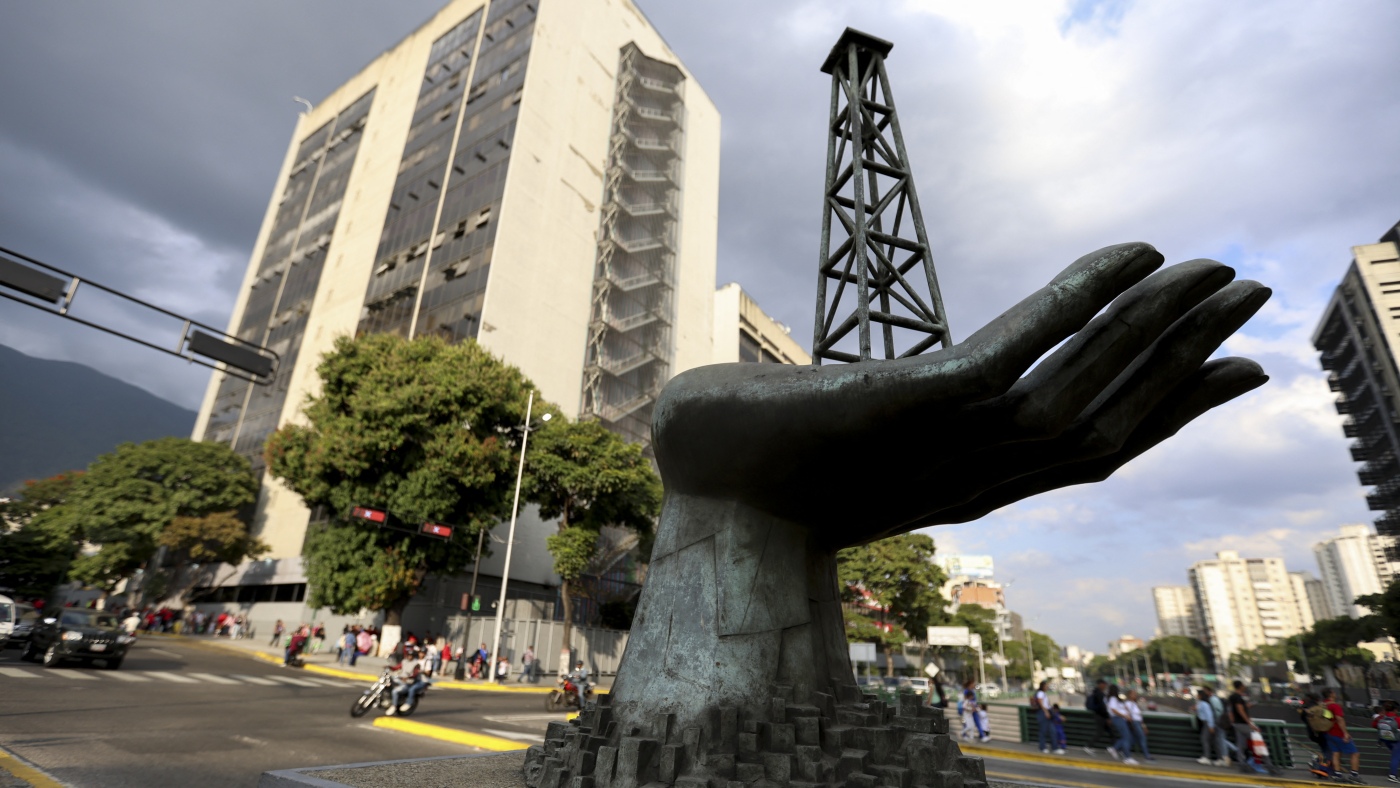
A sculpture of a hand holding an oil drilling rig stands outdoors the state-run oil firm Petroleos de Venezuela S.A. (PDVSA) in Caracas, Venezuela, on February 26, 2025. Within the background are a avenue and a tall constructing.
Pedro Mattey/AFP by way of Getty Photographs
conceal caption
toggle caption
Pedro Mattey/AFP by way of Getty Photographs
President Trump has made no secret that he needs U.S. oil firms to revenue off his removing of Venezuelan President Nicolás Maduro by investing in rebuilding Venezuela’s oil infrastructure and sharing within the cash that might observe.

Late Tuesday, he posted on Reality Social that Venezuelan authorities will flip over to the U.S. between 30 million and 50 million barrels of sanctioned oil, which is able to then be offered at market value, with the proceeds managed by Trump.
However seizing present oil manufacturing is one factor; overhauling Venezuela’s whole oil trade can be one other.
Impartial analysis agency Rystad Power has estimated it might take $183 billion over greater than a decade to revive Venezuelan oil manufacturing again to a Nineteen Nineties-era stage, greater than tripling it from its present fee of lower than 1 million barrels a day.
And corporations is perhaps hesitant to hurry in — or, relatively, rush again in. Chevron is the one U.S. oil firm nonetheless working in Venezuela; ExxonMobil and ConocoPhillips left after the Venezuelan authorities forcibly renegotiated contracts round 2007, which price them billions of {dollars}. Worldwide courts have ordered Venezuela to reimburse Exxon and Conoco, a invoice that is still principally unpaid.
Venezuela’s once-thriving oil fields are stricken by energy cuts, corroded pipelines and stolen gear. However most of all, says Kevin Guide, the managing director of unbiased analysis agency ClearView Power Companions, “it is not only a geologic drawback or an engineering drawback, however a math drawback.” Particularly, this math drawback: Can firms make a revenue off the large investments required to spice up manufacturing?
For now, the most important oil firms haven’t publicly indicated what they’re planning on doing, and so they declined to remark for this story.
However analysts say the businesses should consider whether or not the political scenario in Venezuela will stabilize sufficient that they’d as soon as once more be prepared to commit billions of {dollars} to long-term tasks.
An oil glut and low costs
One large issue within the math drawback is that proper now, the world is making extra oil than it wants. By some calculations, the oversupply is roughly 2 million barrels per day, twice Venezuela’s complete present every day manufacturing.
“If that seems like lots,” Guide says, “it’s.”
And since the world has extra oil provide than demand, world crude costs are fairly low; the worldwide benchmark is a bit of over $60 per barrel.
In the meantime, the breakeven value for tasks in Venezuela to show a revenue is extra like $80, in accordance with Claudio Galimberti, the chief economist for Rystad Power.
“These firms wouldn’t go there in the event that they know that the breakeven is $80 per barrel and that the prospects are for the subsequent two, three, 4 years, oil costs keep between $60 and $70 per barrel,” Galimberti says. “They will not do it, as a result of it is unnecessary.”
Corporations have been selective with their investments lately, specializing in ones which can be more likely to be worthwhile. That may appear apparent, but it surely hasn’t at all times been the case. About 15 years in the past, when new expertise like fracking unlocked the oil in shale formations within the U.S., firms went a bit of wild.
“The go-go days of shale tended to be a ‘drill first and work out the maths later’ time within the oil trade’s historical past,” says Guide. “And it did not go that properly for most of the firms that produced first and requested questions later.”
Proper now, firms are asking the questions first.
That does not imply they will not make investments. However Galimberti thinks they may require important incentives — subsidies — from both Caracas or Washington, in addition to proof of political stability.
Heavy, viscous crude
One other variable in that math drawback: The kind of crude oil that’s plentiful in Venezuela is form of gnarly.
“It is likely one of the heaviest and one of many dirtiest crudes that yow will discover,” Galimberti says.
Heavy crude is thick and sticky. It is harder, and due to this fact costly, to extract, transport and refine. Producing it additionally releases extra planet-warming gases than other forms of crude, making it worse for the local weather.

That is an environmental mark towards Venezuelan crude. And it poses some logistical issues, like the necessity to import substances to dilute the crude sufficient for it to move via pipelines.
However economically, it is not as large of a problem as you may suppose — it’d even give firms an incentive to pursue it.
That is as a result of U.S. refineries alongside the Gulf Coast are completely positioned to course of this tough oil.
Many years in the past, these refineries invested in costly expertise for refining it, due to their geographic proximity to Venezuela, Mexico and Canada — all sources of heavy crude.
Then the shale revolution occurred, and the U.S. was flooded with gentle, candy crude that does not require this expertise.
Right this moment, in accordance with the American Gas & Petrochemical Producers commerce group, 70% of U.S. refining capability is optimized for heavy crude — whereas the overwhelming majority of U.S. manufacturing is gentle crude.
So a few of that fancy expertise goes to waste. If the scenario in Venezuela stabilizes and oil firms do transfer in and increase manufacturing, Galimberti says, U.S. refineries can be properly positioned to totally make the most of their present gear and earn more money.
A watch to the longer term
Then, after all, firms have to think about the lengthy sport. There’s an oil glut immediately. However what occurs subsequent?

Oil demand could sink over time, relying on elements like gross sales of electrical automobiles and whether or not China — one of many largest world sources of vitality demand — transitions to renewables.
However then once more, perhaps the world will keep hungry for oil. And both approach, firms might want to make up for declining output from present, growing old wells — which implies drilling new ones.
And there aren’t many locations on the earth with as a lot oil potential as Venezuela.
[ad_2]