[ad_1]

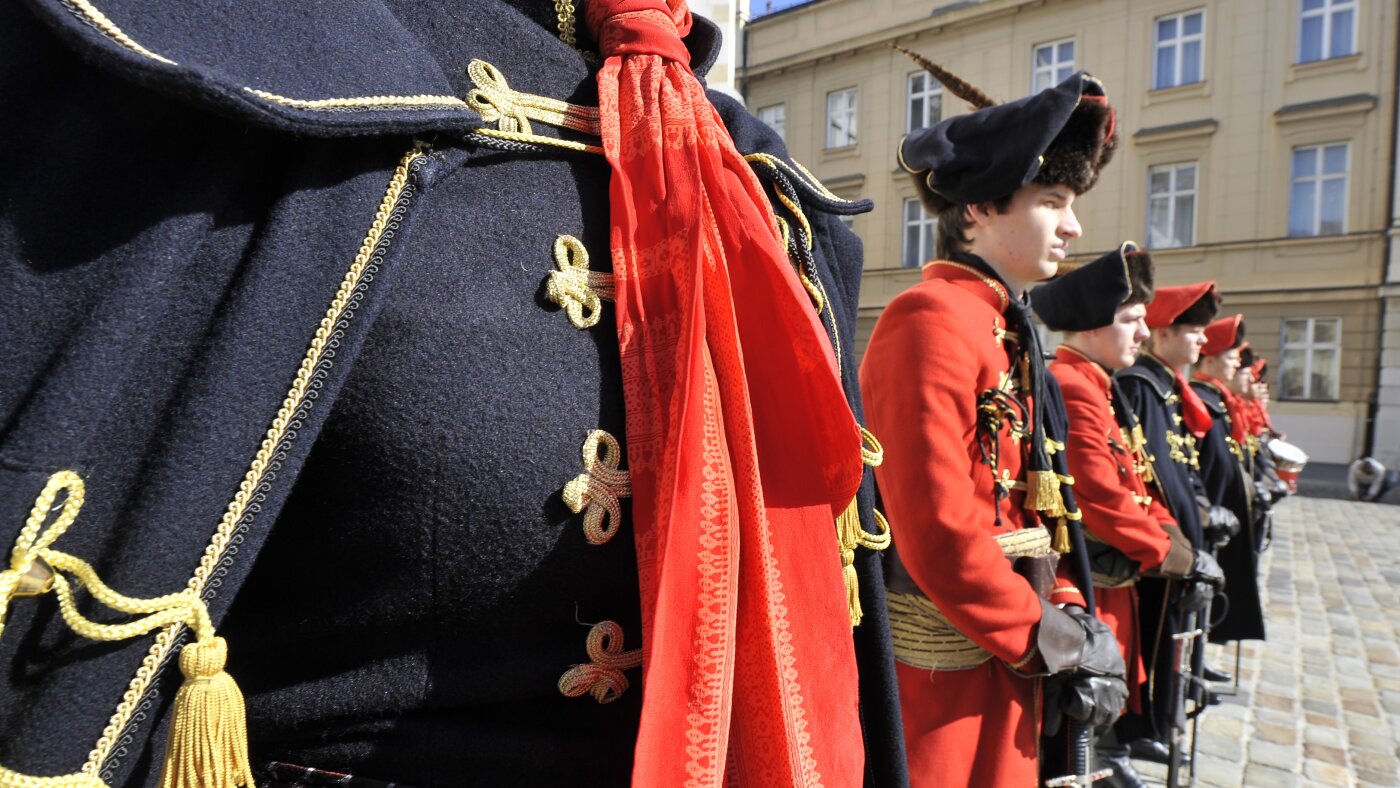
Males wearing conventional seventeenth century uniform line up throughout a ceremony marking the “Cravat Day” in central Zagreb on October 18, 2011.
Hrvoje Polan/AFP through Getty Photos
conceal caption
toggle caption
Hrvoje Polan/AFP through Getty Photos
For a lot of within the enterprise world, a return to work after the winter break will imply as soon as once more donning the dreaded go well with and tie. The company neckwear is the on a regular basis counterpart to the historically extra luxurious cravat – a voluminous neckscarf that conjures up pictures of opulent dinners aboard a yacht crusing by the Mediterranean.
President Abraham Lincoln wore cravats, as did Hollywood actor Cary Grant and the extravagant entertainer Liberace. In newer instances, the garment has been popularized within the American mainstream by the likes of Madonna and the late Diane Keaton.

American pianist Liberace (Władziu Valentino Liberace, 1919-1987), waves as he descends the steps of his airplane on a go to to Britain, London Airport, March thirtieth, 1960.
Night Commonplace/Getty Photos/Hulton Archive
conceal caption
toggle caption
Night Commonplace/Getty Photos/Hulton Archive
On this installment of NPR’s “Phrase of the Week” collection we hint the origins of the “cravat” (borrowed from the French “cravate”) again to the battlefields of seventeenth century Europe and discover its hyperlinks to the fashionable day necktie, patented in New York greater than 100 years in the past.
“Scarves worn across the neck existed lengthy earlier than, however the story of the cravat really begins within the Thirty Years’ Conflict when it first gained wider European recognition,” explains Filip Hren, a army historian on the Croatian Catholic College in Zagreb.
Hren is referring to the 1618-48 battle fought between Catholics and Protestants and generally known as Europe’s final non secular battle.
The phrase “cravate” first appeared within the French language to explain army apparel worn by Croatian mercenaries who have been famend amongst their enemies for his or her brutal preventing prowess.
“The Swedish king stated they’re the brand new tribe of the satan,” says Hren.
The “swift, quick and lethal” Croats, who entered the battle in service of the Holy Roman Empire, wore distinctive crimson scarves round their necks. Manufactured from silk or cotton, the material is alleged to have been used to guard their faces in opposition to chilly climate and smoke in battle, and to deal with accidents.
“Wounded troopers may use the headband as a bandage, however it additionally had symbolic that means,” says Vladimir Brnardić, a historian and journalist who has written extensively about Croatian army historical past.
“There are legends that younger ladies and the wives of troopers tied the headband across the necks of their beloved to point out their belief and love for them, and to indicate that they’d be ready for them once they return,” he provides.
The French military observed the Croats’ preventing abilities – and their trend sense – recruiting many into elite cavalry regiments that might turn out to be generally known as the Royal Cravates.

Circa 1661, King Louis XIV of France, (1638 – 1715), king of France from 1643. He was generally known as ‘The Solar King’.
Getty Photos/Hulton Archive
conceal caption
toggle caption
Getty Photos/Hulton Archive
“The scarves took their names from Croats. It was tied in a Croatian method, or in French – a la Croate,” explains Filip Hren.
King Louis XIV launched the cravat into French trend and from Paris it quickly unfold throughout Europe.
“King Louis XIV was significantly keen on the cravat and it is stated that his pages would convey cravats to him each morning. He was a task mannequin for the French the Aristocracy and for a lot of different European rulers as properly,” says Hren.

The earliest use of the English model “cravat,” based on the Oxford English Dictionary, was recorded in 1656 within the writing of English antiquary and lexicographer Thomas Blount.
Within the nineteenth century, the rise of bourgeois society within the Industrial Revolution noticed the arrival of the necktie. Historians say the accent turned a logo of professionalism and social self-discipline, “significantly in males’s clothes.” Within the twentieth century it entered enterprise, diplomatic and political tradition, and “turned a way of non-public expression.”
In French and lots of different European languages, the phrase for “necktie” nonetheless retains an etymological hyperlink to the phrases for “Croats”.
“Krawatte” in German. In Spanish, “corbata.” “Cravatta” in Italian and “gravata” in Greek.
The necktie as we all know it at present was patented in New York within the early Twenties by tailor Jesse Langsdorf.

U.S. actor Robert Downey Jr. attends the ‘Iron Man’ premiere at Warner Moderno Cinema on April 23, 2008 in Rome, Italy.
Elisabetta Villa/Getty Photos Europe
conceal caption
toggle caption
Elisabetta Villa/Getty Photos Europe
“Langsdorf created a revolution once we discuss neckties. He designed it in a manner that it retains its [form] and to not be delicate as a pure silk scarf,” says Igor Mladinović, co-founder of the Cravaticum Museum in Zagreb, which amongst its reveals hosts a “bulletproof” necktie made in Thailand and one other sewn from the pores and skin of a lifeless snake.

New patterns, colours and materials have outlined its evolution, typically reflecting new trend tendencies, social and financial change. Considerably so after the Second World Conflict when the invention of polyester material made neckties extra inexpensive to fabricate and purchase. The designs additionally turned brighter and extra colourful.
“The necktie has modified by way of materials and sample design, however the way in which it’s produced has remained unchanged for the final 100 years,” provides Mladinović.
Over time, the necktie has come to represent success, sophistication and standing, however has additionally been criticized by some as a logo of energy, management and oppression. In that manner, maybe, it echoes partially a few of the earliest seventeenth century origins of its ancestor, the cravat.
[ad_2]