

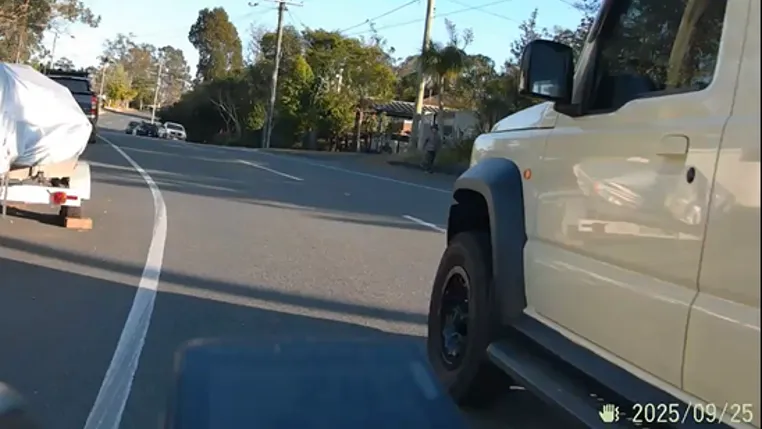
Michael Bradbrook rides to work along Chapel Hill Road just before 7 a.m. when a four-wheel drive speeds past, mere centimeters from his right arm. On this route—a shortcut avoiding busy sections of Moggill Road—drivers frequently disregard the one-meter minimum passing distance rule for bicycles and e-scooters, which marks its 10th anniversary this year.
“I knew this one was fast and close when I felt the wind on my left elbow and shoulder,” Bradbrook said. “I flinched but held my line, not wanting to deviate or cause myself to hit the parked cars on the left due to my own reaction. It’s not the first time, or the second, so I know that riding predictably is important for my safety.”
Queensland’s Minimum Passing Distance Rule
In Queensland, drivers must maintain at least one meter when overtaking cyclists or e-scooter riders in zones with speed limits of 60 km/h or less, and 1.5 meters in higher-speed areas. The rule became permanent in 2016 following a two-year trial prompted by several cyclist fatalities, including violinist Richard Pollett, killed by a truck on Moggill Road.
Despite cyclists submitting videos regularly, police issued only 36 fines for cyclist-related violations and two for e-scooters in the last financial year—numbers comparable to fines for bikes lacking brakes or bells.
Rider Experiences and Reporting Outcomes
A survey by Amy’s Foundation reveals that nearly every Queensland cyclist has encountered a close pass, with 54 percent experiencing it on most or every ride. Among those reporting to police, 78 percent provided video evidence. Of these, nearly one in three led to a fine, 21 percent to a warning, while 28 percent received no response and 10 percent were told no action was possible.
Katherine Bates from Amy’s Foundation, which pushed for the passing distance laws, emphasizes that physical separation offers the best safety for cyclists. On shared roads, she adds, enforcement must be consistent.
“Driver education matters too, particularly for newly licensed drivers who need to understand the law before they get behind the wheel,” Bates said. “While drivers broadly know the rules, what’s missing is consequence.”
Bates advocates adopting the Australian Capital Territory’s system, where riders submit videos and police issue fines and demerit points directly to vehicle owners after review.
“An officer still reviews the evidence, but the process is efficient, and it doesn’t require police to be on every road at the time of the incident,” she said. “Ultimately, this is about mutual respect on our roads—every cyclist is someone’s parent, partner, child.”
Calls for Awareness and Action
Bicycle Queensland chief executive Matthew Burke notes that members frequently raise concerns about drivers ignoring the rules, especially in regional areas.
“Drivers are beginning to ignore the minimum passing distance rules and get really close to cyclists again,” Burke said. “It’s been a decade now since the laws first came in. Queensland riders told us they wanted a ‘refresher’ advertising campaign to reinforce these messages and knowledge of the laws.”
Burke urges cyclists to use affordable clip-on cameras and report unsafe driving.
A Queensland Police spokeswoman reaffirms commitment to road safety for all users.
“We ask drivers to be on the lookout for cyclists and personal mobility devices, be patient and ensure to allow the minimum passing distance,” she said.
Research and Government Response
An evaluation by CARRS-Q of the initial trial found enforcement challenging due to narrow or winding roads and oncoming traffic. Western Australia research shows modest gains from similar laws and campaigns, with protected infrastructure proving more effective.
Queensland Transport and Main Roads promotes safety via the StreetSmarts program, reaching over 1.5 million users yearly through social media. Officials confirm continued promotion of the passing distance rule in 2026.









