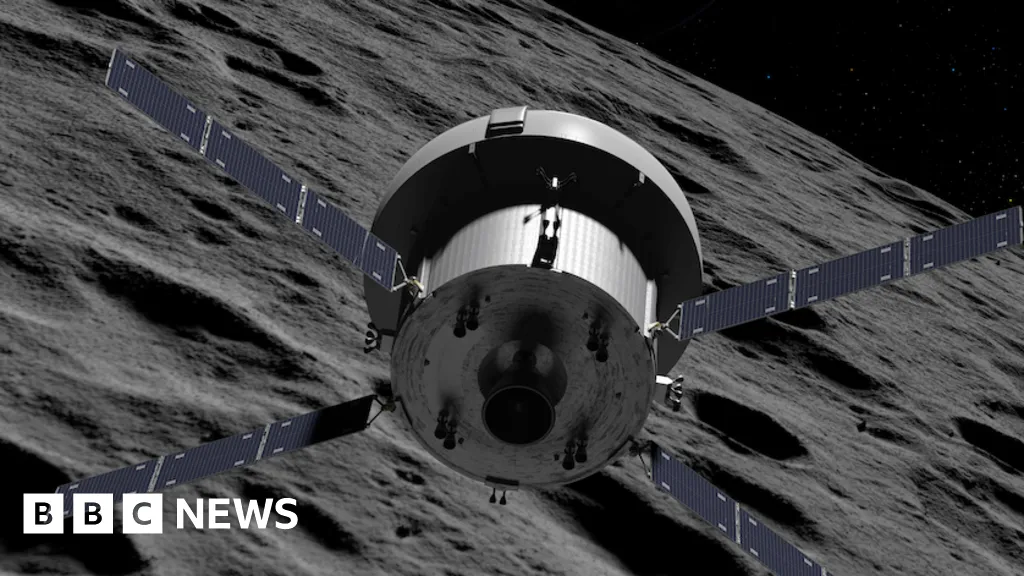
Four astronauts aboard NASA’s Artemis II mission are heading back to Earth following a successful lunar flyby that took them farther from the planet than any humans before. The crew experienced a planned 40-minute communication blackout while passing behind the Moon, then re-established contact.
Mission Milestones and Record-Breaking Distance
Astronaut Christina Koch expressed relief upon reconnection: “It’s so great to hear the Earth again.” The Orion spacecraft then approached within thousands of miles of the lunar surface, allowing the crew to observe a total solar eclipse from the Moon’s vantage point—the first such view for humans.
At approximately 13:56 EDT on Monday, Orion surpassed the Apollo 13 record of 248,655 miles (400,000 km) from Earth, marking the farthest human spaceflight. Canadian astronaut Jeremy Hansen reflected humbly: “As we surpass the furthest distance humans have ever traveled from planet Earth, we do so in honoring the extraordinary efforts and feats of our predecessors in human space exploration.”
Observing the Moon’s Far Side
As the Moon filled the windows, the astronauts documented the scene using digital cameras, sketches, and audio recordings. The spacecraft skirted the far side—never visible from Earth—offering the first human eyewitness views of certain craters and lava plains, previously imaged only by satellites.
Equipment included professional SLR cameras with wide-angle and zoom lenses, a mirrorless camera for human-like perspective, wing-mounted video cameras on solar arrays, and personal smartphones. The crew dimmed interior lights to minimize window glare and enhance visibility. NASA plans to release much of this imagery soon.
Scientific Value of Human Observation
Audio descriptions prove as valuable as images. NASA’s lunar science lead, Dr. Kelsey Young, noted that trained observers detect subtle colors, textures, and geological features up close. “Human eyes and brains are highly sensitive to subtle changes in color, texture, and other surface characteristics,” she explained.
Communications Blackout and Eclipse
The most tense moment occurred during the 40-minute signal loss behind the Moon. Pilot Victor Glover addressed Earth: “As we prepare to go out of radio communication, we’re still going to feel your love from Earth. And to all of you down there on Earth and around Earth, we love you, from the Moon. We will see you on the other side.”
Contact restored with Christina Koch’s evocative words: “We will explore. We will build ships. We will visit again. We will construct science outposts. We will drive rovers, we will do radio astronomy, we will found companies. We will bolster industry, we will inspire. But ultimately, we will always choose Earth. We will always choose each other.”
Starting around 20:35 UTC, the crew witnessed the solar eclipse, with the Moon revealing the Sun’s corona. Glover remarked: “It is amazing the brightness where the sunset is still bright and you still have a distinct Earth shine.”
Testing for Future Missions
This “Moon Day” tested Orion’s power, thermal systems, and performance without sunlight during the eclipse. As a precursor to landings—the first since 1972—sensors monitored rapid temperature shifts. Lunar gravity now propels the craft homeward.
Ahead lie routine checks, experiments, and a high-speed reentry at nearly 25,000 mph, culminating in a Pacific Ocean parachute splashdown to validate the heatshield and recovery systems.