

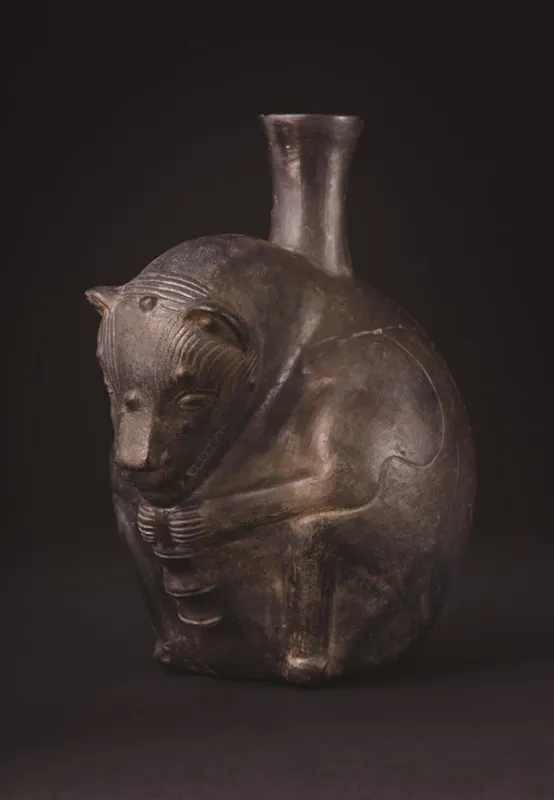
A groundbreaking study combining zooarchaeology and multi-isotopic analysis uncovers the diverse roles of dogs in the Wari Empire (ca. 600–1050 CE). Researchers have identified the first ical evidence of Peruvian Hairless Dogs at Castillo de Huarmey in northern Peru, revealing these animals likely received special treatment compared to other canines.
Dogs’ Significance in Wari Society
Dogs have long been integral to human communities since their domestication in the late Pleistocene. In pre-Columbian Andean societies, they functioned as hunters, guardians, ritual sacrifices, or scavengers. Castillo de Huarmey served as a key site in the Wari Empire, the first major polity spanning much of modern Peru during the Middle Horizon.
Prior knowledge of Wari interactions with animals remains limited, as Dr. Weronika Tomczyk, lead researcher, notes: “We actually did not know much about hairless dogs in the Wari Empire before.” Wari art focuses on abstract, hybridized religious and political symbols, often omitting common domesticated species except for Peruvian Hairless Dogs.
Analysis of Remains from Castillo de Huarmey
Scientists examined 341 dog bones from the site. Dr. Tomczyk explains: “Only some remains were found in undisturbed contexts, while most came from the fill disturbed by looters’ activity in the 1980s.” To avoid duplicating samples, the team selected based on spatial location, body size, and elements like mandibles or tibiae.
The remains represent at least 20 individuals of varying ages—from puppies to seniors—and sizes. Minimal butchery marks indicate dogs were rarely consumed. Some bones appeared with human remains, suggesting spiritual roles as afterlife guides, consistent with ethnographic records.
Dogs in Funerary Contexts
Key burials highlight dogs’ social importance. One dog with an amputated foot likely served as a perpetual tomb guardian. Another accompanied a teenage boy in a palatial complex termination ritual, while a third lay with a skilled artisan buried alongside tools and grave goods.
These associations point to dogs’ roles extending beyond companionship, reflecting beliefs in their spiritual significance and lasting bonds with humans even after death.
Identification of Peruvian Hairless Dogs
Three individuals show traits of Peruvian Hairless Dogs, including congenital missing premolars and molars linked to the FOXI3 gene mutation causing hairlessness. Mummified remains, such as a skull and skeleton, confirm similarities to modern hairless breeds.
These dogs shared diets akin to Wari children during puppyhood, hinting at shared breeding traditions and special care. Ethnographic and modern accounts value their warm skin for medicinal uses, positioning them as household companions distinct from utilitarian dogs.
This marks the first ical proof of Peruvian Hairless Dogs at a Wari site, beyond a single artistic vessel depiction—the only clear representation of a domesticated species in Wari art.
Ongoing Excavations
Dr. Tomczyk concludes: “Excavations and zooarchaeological analyses continue in Castillo de Huarmey, so we expect many more studies to come. Right now, we are focused on merging zooarchaeology and archaeobotany to analyze the gut content of a well-preserved camelid deposited in a ritual context.”









