

Innovative Imaging Strategy Dramatically Enhances 3D Microscopy Speed and Safety
A groundbreaking imaging strategy, dubbed AIMED (Arbitrary illumination microscopy with encoded depth), has been developed by researchers, promising to revolutionize 3D microscopy. This novel approach employs a sub-sampling technique that integrates innovations in axial optical encoding with advanced computational image reconstruction. The AIMED technology significantly accelerates 3D imaging speeds while simultaneously improving photon safety, all without introducing substantial system complexity.
This breakthrough, spearheaded by the OMEGA laboratory under the direction of Professor Kenneth K. Y. Wong from the University of Hong Kong’s Department of Electrical and Computer Engineering, offers considerable advantages in efficiency, image quality, and system compatibility. The findings are detailed in the latest issue of the journal Advanced Photonics.
Overcoming Limitations in 3D Multiphoton Microscopy
Multiphoton microscopy (MPM) is a vital tool for deep-tissue three-dimensional imaging in life sciences, crucial for in-vivo studies of neural structures, vascular networks, and biological dynamics. However, conventional MPM struggles with low imaging efficiency and high cumulative light exposure when acquiring full 3D volumes. This limitation restricts its use for observing rapid biological processes and conducting long-term studies.
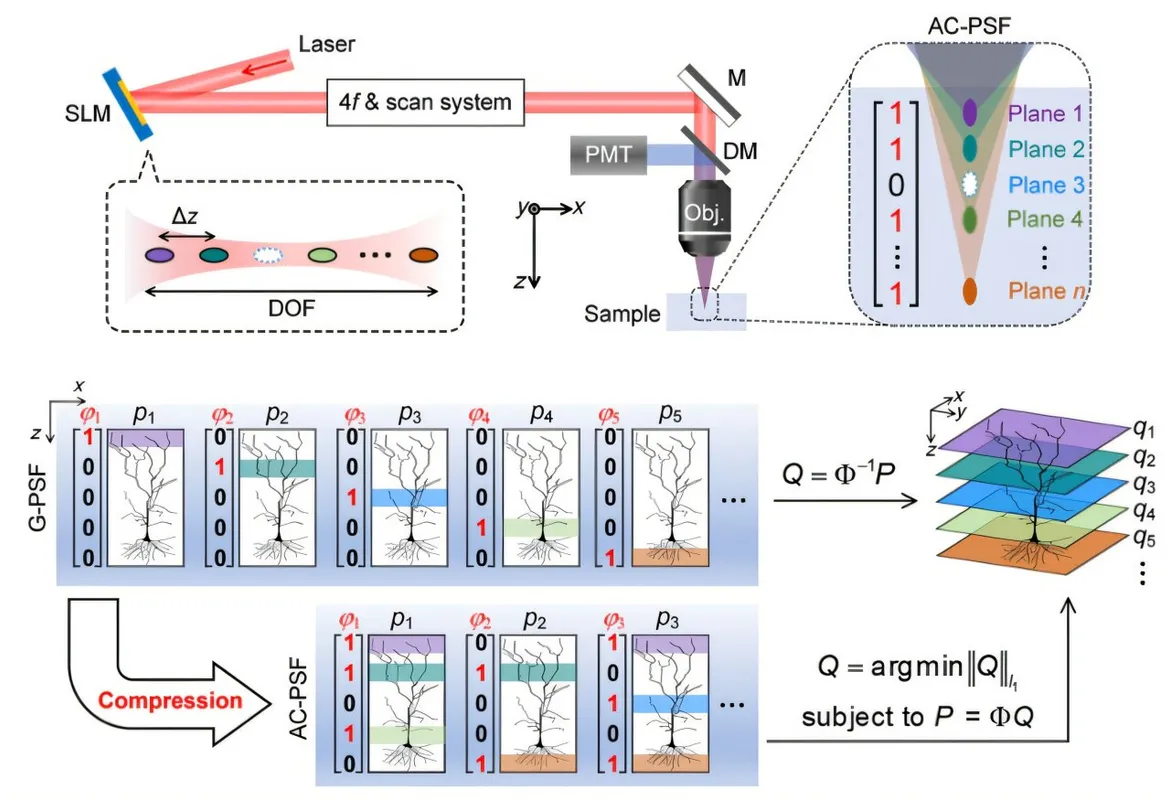
AIMED fundamentally shifts from the conventional method of scanning plane by plane. Instead, it utilizes axially structured illumination to excite multiple depth layers concurrently within a single exposure. Subsequent computational reconstruction, based on compressive sensing principles, then recovers the full 3D information. The research team employs a spatial light modulator (SLM) to generate phase masks that divide an incident laser beam into multiple controllable focal spots along its path. Crucially, the intensity of each focal spot can be independently adjusted to counteract depth-dependent signal attenuation. The inherent nonlinear nature of two-photon or three-photon excitation naturally minimizes interference between planes, enhancing the independence of the encoded layers.
In terms of imaging, rather than sequential axial scanning, AIMED requires only a limited number of encoded illuminations. Depth-resolved fluorescence signals are then retrieved using sparse optimization algorithms, enabling complete 3D reconstruction from compressed measurements.
High-Quality Imaging Demonstrated in Mouse Brain Studies
Measurements of the axially encoded point spread function under various encoding schemes have confirmed precise axial control and uniform intensity across multiple planes. In a five-plane configuration, lateral resolution remains around 600 nm, with axial resolution ranging from 2 to 4 µm, indicating that high-quality optical focusing is maintained even with simultaneous multilayer excitation.
AIMED was further validated in imaging experiments on mouse brain neuronal samples. Compared to traditional plane-by-plane scanning, AIMED successfully resolved intricate neuronal substructures, including dendrites and axons, at approximately 60% compression. This was achieved using only one-half to one-third of the optical power per plane. In certain configurations, the reconstructed images even exhibited improved contrast.
For delicate structures like dendritic spines, AIMED consistently provided reconstruction fidelity comparable to or surpassing that of high-power sequential scanning. Across compression ratios from 62.5% to 87.5%, the reconstructed 3D images maintained a structural similarity index of approximately 0.95 and a peak signal-to-noise ratio of 41–42 dB, showing minimal degradation when contrasted with fully sampled volumetric scans.
Additional simulation studies suggest that for large-scale volumetric tasks involving up to 47 axial planes, AIMED could achieve an approximately eightfold increase in acquisition speed. This highlights its significant scalability and potential for high-throughput volumetric imaging.
Technical Advantages and Future Applications
The AIMED paradigm, combining axial optical encoding with sparse reconstruction, offers a flexible and efficient solution for 3D multiphoton imaging. Unlike hardware-intensive acceleration methods, AIMED does not necessitate expensive components or major system overhauls. Instead, it leverages programmable light-field engineering and a robust compressive sensing framework to boost imaging speed while preserving image fidelity and system stability.
This approach is particularly well-suited for imaging sparse biological structures such as neuronal networks and is inherently advantageous for samples sensitive to phototoxicity. The principles and framework of AIMED are readily adaptable to other 3D optical imaging modalities, including confocal microscopy, Raman imaging, and photoacoustic imaging.
By enabling faster, deeper, and longer-term volumetric imaging, AIMED also paves the way for future integration with data-driven and deep-learning-based intelligent imaging strategies.
Publication details: Xin Dong et al, Multiplane compressive imaging with axial-coded multiphoton microscopy, Advanced Photonics (2025). DOI: 10.1117/1.ap.7.4.046010









