Ancient Arthropods’ Complete Evolutionary History Revealed
Long before land vertebrates emerged, millipedes were established inhabitants of Earth’s terrestrial ecosystems. These ancient decomposers played a crucial role in developing the planet’s environments hundreds of millions of years prior to the advent of dinosaurs. Despite their significant evolutionary past, a comprehensive understanding of their lineage remained elusive until a recent international research effort, spearheaded by scientists at Virginia Tech.
This groundbreaking study has successfully reconstructed the complete evolutionary history of all living millipede orders, offering new insights into a group of creatures that were instrumental in paving the way for terrestrial life. By integrating genomic data from contemporary species with fossilized morphological evidence, researchers have traced the origins of millipedes to approximately 460 million years ago. This timeline suggests their presence on Earth predates the oldest currently known millipede fossils by a considerable margin.
Millipedes: Early Land Colonizers
“Millipedes preceded vertebrates on land by over 80 million years,” stated Paul Marek, the lead investigator and an associate professor in the Department of Entomology within the College of Agriculture and Life Sciences. “They truly set the stage for subsequent life on land, including humans and other vertebrates.”
Reconstructing Missing Evolutionary Links
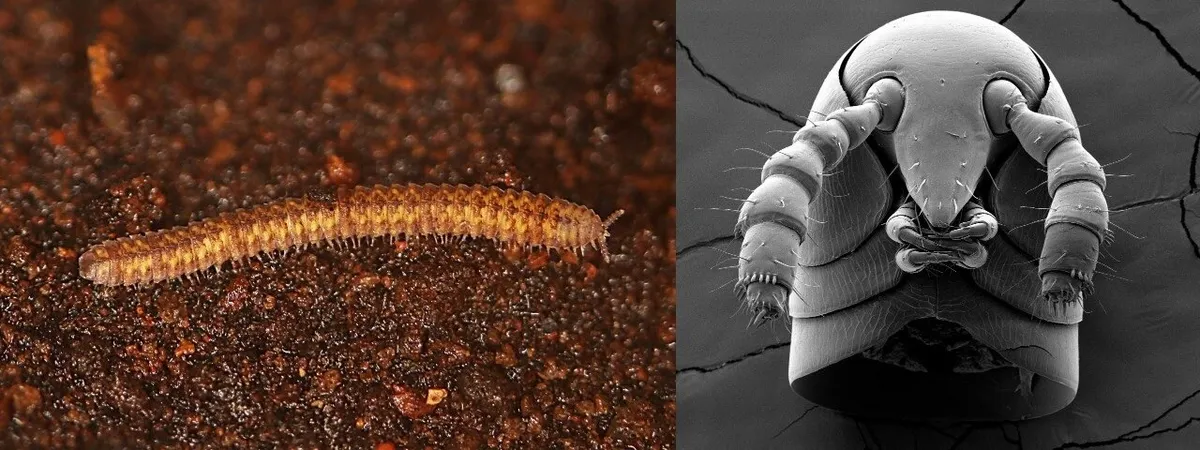
For over a century, scientists recognized the existence of two rare millipede groups, Siphoniulida and Siphonocryptida. However, the lack of fresh specimens for genetic analysis prevented their precise placement within the millipede family tree. One of these groups comprises millipedes measuring barely a centimeter in length, spending their entire lives underground, while the other inhabits only a few specific locations.
“These last two were akin to our ‘white whales’,” Marek explained. To address this gap, researchers embarked on expeditions to Los Tuxtlas, Mexico, and Spain’s Canary Islands. Their objective was to collect specimens of Siphoniulus neotropicus and Hirudicryptus canariensis, two species whose DNA had never been subjected to evolutionary analysis.
Luisa “Fernanda” Vasquez-Valverde, the paper’s first author and an assistant in Marek’s laboratory, described the challenges of their fieldwork. “It took 10 people over a week just to find this one tiny 10-millimeter adult,” she recounted. “Finding them in the field was hard because we were just seeing this little white nematode. We didn’t know for sure it was a millipede until we looked under the microscope.”
Through the sequencing of DNA from these two groups, the comparative analysis of hundreds of genes across 82 millipede species, and the integration of evidence from 29 fossils, the team successfully determined the historical placement of these groups and the emergence of their lineages. This extensive undertaking generated terabytes of genetic data, necessitating the use of Virginia Tech’s Advanced Research Computing resources for reconstructing evolutionary relationships spanning hundreds of millions of years.
The analysis revealed that the Siphonocryptida group was not a distinct order as previously thought, but rather a part of an existing lineage. The Siphoniulida group, however, was definitively placed among its closest relatives on the millipede evolutionary timeline.
Colonizing an Early Earth
The comprehensive analysis indicates that millipedes may have originated approximately 460 million years ago. This is roughly 35 million years before the oldest known millipede fossils and significantly earlier than previous estimates.
“The biggest surprise was just how ancient some of these lineages turned out to be,” Marek commented. During that ancient period, life on Earth was vastly different. Marek noted that millipedes were pioneers of terrestrial life, contributing to the breakdown of organic matter and nutrient cycling in some of the planet’s earliest ecosystems. “There were no vertebrates, no trees, no leaves, no flowering plants, no plants with seeds,” he elaborated. “Millipedes were feeding on decaying mosses, decomposed slime and primordial gunk on the surface of the Earth.”
The completed family tree also shed light on the emergence of one of millipedes’ most critical adaptations. “They made the first chemical weapons,” Marek observed. “They’re little chemical factories.” The study traces the development of these chemical defenses to around 260 million years ago, providing the most detailed understanding to date of when millipedes first evolved them.
Unheralded Ecosystem Engineers
Millipedes continue to serve as vital detritivores in contemporary ecosystems, breaking down decaying plant material and returning essential nutrients. “It’s really kind of puzzling that they have such an important function in the ecosystem, and yet they’re so poorly known,” Marek remarked.
Despite significant advancements, millipedes still hold many undiscovered secrets. While over 14,000 millipede species have been described globally, experts estimate that tens of thousands more remain undiscovered. Marek and his students have contributed to identifying new millipede species in diverse locations, from Virginia Tech’s campus to the city of Los Angeles.
For a new generation of millipede researchers like Vasquez-Valverde, this potential for discovery is a driving force. “There is all this potential for discovery,” she said. “It keeps me wondering what else we’re going to find.”