A Day of Unprecedented Decisions in 1940
On July 3, 1940, Winston Churchill, just 55 days into his premiership, faced a crisis that would define Britain’s war effort. With Western Europe largely under Nazi control and the recent miraculous, yet costly, evacuation of 330,000 troops from Dunkirk, Britain stood precariously alone. The Royal Navy, its sole significant military advantage over Adolf Hitler, was paramount to maintaining vital supply lines. The prospect of the formidable French Fleet, the fourth largest in the world, falling into German hands was an existential threat.
Operation Catapult: A Brutal Ultimatum
Churchill, deeply familiar with naval matters from his time as First Lord of the Admiralty, ordered ‘Operation Catapult’. The objective was stark: the French Navy must either be secured against German capture, or Britain would neutralize it by force. While many French warships had been dispersed globally, the heart of their naval power, including the battleships Dunkerque and Strasbourg, lay at Mers-el-Kébir in Algeria. These vessels, along with nine others, formed France’s ‘Force de Raid’ under the command of Vice Admiral Gensoul, a man known for his mistrust of the British.
Negotiations and the Shadow of War
Vice Admiral Somerville, leading British Force H aboard HMS Hood, was tasked with executing the operation. Aware of Gensoul’s suspicions, Somerville dispatched Captain Holland, a highly respected officer and fluent French speaker, to negotiate. Holland presented Gensoul with four options: the French fleet could sail to Britain to continue fighting, relocate to the West Indies or America for disarmament, scuttle their ships, or hand them over to the British. Under no circumstances were the vessels to fall into German hands. If these options were rejected, Somerville’s orders were to destroy the fleet. The code word for this decisive action was ‘ANVIL’.
However, the negotiations quickly soured. Gensoul, insulted by the junior rank of Captain Holland delivering an ultimatum, refused to meet directly for most of the day. This delay, however, was not merely stubbornness; it was a strategic maneuver to rearm his fleet and prepare for escape or resistance.
The Hateful Strike at Mers-el-Kébir
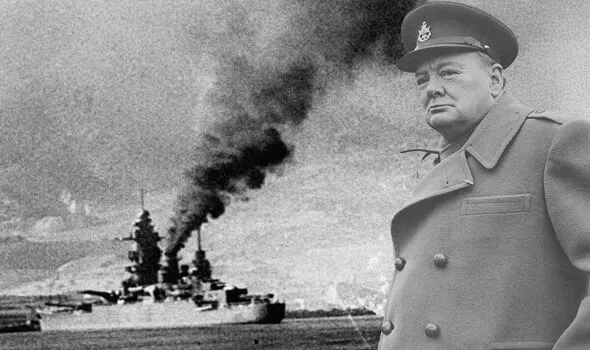
As dusk approached and negotiations remained stalled, Somerville received clear instructions: the matter had to be resolved before nightfall. At 17:54 hours, with no agreement reached, Somerville gave the order: ‘ANVIL’. Less than ten minutes of intense shelling followed. The French fleet, trapped in the harbor and vulnerable to the British position, offered little effective defense. When Somerville ordered a ceasefire, the grim reality emerged. The battleship Dunkerque was grounded, the Provence was ablaze, and the Bretagne had capsized, sinking with most of its crew. The oil-slicked waters were a scene of devastation, with rescuers struggling to pull survivors from the wreckage.
Escape and Aftermath
Despite the destruction, the battleship Strasbourg, one of Churchill’s primary targets, managed to slip out of the harbor under the cover of the bombardment, escorted by four destroyers. Although torpedo aircraft were launched in pursuit from HMS Ark Royal, they failed to intercept Strasbourg, which reached Toulon to a hero’s welcome. In total, four French ships were incapacitated, resulting in the deaths of 1,299 men, with an additional 351 wounded. Two British airmen also perished in aerial engagements above the harbor.
A Necessary Evil for Allied Survival
Despite the operation’s heavy cost and the loss of some vessels, it was deemed a success by British command. Churchill himself described it as a “hateful decision, the most unnatural and painful in which I have ever been concerned. It was a Greek tragedy. But no act was ever more necessary for the life of Britain and for all that depended upon it.”
This act of aggression, though deeply regrettable, proved pivotal. Private communications from the time indicate that the attack at Mers-el-Kébir significantly bolstered President Franklin D. Roosevelt’s confidence in Britain’s resolve. Harry Hopkins, a close advisor to Roosevelt, reportedly conveyed that the event convinced the President that Britain would indeed fight on, even alone, as Churchill had promised. This assurance was a crucial factor in Roosevelt’s decision to sign the Destroyers for Bases Agreement, marking a significant step towards American involvement in the war.
Thus, a decision born of desperation and executed with brutal efficiency, while a dark chapter, may have been one of the most consequential in securing Britain’s ultimate survival and the eventual Allied victory.