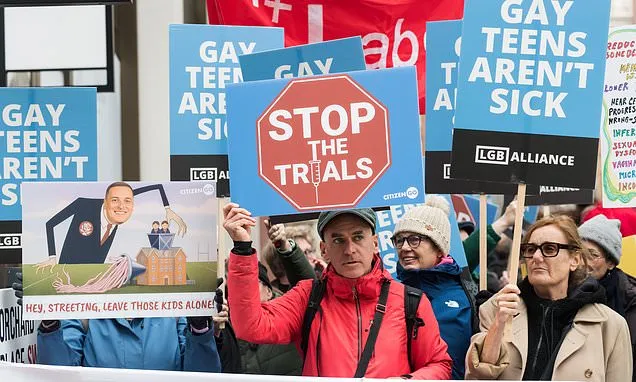
Controversial Puberty Blocker Trial to Resume with Lower Age Limit
A controversial clinical trial involving puberty blockers for young people experiencing gender incongruence is set to resume recruitment in August, allowing children as young as 11 to participate. This decision follows a significant modification to the trial’s protocol, which has drawn sharp criticism from campaign groups urging legal intervention.
Initially halted in February due to safety concerns raised by regulators, the trial’s resumption was announced today by researchers. The Medicines and Healthcare products Regulatory Agency (MHRA) had previously expressed a desire to restrict participation to individuals aged 14 and older. However, officials have now agreed to a lower age threshold, with recruitment slated to begin on August 1.
Campaigners Vow Legal Action Against ‘Unethical Experiment’
Furious campaigners are preparing to launch a judicial review, aiming to shut down what they describe as an “unethical experiment.” Approximately 226 young individuals are expected to receive hormone-suppressing drugs as part of this trial, which was commissioned under the purview of former health secretary Wes Streeting. Streeting had previously placed an indefinite ban on these drugs, citing ‘an unacceptable safety risk’ identified by the Commission on Human Medicines.
Despite this prior stance, Streeting, who is also a contender for leadership, has supported the Pathways trial, which aims to investigate the side effects of these medications, aligning with recommendations from the Cass review into the treatment of transgender youth.
Campaigners express deep concern over potential harm to young participants and accuse the MHRA of yielding to ‘gender ideology.’ They argue that the agency’s mission to ‘put patients first’ is being undermined.
Understanding Puberty Blockers and Trial Concerns
Puberty blockers are medications designed to temporarily halt the physical changes associated with the onset of adulthood, such as the development of secondary sexual characteristics. The trial, led by King’s College London, has faced ethical scrutiny regarding the administration of drugs that could lead to irreversible consequences, including impacts on brain development and fertility.
Helen Joyce, director of advocacy at Sex Matters, stated, “It appears that gender ideology has broken yet another institution.” She added, “The MHRA’s mission is supposedly to ‘put patients first’ in everything it does, and yet it is signing off on a trial that does the opposite.” Joyce contended that puberty blockers are not a solution for childhood gender distress and cause unacceptable harm. She criticized the MHRA for backing away from earlier concerns and allowing the trial to proceed with only minor modifications, such as the introduction of minimum ages.
The trial’s modified protocol establishes a minimum entry age of 11 for individuals registered as female at birth and 12 for those registered as male. Researchers noted that this age limit was introduced because it is highly unlikely younger children would qualify, despite prior assertions that good ethical practice should not discriminate based on age alone.
Regulatory Scrutiny and Expert Opinions
A letter from the MHRA in February had previously requested that the minimum age be raised to 14, citing the “potentially significant and, as yet, unquantified risk of long-term biological harms.” The agency noted that biological safety had not been definitively demonstrated in the proposed cohort.
In its latest update, the MHRA confirmed it had consulted with independent experts from the Commission on Human Medicines regarding participant safety and the adequacy of strengthened safeguards.
Kate Barker, chief executive of the LGB Alliance, expressed shock, stating, “It’s shocking that 11-year-olds could be given drugs with lifelong consequences, including permanent infertility.” She characterized the trial as a “mass medical experiment on children, many of whom would grow up to be happily gay or lesbian if left alone.” Barker urged the new health secretary, James Murray, to halt the trial.
Legal Challenges and Trial Objectives
Legal action is currently underway against the Government, with various public figures voicing opposition. Author J.K. Rowling has described the trial as an “unethical experiment on children who can’t give meaningful consent.” A campaign group and two individuals are pursuing legal action against the Health Research Authority (HRA) and the Department of Health and Social Care (DHSC), alleging serious flaws in the ethical approval process.
Researchers from King’s College London emphasized that their priority is to “safely, and robustly, investigate the benefits and risks of puberty suppression for young people with gender incongruence to improve the evidence base and inform NHS healthcare.” They stated that no participant can join without parental consent and that all individuals must demonstrate a thorough understanding of the intervention and its potential outcomes.
The MHRA indicated that no children are expected to be recruited before August 1 due to ongoing legal proceedings. Researchers also confirmed that further details regarding the potential impact on bone density and fertility will be provided to participants and their parents throughout the trial. Plans for a follow-up study to monitor individuals who may remain on puberty blockers post-trial are also being considered.