

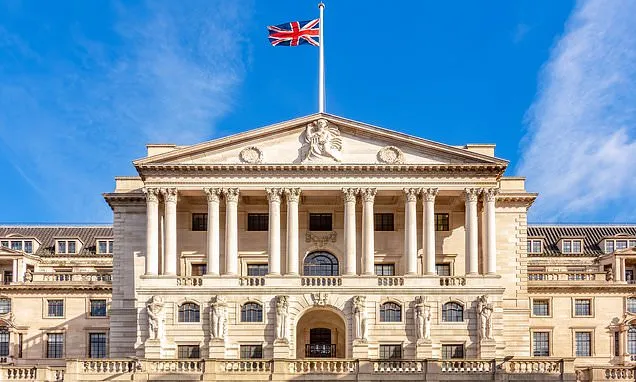
Bank of England Maintains Interest Rate at 3.75%
The Bank of England has decided to hold its benchmark interest rate at 3.75 percent for the fourth consecutive meeting. This decision, made since December 2025, reflects a cautious approach amid ongoing inflation concerns. Seven members of the Bank’s Monetary Policy Committee voted to maintain the current rate, while two advocated for a 0.25 percentage point increase to 4 percent.
While a rate reduction was previously anticipated for this year, heightened worries about a potential inflation surge, influenced by geopolitical events in Iran, have prompted the Bank to maintain a steady course. Higher interest rates are a tool used to encourage consumers to reduce spending and increase savings, thereby mitigating inflationary pressures within the economy.
Recent figures from the Office for National Statistics indicate that inflation remained stable at 2.8 percent in May, a figure that had been expected to climb. However, the Bank of England faces the challenge of balancing the imperative to control inflation against the risks of sluggish economic growth and potential unemployment, both of which can be exacerbated by sustained high interest rates.
Implications for Mortgage Borrowers
Mortgage rates have seen a downward trend over the past month, following an earlier increase attributed to lenders’ responses to the economic impact of the conflict in Iran. Notably, Nationwide reduced its mortgage rates for the second time in a week recently. The average two-year fixed mortgage rate, which stood at 4.83 percent at the beginning of March, had risen to 5.89 percent by April 13. Since then, this figure has decreased to 5.6 percent.
Fixed mortgage rates are primarily influenced by Sonia swap rates, which reflect future interest rate expectations, rather than directly by the Bank of England’s base rate. These swap rates have been declining. Nicholas Mendes, mortgage technical manager at broker John Charcol, commented, “Swap rates have fallen meaningfully from their May peak, easing again after yesterday’s softer inflation figure. The two-year swap is now sitting below 4 percent. Lenders have already begun passing some of that on.”
Navigating Remortgaging in the Current Climate
With interest rates at elevated levels, it is crucial for individuals needing to remortgage to secure the most favorable deal available. Experts advise speaking with a broker or lender promptly to lock in a new rate. It is possible to reserve a mortgage rate up to six months before your current deal expires. Those with a mortgage ending in December or sooner should consider securing a rate now. Should market conditions improve and rates fall further, it is typically possible to switch to a more advantageous rate before the new mortgage commences.
Mendes further advised, “Anyone coming to the end of a fixed deal should look early, secure a rate where possible, and speak with a broker about the options available. In this kind of market, the better approach is often to lock in an affordable option and then keep it under review, rather than sit on the sidelines waiting for a clearer signal that may not arrive. A broker can help secure what is available now while still monitoring whether a better option appears before completion.”
Future Outlook for Mortgage Rates
Currently, the most competitive fixed-rate mortgages are priced between 4.35 percent and 4.75 percent, with borrowers possessing larger deposits generally qualifying for better terms. While an immediate, dramatic shift in pricing is not anticipated following today’s announcement, there is optimism that rates may continue to improve. Mendes stated, “It is too early to say sub 4 percent deals are back on the market, but for now there is light at the end of the tunnel. The recent cuts have been small and frequent rather than dramatic, and that is the more realistic shape of things to come.”
Aaron Strutt, of broker Trinity Financial, offered a more reserved perspective, adding, “Lower rates are possible, but it seems like there are some pretty big global issues that need to be fixed first before this is likely to happen.”
Impact on Savers
The Bank of England’s base rate directly influences the interest earned by savers. Generally, savings rates tend to rise with the base rate and fall as it decreases. With the base rate held at 3.75 percent, savers can expect current savings rates to remain largely static in the short term.
A number of savings accounts already offer rates exceeding the 3.75 percent Bank of England base rate. For instance, Cahoot’s Sunny Day Saver, which has an annual deposit limit of £3,000, offers a 5 percent rate. Hampshire Trust Bank’s easy-access account provides a 4.24 percent rate.
However, many accounts yield less than the base rate, underscoring the importance of switching providers if your money is not earning optimally. Analysis indicates that four out of five easy-access accounts pay less than the base rate, with the average rate falling below the current inflation rate of 2.8 percent. This means that for many savers, their money is losing value in real terms.
Rachel Springall, a finance expert at Moneyfacts, noted, “Convenience comes at a cost, so savers who keep their pots with a high street bank, or even in a current account, are not making their money work as hard as it could. Challenger banks and building societies offer some of the best returns on the savings market and switching doesn’t take much effort, yet some savers might feel it’s not worth doing.”
Strategies for Savers
Savers are encouraged to monitor their easy-access rates closely and consider utilizing a cash Isa to shield their interest earnings from taxation. The current annual tax-free allowance for cash Isas is £20,000, though this is slated to decrease to £12,000 from April 2027, with an exception for those over 65, according to plans announced in the November Budget.
Cash Isa rates are currently competitive, with some exceeding rates offered by certain easy-access accounts. These rates have seen an increase since the base rate was held at 3.75 percent last month. However, some of the top deals include limited-time bonus rates, after which the interest rate may fall.
Current Best Savings Rates
The most competitive easy-access savings accounts with no withdrawal restrictions currently offer 4.27 percent. Hampshire Trust Bank has an easy-access product paying 4.24 percent. For a £10,000 deposit in this account, an individual could expect to earn approximately £424 in interest over a year, assuming the rate remains constant. Cynergy Bank offers a 4.23 percent rate, which includes a 2 percent bonus for the first 12 months; the overall rate will then decrease to 2.23 percent.
Both of these accounts are fully protected under the Financial Services Compensation Scheme (FSCS) up to £120,000 per person.
For individuals with funds they do not anticipate needing access to within the next year or longer, fixed-rate savings accounts are a viable option. The best one-year fixed-rate deal is available from MBNA, offering 4.85 percent. A £10,000 deposit in this account would yield a guaranteed £485 in interest over one year. This product also benefits from full FSCS protection up to £120,000 per person.
Thisbank and Close Brothers are offering rates of 4.82 percent and 4.8 percent respectively, both with FSCS protection. The best two-year bond is offered by Recognise Bank at 4.7 percent. For those looking to lock away savings for longer periods, Oxbury Bank provides the top three-year and five-year bonds, paying 4.83 percent and 4.88 percent respectively.









