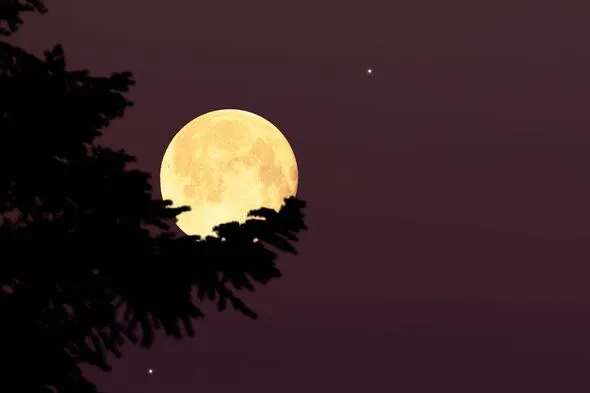
Stargazers across the nation are anticipating a celestial event known as a ‘Blue Moon’ tonight. However, astronomers are cautioning that the phenomenon will not present a visually blue lunar disc, potentially leading to some disappointment for those expecting a colourful spectacle.
Understanding the ‘Blue Moon’
According to Evan Irawan Akbar, a lecturer from the Astronomy Research Group at the Bandung Institute of Technology (ITB), the term ‘Blue Moon’ does not refer to the Moon’s colour. Instead, it is a designation for the second full moon that occurs within a single Gregorian calendar month. For instance, in May 2026, the first full moon occurred on May 2nd, making the full moon visible on Sunday night the second of the month, and therefore a ‘Blue Moon’.
Mr. Akbar emphasized that the Moon will appear as any other ordinary full moon. It will not be larger, brighter, or exhibit any blue hue. He stated, “For the May 31 event, it has nothing to do with the Moon turning blue. The Moon will still appear like a regular full moon.”
Origins of the Term
The nomenclature ‘Blue Moon’ originates from traditional American naming conventions for full moons, which were often linked to seasons or specific events, such as the ‘strawberry moon’ or ‘harvest moon’. The contemporary definition, denoting the second full moon in a month, gained traction following a misinterpretation in a 1946 article published in Sky & Telescope magazine by James Hugh Pruett.
Genuine instances of the Moon appearing blue are rare and are attributed to specific atmospheric conditions. These can include large particles from volcanic eruptions that scatter light in a way that makes the Moon appear blue.
Frequency and Future Occurrences
Contrary to the idiom ‘once in a blue moon’, which implies extreme rarity, these calendrical ‘Blue Moons’ are relatively common in astronomical terms. They occur approximately seven times every 19 years. The occurrence is driven by the Moon’s synodic period of about 29.5 days, which is slightly shorter than most Gregorian calendar months.
Future ‘Blue Moons’ are anticipated on December 31, 2028, and September 30, 2031.
Viewing Tonight’s Lunar Event
For observers in the United Kingdom, the full moon will reach its peak illumination around 9:44 a.m. British Summer Time. However, the Moon will remain a prominent sight throughout the night, rising shortly after sunset and setting the following morning.
No specialized equipment is required to view the ‘Blue Moon’; it is easily observable with the naked eye. The Astronomy program at ITB, which manages facilities like the telescope lab at the Ganesha Campus and the Bosscha Observatory, is not organizing special observations for this event, as it does not present any unique scientific phenomena beyond its calendrical definition.
Mr. Akbar noted that public interest in the ‘Blue Moon’ provides a valuable opportunity to educate the public about lunar cycles and the calendar system. Therefore, while tonight’s ‘Blue Moon’ offers a beautiful full moon to appreciate, those anticipating a literal blue lunar spectacle may indeed find themselves disappointed.