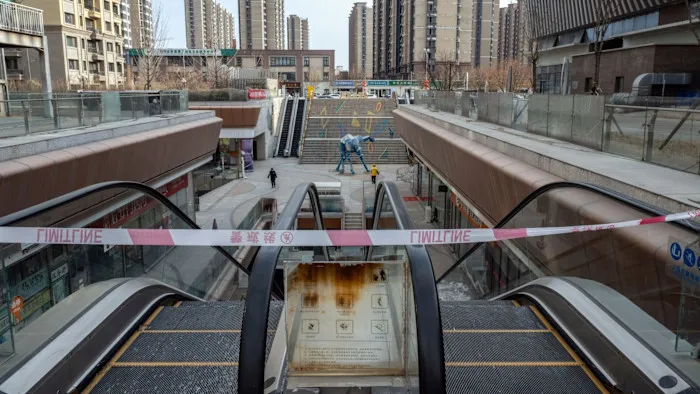
Almost five years aer the collapse of Evergrande, the world’s most indebted property developer, China’s real estate sector continues to falter. Property investment, a former pillar of economic growth, has declined steadily since early 2022. Investors holding over $150 billion in defaulted international bonds from Chinese developers see no quick relief, as housing prices keep dropping.
Ongoing Property Market Downturn
The sector entered a downturn cycle in 2021, and experts now estimate it has at least one to two more years to run. Dhevine Chandrapala, a restructuring lawyer at Sidley Austin in Hong Kong, explains: “We are five years into a cycle that began in 2021… We still have, I think, one to two years to go at least.”
This prolonged slump highlights recovery challenges for offshore investors. Bonds issued outside mainland China contrast with assets mostly located onshore, lacking a unified legal process to address both. “There isn’t a single holistic process that can deal with onshore assets and liabilities and offshore assets and liabilities,” Chandrapala states.
Key Restructuring Efforts Offshore
Several developers have pursued offshore debt restructurings, oen blending new notes with equity-like stakes and leveraging offshore assets. Country Garden, once China’s top developer by sales, completed an $18 billion debt overhaul in January. Shimao and Kaisa followed with $11.5 billion and $12.3 billion restructurings, respectively, both in 2025—deals advised by Sidley Austin.
State-owned Sino-Ocean restructured $6.3 billion in debt last year, marking the first use of an English plan. While some bondholders opposed it, Hong Kong-based banks supported the deal, securing court approval in February 2025 via an English legal mechanism. One restructuring expert notes that the balance of offshore debt against assets influences creditor support.
Minimal Recoveries and Liquidation Risks
Bondholders oen resist offered recoveries, but alternatives remain scarce beyond liquidation, as seen with Evergrande’s offshore entity in early 2024. By mid-2025, when delisted from the Hong Kong stock exchange, only $255 million in assets— including a Monet painting—had been recovered against over $300 billion in liabilities, mostly onshore. Authorities prioritize completing unfinished housing projects there.
Early 2025 analysis from Debtwire, part of Ion Analytics, reveals offshore bondholders recovered just 0.6 percent of the $150 billion in defaulted bonds. Derek Li, a Debtwire analyst, highlights tracking difficulties: “It has become nearly impossible to track how much cash is actually being recovered… Companies are not required to disclose whether they exercise [capitalizing interest] such an option.”
Shiing Strategies and Future Outlook
Restructurings increasingly feature “equitisation,” converting debt to equity, unlike earlier “amend and extend” tactics that swapped high-yield bonds for longer-term debt. Chandrapala observes: “Creditors and investors are getting more realistic… There is little point in saying you need to have future cash flows by 2027, 2028—they’re actually saying we don’t know when these cash flows are going to come.”
New home prices, a key urbanisation gauge, fell further in March, though some cities stabilized. HSBC analysts view 2026 as a potential turning point, citing rising secondary market activity: “Homeowners are no longer desperate to exit and buyers are gradually re-entering.” Any offshore gains hinge on onshore claim resolutions under China’s distinct regime.