

Indestructible Archive to Document Humanity’s Path to Potential Apocalypse
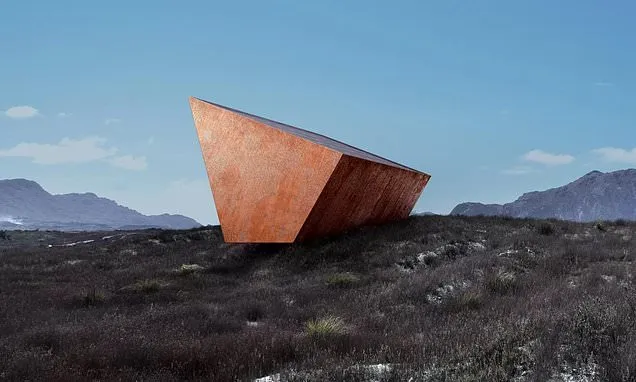
A monumental and resilient structure, aptly nicknamed ‘Earth’s Black Box,’ is set to be constructed in a remote Tasmanian airfield. This ambitious project is designed to serve as an unblinking chronicle of humanity’s journey, particularly in the face of accelerating environmental crises.
Drawing inspiration from the flight recorders found in aircraft, which meticulously document crucial data in the event of a crash, Earth’s Black Box aims to capture every significant development as humanity navigates towards potential ecological disaster. The heavily fortified data repository will collect vital information from a diverse range of sources, including international space agencies, global weather monitoring stations, and leading academic institutions. The stated goal is to provide an impartial and enduring record for generations to come.
A Monument to Resilience
Upon completion, the structure will stand as a formidable recording device, measuring approximately 52 feet (16 meters) in length and 13 feet (4 meters) in height. Its creators, Rouser Lab, emphasize its near-indestructible design, with steel walls engineered to withstand a multitude of catastrophic events, including severe cyclones, seismic activity, widespread fires, extensive flooding, and even physical attacks.
The chosen location, situated on the west coast of Tasmania atop 500-million-year-old granite, is highlighted by Rouser Lab as one of the most politically and geologically stable regions on the planet. Powering this long-term endeavor will be a combination of 36 solar panels encased in protective glass and thermoelectric power generation, ensuring continuous operation and data recording long after human presence may have ceased.
From Concept to Construction
Initially announced in 2021, coinciding with the COP26 climate summit in Glasgow, the project utilized digital hard drives to capture data from the event, intended for integration into the final structure. While progress appeared to stall in the intervening years, Rouser Lab has now confirmed that construction is actively underway. The Black Box is slated for installation just outside Queenstown, Tasmania, by December of this year.
Jonathan Kneebone, the artistic director of Earth’s Black Box, stated, “It will be approximately five years to the day that we are finally able to install the work. In those five years, we have been evolving the design, data storage systems, source materials, web platform – as well as developing funding models to sustain the project into the future.” Specific cost projections for the construction and ongoing operation of Earth’s Black Box have not yet been publicly detailed.
Documenting the Climate Crisis
Once operational, the structure will begin accumulating and storing an extensive collection of datasets related to the progression of climate change. This will encompass critical metrics such as global temperatures, sea levels, and atmospheric carbon dioxide concentrations. Crucially, it will also document humanity’s responses, including energy consumption patterns and broader societal data.
To provide comprehensive context, the device will also record significant speeches, media narratives, academic research, and social media discourse pertaining to climate change. The creators envision Earth’s Black Box as a means to “provide an unbiased account of the events that lead to the demise of the planet, hold accountability for future generations, and inspire urgent action.” Rouser Lab adds a stark reminder: “How the story ends is completely up to us. Only one thing is certain, your actions, inactions, and interactions are now being recorded.”
Questions remain regarding the accessibility of the data in the aftermath of a severe climate catastrophe and whether any individuals would be present to retrieve it. The possibility exists that a small contingent of survivors might gain insights into the collapse of civilization, brought about by devastating fires, floods, and droughts.
A New Chapter for the Project
The confirmation of a construction timeline effectively dispels prior speculation that the project might have been an elaborate publicity stunt. The robust steel construction, designed to withstand extreme environmental and potential adversarial conditions, has been a consistent feature of the project’s description.
While the University of Tasmania was an initial affiliate, it withdrew its participation over time, requesting to be removed from project-related materials. This left a consortium of advertising agencies, creative networks, and architects to advance the initiative. Rouser Lab had also explored other ambitious concepts, such as a ‘techno-obelisk’ designed to transmit an ‘SOS’ signal into space.
Currently, the project is being coordinated by the Earth’s Black Box Foundation, a registered charity dedicated to its realization. Shane Pitt, the mayor of the West Coast council in Tasmania, remarked that the project “had been a long time coming” and suggested it could also serve as a local tourist attraction.









