

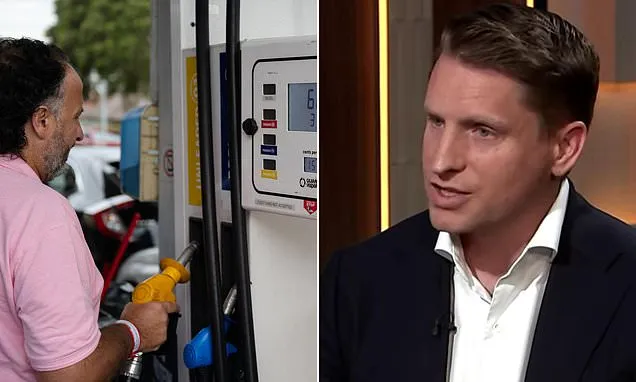
Senior Liberal MP Andrew Hastie criticizes Donald Trump while delivering a stark warning on Australia’s energy security. Global conflict disrupts fuel supplies, driving prices higher and threatening economic stability.
In a recent interview on ABC’s Insiders, Shadow Minister for Industry and Sovereign Capability Andrew Hastie predicts Australians will soon experience significant economic hardship as the Middle East war enters its second month. He views the fuel crisis as a critical alert for the Albanese government.
Perfect Economic Storm Ahead
“We are heading into a perfect economic storm,” Hastie states. He challenges Prime Minister Anthony Albanese and Treasurer Jim Chalmers to prevent the nation from slipping into recession.
Trump’s Comments Hit Hard
Hastie’s remarks respond to Trump’s recent statement: “Australia was not great. I was a little surprised by Australia.” These words resonate deeply given Australia’s century-long alliance with the United States.
“It gives me a visceral reaction because I think about what we’ve done over the last 100 years with the United States,” Hastie explains. “We were there in the First World War, the Second World War and lost 500 soldiers in Vietnam. We were there in Iraq and Afghanistan, so we’ve been a good ally.”
World Changes Demand Self-Reliance
Hastie emphasizes that global shifts require Australia to prioritize national self-sufficiency. “Whatever you think about Donald Trump’s rhetoric, the world has changed and we need to take that seriously,” he says. “This war has emphasised the need for us to be self-reliant as a nation.”
The U.S. decision to engage in conflict without ally consultation leaves nations like Australia exposed, especially those reliant on Middle East hydrocarbons. “Iran has been able to pretty much hold the whole world economy to ransom,” Hastie notes. “The economic pain is going to be more acute, and the Australian public are going to question the judgement of the president.”
Unique Vulnerabilities Exposed
Australia’s position at the end of extended global supply chains, combined with only two domestic oil refineries, heightens risks. “As a country that depends on imported oil via Asia, we are in a very difficult place right now,” Hastie warns.
Resolution in the Strait of Hormuz may take weeks or months, with no immediate international naval effort to secure shipping routes. “The battle of Hormuz is going to take some time to resolve,” he predicts. “The best-case scenario is late April, but this could drag on much longer.”
Existing pressures like high interest rates, persistent inflation, rising bond yields, and low consumer confidence amplify the threat. “Iran has managed to hold the world economy to ransom, and because we are at the end of a very long supply chain, we are going to experience pain,” Hastie adds.
Calls for Immediate and Long-Term Action
Hastie urges emergency measures to secure fuel, including greater transparency from the Prime Minister. “The Prime Minister needs to be speaking daily to the nation and giving people confidence that the situation is under control,” he insists.
He supports the Coalition’s proposal to temporarily halve the fuel excise to ease pump prices. “If we cannot get fuel to the bowser and keep it affordable for families and tradies, then this country risks sliding into recession,” Hastie cautions.
For the future, he advocates a major overhaul of energy policy, including exploring coal-to-liquid fuel production. “If we do not have feedstock and refining capacity in this country, we will always be vulnerable to geopolitical shocks,” he concludes.









