New Research Reshapes Understanding of American Revolution’s Central Figure
The enduring image of King George III as a “mad tyrant,” a villain deeply ingrained in American popular culture, is undergoing a significant historical re-evaluation. As the United States approaches its 250th anniversary, a growing body of scholarship suggests that the traditional narrative of his oppressive reign is largely a fabrication, challenging a foundational element of the American origin story.
Challenging Wartime Propaganda
Historians now widely contend that the portrayal of George III as a maniacal or irrational monarch, as often depicted in historical dramas and educational materials, is a myth. British historian Andrew Roberts, in his 2021 biography, “The Last King of America,” argues that the grievances listed against the king in the Declaration of Independence largely “crumble under scrutiny,” with most lacking substantial evidence. Roberts asserts that “Truth became the first casualty of the American War of Independence, as it is in most wars,” concluding that the revolution was a testament not to George III’s tyranny, which he deems fictitious, but to a genuine American yearning for autonomy.
Crucially, scholarly consensus now indicates that George III was not mentally ill during the period of the Revolutionary War. This scholarly pushback against the traditional narrative began well before the United States’ bicentennial celebration.
A Royal Perspective on Historical Narratives
In 1972, King Charles III, then Prince of Wales, offered a pointed commentary on the prevailing historical perception of his ancestor. In a foreword to a biography, he noted the common schoolchildren’s memory of George III being “mad,” often cited as the reason for his “irrational” behavior toward the colonists, necessitating independence. He expressed a hope that Americans would eventually view the “true George III without bias and traditionally held opinions.”
The Constitutional Monarch’s Role
George III ascended to the throne in 1760 at the age of 22, inheriting a vast empire. He viewed his role as a father figure to his subjects, emphasizing order, integrity, and intellectual curiosity characteristic of the Enlightenment era. As a constitutional monarch, his influence was significant, including the selection of prime ministers. However, legislative power, including the passage of laws and budgets, rested with Parliament, particularly the Cabinet and the House of Commons. The king’s role was primarily to assent to policies enacted by Parliament.
This constitutional framework is essential when examining policies like the Stamp Act of 1765, the first direct tax imposed on the colonies. Colonists vehemently opposed it with the slogan “No taxation without representation,” arguing that their elected colonial assemblies, not Parliament, provided their legitimate representation. Despite colonial boycotts leading to the Stamp Act’s repeal in 1766, Parliament simultaneously reaffirmed its authority to legislate for the colonies.
Deteriorating Relations and a Shift in Understanding
Relations continued to sour in the following decade. Parliament’s passage of the Tea Act in 1773 led to the iconic Boston Tea Party, an event that reportedly shocked George. The subsequent year, he approved parliamentary measures aimed at curtailing Massachusetts’ self-governance. Appeals from the Continental Congress to the king as “your majesty’s faithful subjects” for relief were ultimately disregarded as George aligned with Parliament. The armed conflict that erupted in April 1775 at Lexington and Concord marked the beginning of what is commonly referred to as the American War of Independence.
A pivotal shift in understanding George III’s health emerged with the 2015 release of the uncatalogued Georgian Papers by Queen Elizabeth II. These extensive archives from Windsor Castle, subsequently digitized, provided a detailed re-examination of the monarch’s life. They revealed his meticulous record-keeping across various domains, including crop yields and parliamentary affairs. Crucially, the archives contained comprehensive medical notes, doctor’s orders, and observations of George’s behavior during his periods of illness.
This newly accessible information challenged the long-held theory that George suffered from porphyria, a metabolic disorder. Roberts’ 2021 analysis, drawing on 100,000 Georgian documents and contemporary medical research, now suggests that George likely experienced bipolar affective disorder Type 1, characterized by severe manic episodes, which became apparent after 1788.
Evolving American Narratives
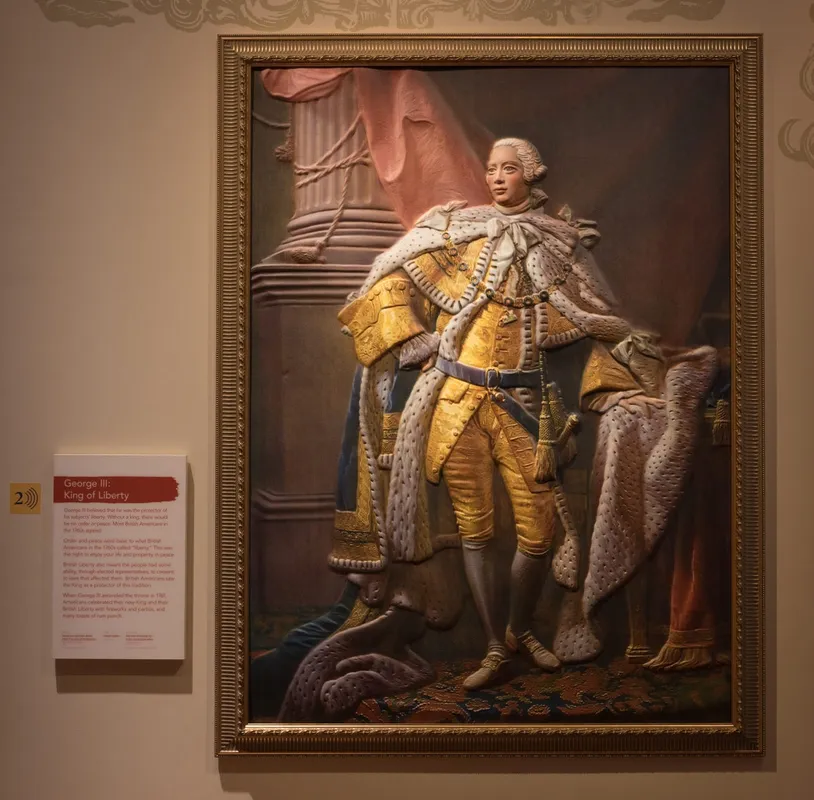
As America approaches its 250th anniversary, the narrative surrounding George III is evolving, even within the United States. Exhibitions, such as the Library of Congress’s “The Two Georges,” which draws parallels between King George III and George Washington, highlight “Parallel lives in an age of Revolution.” The Museum of the American Revolution in Philadelphia begins its historical account 15 years prior to the conflict, showcasing a period when Americans held “great affection for George III,” with royal symbols adorning everyday objects.
R. Scott Stephenson, president of the Museum of the American Revolution, notes, “We make the point that he was literally called ‘the king of liberty’ in popular culture… This was not a despot in anyone’s minds.”
This evolving perspective was evident when King Charles III addressed Congress in April 2024. He referred to George III, lightheartedly endorsing the “Tale of Two Georges” theme and reassuring listeners, “King George never set foot in America, and, please rest assured, I am not here as part of some cunning rear-guard action.” Later, at a White House state dinner, Charles again invoked his ancestry, stating, “As the direct descendant of King George III, I know this is a nation that never gives up.”
Despite these efforts to reframe historical understanding, some observers remain skeptical about the extent of public acceptance of this revised narrative. As historian Andrew Roberts commented, “Nothing will dislodge the Americans from their desire to see GIII as an evil dictator.”