

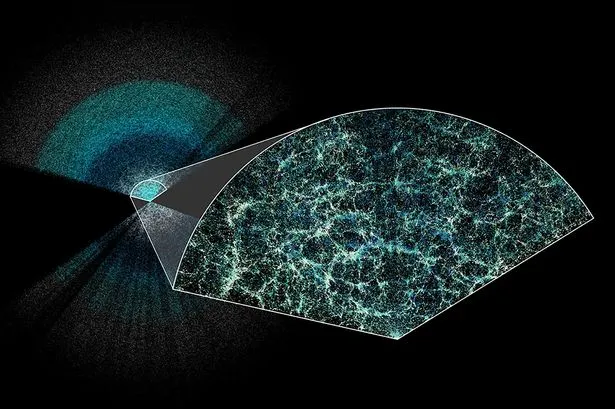
Scientists from the University of St Andrews have played a key role in developing the most extensive 3D map of the universe to date. The Dark Energy Spectroscopic Instrument (Desi), positioned at the Mayall telescope in Arizona, gathers data on millions of galaxies and quasars.
Collaborative Effort Yields Unprecedented Detail
Working alongside experts from the University of California, Berkeley, and teams from 70 institutions globally, researchers over five years produced a high-resolution 3D cosmic map. This map targets dark energy, which theory suggests dominates the universe’s composition.
Desi launched in May 2021 with a goal to observe light from 34 million galaxies and quasars. The project surpassed expectations, incorporating data from 47 million galaxies and quasars, along with 20 million stars.
Revolutionary Insights into Cosmic Structures
Rita Tojeiro, Professor of Astronomy at the University of St Andrews, highlights Desi’s transformative impact on cosmology. “There is no doubt of the huge impact that Desi is having on cosmology,” she stated. “What is also fantastic about Desi, in addition to being a revolutionary cosmology survey, is that this new, three-dimensional map is enabling world-class legacy science.”
Each of the 47 million galaxies and quasars offers unique insights, allowing scientists to trace galaxy formation and evolution across cosmic time. The map unveils the three-dimensional cosmic web with exceptional clarity, enabling novel studies of how galaxies interact with surrounding structures.
Next Steps: Unraveling Dark Energy and Matter
Researchers now aim to deepen understanding of dark energy and dark matter, which together form most of the universe’s mass yet remain undetected physically. Professor Tojeiro added, “I have been waiting for over 10 years for this cosmic map. Now it is here and we are lucky enough to extend it and make it even better. The level of detail is incredible, and the map is so rich with information. We will be exploring it for 10 years to come.”









