Astronomers may have observed a rare astronomical event: the near-complete destruction of a colossal star in a ‘pair-instability’ supernova. This catastrophic explosion is theorized to obliterate some of the universe’s most massive stars, leaving no stellar remnants behind.
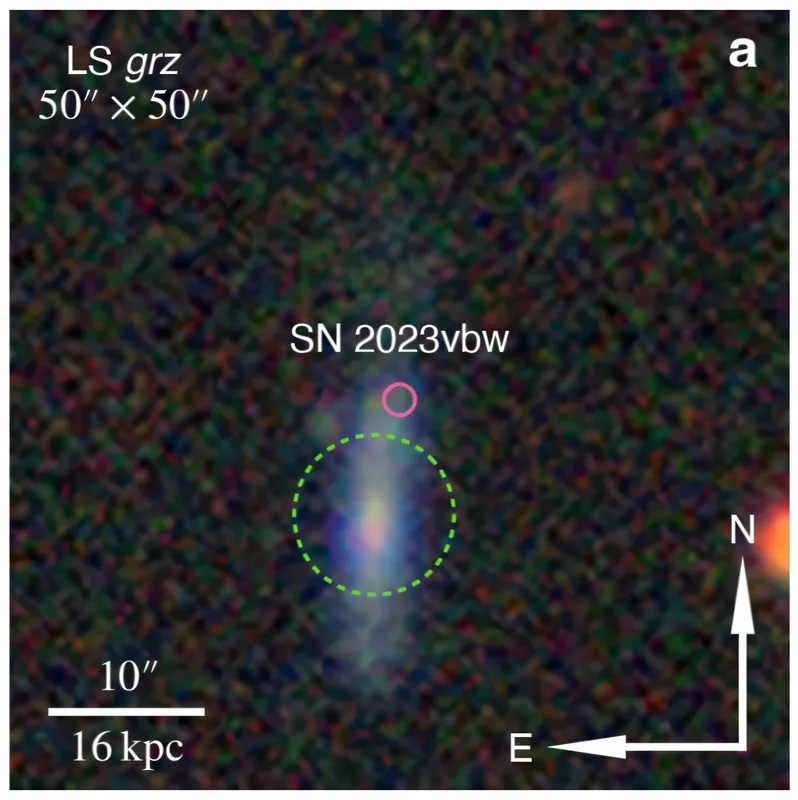
The details of this extraordinary explosion, designated SN 2023vbw, were recently documented. The event was first identified in October 2023 by the Zwicky Transient Facility, occurring in the periphery of a small, metal-poor dwarf galaxy approximately 1.3 billion light-years away. Initial observations tentatively classified it as a Type II supernova, a typical outcome when a massive star depletes its nuclear fuel, collapses under its own gravity, and explodes. However, several characteristics of SN 2023vbw defied this standard explanation.
An Astronomical Outlier
In a new investigation, researchers conducted in-depth observations and sophisticated modeling of SN 2023vbw to ascertain its true nature. The initial indication of an unusual event emerged from its light curve, which tracks its brightness over time. Unlike the characteristic plateau seen in Type II supernovae, SN 2023vbw exhibited a steady increase in brightness after an initial cooling phase, reaching a peak around 190 days. This was followed by a rapid dimming between 190 and 230 days. After this decline, the explosion’s light curve entered a phase of slow fading, known as the ‘tail’.
The total energy radiated by SN 2023vbw, estimated at around 3 × 1050 ergs, is more than ten times the energy output of a typical Type II supernova. During its brightening phase, the explosion maintained a nearly constant temperature as its outer shell expanded. This suggests a substantial, continuous internal energy source, distinguishing it from conventional Type II supernovae.
As the supernova faded, unusual emission lines, known as forbidden lines, began to appear. In the tail phase, the hydrogen lines developed a complex profile, including a redshifted component. This observation suggests that the expelled stellar material is interacting with a disk-shaped shell of gas previously shed by the star before its demise.
A ‘Blue’ Culprit Identified
Modeling of the light curve points towards an exceptionally massive blue supergiant star as the likely origin of the explosion. The morphology of SN 2023vbw’s light curve bears a striking resemblance to SN 1987A, another supernova originating from a compact blue supergiant. However, SN 2023vbw displays significantly greater luminosity and a longer duration, indicating a progenitor star of far greater mass.
The estimated mass of the ejected material ranges from 170 to 350 solar masses. The kinetic energy of the explosion is calculated to be 60 to 130 times greater than the maximum energy produced by an ordinary iron core-collapse supernova. The low metallicity of the host galaxy, approximately one-tenth that of our sun, aligns with theoretical predictions for pair-instability supernovae.
The research team also proposes that the blue supergiant star may have formed through the merger of two massive stars within a binary system. This formation scenario could naturally explain the presence of the dense, disk-like shell of material with which the ejected material interacted. Nevertheless, the team acknowledges remaining uncertainties, including the precise final state of very massive stars (red or blue supergiants) and the timing of such mergers during their stellar lifetimes.
A Star’s Self-Destruction
Pair-instability supernovae occur in stars so massive that the extreme temperatures within their cores trigger the creation of electron-positron pairs. This process diminishes the radiation pressure that counteracts the star’s inward gravitational pull, initiating a runaway thermonuclear explosion so violent that the entire star is consumed. Consequently, no neutron star or black hole is expected to remain after such an event.
Stars with initial masses between approximately 140 and 260 solar masses and low metallicity are predicted to experience this fate. The modeled properties of SN 2023vbw fall squarely within this predicted range.
Due to its relative proximity, “SN 2023vbw remains sufficiently bright for continued multiwavelength observations that will reveal its progenitor mass-loss history and explosive nucleosynthesis,” the research team stated. They further noted that upcoming surveys utilizing the Vera C. Rubin Observatory and the Nancy Grace Roman Space Telescope are anticipated to detect tens to hundreds of similar events, shedding crucial light on the final stages and evolution of the universe’s most massive stars.