

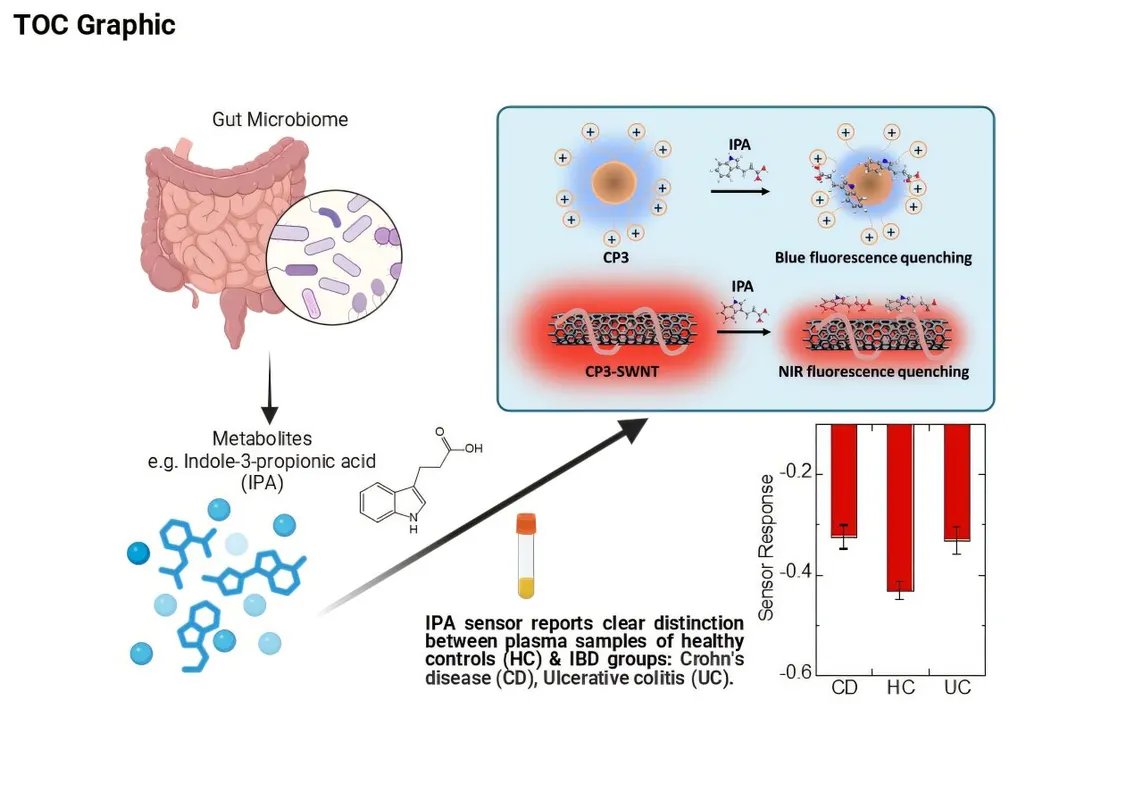
A groundbreaking fluorescent nanosensor has been developed, enabling the rapid detection of indole-3-propionic acid (IPA), a key biomarker associated with gut health and disease. This innovative technology promises to significantly accelerate diagnostic processes, moving beyond traditional, time-consuming laboratory methods.
Rapid IPA Detection for Improved Gut Health Monitoring
IPA is a metabolite produced by gut bacteria when they break down dietary tryptophan. It plays a crucial role in regulating inflammation and oxidative stress and has been linked to various health conditions, including inflammatory bowel disease (IBD), type 2 diabetes, and liver disease. Current methods for detecting IPA, such as mass spectrometry, are expensive and require considerable time, making them unsuitable for routine screening or immediate point-of-care use.
This newly developed platform represents the first reported optical nanosensor specifically designed for IPA detection. It utilizes a fluorescence-based approach to provide an optical readout within minutes, offering a much faster and more accessible alternative to existing analytical techniques. The sensor demonstrates high selectivity, capable of distinguishing IPA from other similar metabolites commonly found in the gut, ensuring accurate detection even in complex biological samples like blood serum.
A Leap Forward in Gut Metabolite Sensing
Assistant Professor Mervin Ang, a co-first author of the research, stated, “This is the first time we are able to directly and rapidly measure IPA levels in biological samples using an optical nanosensor. This novel approach, which moves away from traditional mass spectrometry, can pave the way toward faster and more accessible ways of monitoring gut health in real-world settings.”
The technology builds upon earlier research focused on nano and optical sensor development for agricultural applications, such as monitoring plant health. This existing framework has now been ingeniously adapted for human health by redesigning the sensing platform to target IPA.
Professor Michael Strano, a lead principal investigator on the project, commented, “We have used techniques like this to measure hormones and metabolites in living plants for agriculture, and have now applied it to the human gastrointestinal system. We were able to apply it to this long-standing challenge in gut health. By focusing our molecular recognition on this important gut health biomarker, we’ve demonstrated a powerful new tool that could one day enable proactive, personalized health care.”
Dual-Mode Platform for Versatile Applications
A significant advancement of this technology is its dual-mode sensing capability. The nanosensor can operate in two modes:
- Visible fluorescence mode: Ideal for rapid, low-cost, high-throughput screening of biological samples.
- Near-infrared mode: Utilizes wavelengths that can penetrate deeper into tissues, opening possibilities for in vivo applications and integration into wearable devices for home-based or continuous monitoring.
This flexibility allows the platform to be used in various settings, from laboratory analysis and hospital bedside use to wearable devices for real-time health tracking. Such capabilities could be particularly beneficial for patients with chronic conditions like IBD, enabling earlier detection of flare-ups and greater autonomy in managing their health.
Clinical Validation and Future Potential
To assess its clinical relevance, the nanosensor was tested on 125 human plasma samples from various patient groups, including healthy individuals and those with gastrointestinal diseases. The study revealed notable differences in IPA levels between healthy individuals and patients with inflammatory bowel diseases, such as Crohn’s disease and ulcerative colitis. Patients experiencing active gut inflammation exhibited lower IPA levels, aligning with established clinical observations.
Adjunct Associate Professor Jonathan Lee, a co-first author involved in the clinical validation, noted, “From a clinical perspective, having a rapid and minimally complex way to assess metabolite levels like IPA could be very valuable. It has the potential to complement existing diagnostic tools and provide additional insights into patients with inflammatory bowel diseases.”
Transforming Gut Health Testing
This research has the potential to revolutionize gut health testing, making it faster and more accessible. The nanosensor could facilitate rapid screening in clinics or enable portable and home-based testing, leading to earlier disease detection and easier monitoring of treatment progress.
Unlike conventional microbiome tests that identify bacterial presence, this nanosensor measures the active output of those microbes, providing a more direct and functional snapshot of gut health. Measuring metabolite production directly offers more meaningful insights into overall health and supports personalized healthcare approaches.
Beyond diagnostics, the technology can be used to assess the immediate impact of dietary interventions, allowing individuals to quickly determine if specific foods or probiotics are effectively promoting the production of anti-inflammatory molecules like IPA. Its reliable performance in complex biological fluids such as serum and plasma marks a significant step towards clinical deployment.
For pharmaceutical and therapeutic research, the nanosensor can expedite functional tests to evaluate the efficacy of new treatments or probiotics, significantly accelerating drug screening and dosage optimization processes.
Path Towards Point-of-Care Diagnostics
Assistant Professor Ang indicated that the transition from laboratory discovery to a point-of-care clinical tool is already in progress. With further development, the platform is poised for clinical translation and eventual adaptation into portable devices for routine health monitoring.
The research team has received an Innovation Grant to establish a startup focused on further validation and development. The goal is to transform the sensor into a point-of-care clinical diagnostic tool, with future plans to expand its capabilities to detect multiple gut metabolites simultaneously and incorporate AI-driven analysis for more accurate and comprehensive gut health monitoring. Future developments may also explore integration into wearable devices, microneedle systems, or microfluidic platforms for continuous, real-time sensing.









